La entrada La familia Ulma: una vida normal, base de su entrega extraordinaria se publicó primero en Omnes.
]]>Together with them, eight Jews from the Szall and Goldman families were murdered, including the latter's little daughter. In the letter published before this beatification, the Polish bishops emphasize that the Ulma family "is an inspiration for modern marriages and families. Their heroic attitude is a testimony that love is stronger than death," reads the letter of the episcopate.
Martyrs
The heroic act of the Ulma family was recognized by the Catholic Church as a martyrdom for the faith. It is logical to ask: Why martyrs? The motivation for this martyrdom is clear and eloquent: a manifestation of the Christian faith is the loving defense of the life of one's neighbor. In this case there were no doubts at all, everything was made easier thanks to the innovative decision of St. John Paul II on the canonization of Maximilian Kolbe. It was then that the Polish Pope affirmed that in order to recognize someone as a saint it is enough to demonstrate that the candidate for sainthood gave his life for another person.
The beatification of Maximilian Maria KolbeThe canonization process, carried out by St. Paul VI in 1971, for various reasons, including political ones, was as a defender of the faith, not as a martyr. John Paul II broke with tradition and decided that giving one's life for a man in the Auschwitz camp was sufficient reason for canonization as a martyr, without requiring the process of a new miracle. This gesture of forty years ago opened the way for all the beatifications and canonizations that take place with this extended formula, that is, to give one's life for another man, as a consequence of the Christian faith lived is an act of witness of faith, it is to be a martyr.
"In preparing for the beatification ceremony, we want to contemplate his holiness and draw from it an example for contemporary marriages and families. It will be an unprecedented beatification, because for the first time the whole family will be elevated to the altars and for the first time an unborn child will be beatified," the bishops wrote.
The bishops emphasized that Józef and Wiktoria Ulma show the beauty and value of marriage based on Christ. "Their love, realized in everyday life, can also motivate them to open themselves to life and take responsibility for the education of the young generation. The heroic attitude of love for one's neighbor should impel us to live not so much for our own comfort or the desire to possess, but to live as a gift of ourselves to others.
"As we await beatification, let us look at the example of an extraordinary family who achieved sainthood in ordinary life circumstances. It is an inspiration for contemporary marriages and families."
Extraordinary holiness in the ordinariness of life
"You must decide to be a saint! Saints must be brought down from the clouds and become a normal, everyday ideal for believers." (Rev. F. Blachnicki. Letters to the Prisoner, Krościenko 1990, pp. 15-16).
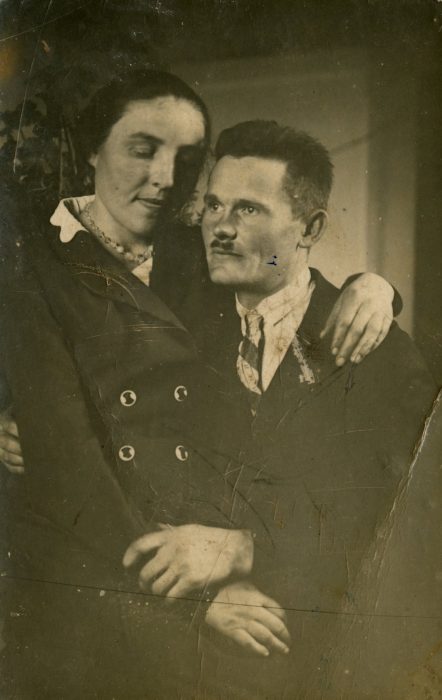
The family of Józef and Wiktoria Ulma lived at the beginning of the 20th century in Markowa, Podkarpacie. They had seven children. As head of the family, Józef combined caring for his loved ones with hard work on the farm. At the same time, he was open to development and knowledge. Despite the effort he put into running the farm, he was able to find time to enjoy his passion for photography, beekeeping, silkworm breeding, bookbinding and horticulture. He built himself a camera and a windmill, which he used to generate electricity.
Józef's passion for photography was used to record not only the lives of his loved ones, but also local events, churches and family celebrations. He also took commissioned photos, portraits for documents, thanks to which he became known throughout the area. She inspired others not only with her knowledge and skills, but also with her constant willingness to help and give advice.
Wiktoria Ulma, née Niemczak, was an exemplary wife and mother, caring with great care and love for the good Catholic education of her children. She came from a home where the principle was that no man who asked for help could be refused. She was always a support for her husband, and at the transcendent moment, when they had to decide to take in the Jews threatened with death, she gave testimony of her love for others. She tried to introduce a kind and friendly atmosphere in the home, emphasizing that the family should be based on mutual respect, kindness and devotion.
Józef and Wiktoria were married on July 7, 1935 in the local church. Soon the family began to grow. Stasia, Basia, Władzio, Franuś, Antoś and Marysia were born, and at the time of his tragic death, Wiktoria was in a state of bliss with another son.
The Ulma family treated their marriage as a community of people who trust, love and strive for holiness through the faithful performance of their daily duties. In their lives, the essence of the sacrament of marriage was realized, in which Christ himself "Abides with them, gives them the strength to follow him by taking up their cross, to rise after their falls, to forgive one another, to bear one another's burdens." (Catechism of the Catholic Church, 1642).
Their human love was purified by the grace of the sacrament of marriage, brought to fullness, and by the power of the Holy Spirit permeated their lives with faith, hope and love.
The daily life of their marriage was based on real and concrete gestures through which God dwells in this diversity of gifts and encounters. They lived the promises made on their wedding day, fulfilling every day the covenant of faithful married love.
As Pope Francis stated during the audience of November 28, 2022, the family of Józef and Wiktoria Ulma must be "an example of fidelity to God and his commandments, love of neighbor and respect for human dignity."
Looking at the example of the married life of Józef and Wiktoria, it is worthwhile to perceive our homes as places where God's love is visible and personal, where it manifests itself in concrete deeds, and Christ is present in the sufferings, struggles and joys of every day. He strengthens and enlivens love, reigning with his joy and peace.
Ulma marriage, open to life
"The fundamental task of the family is to serve life" (John Paul II, Familiaris Consortio, 28).
Józef and Wiktoria discovered a vocation to a special participation in God's creative work through the lives of their seven children. Despite the difficult conditions, they did not fear adversity. They trusted in God's Providence. They believed that God, in giving life, also gives strength to fully realize the vocation to motherhood and fatherhood.
They were concerned about the good education of their children, based on gospel values. They lived a life of faith under their own roof. They transmitted a living faith to the children through the example of life and the teaching of prayer. The children learned to talk to God by watching their parents do so. In family prayer they found strength to make daily sacrifices and witness to Christ. The Ulma's taught their children to worship God both in church and at home. They introduced us to experience the Holy Mass and to practice love of neighbor.
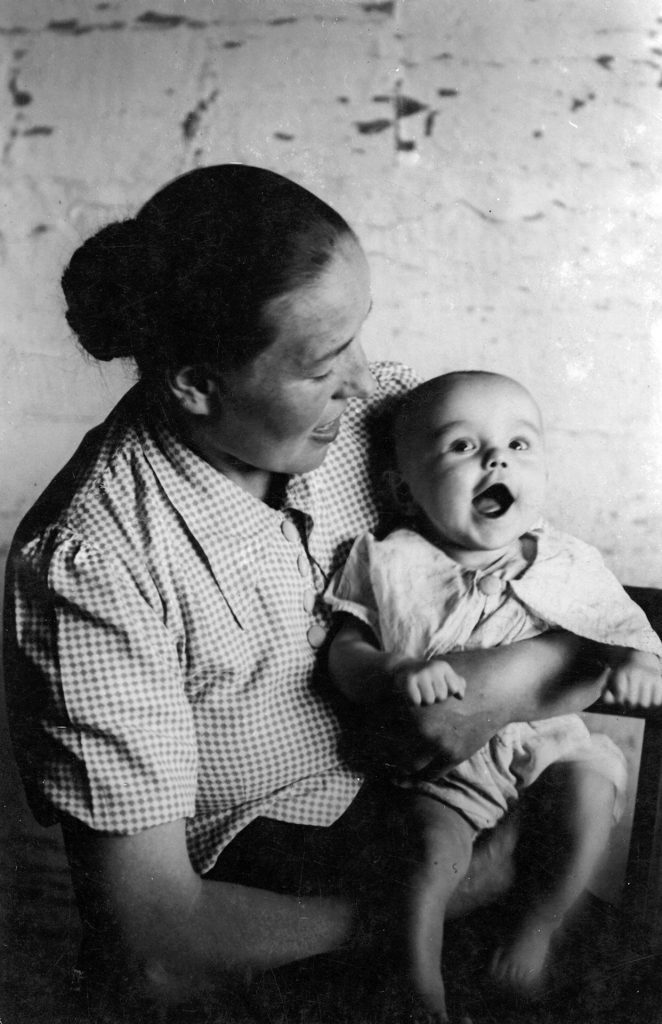
Wiktoria, as a loving mother, devoted time to her children, helping them to learn, taking care of their upbringing and education. From eyewitness accounts, we know that she taught the children housework and cleanliness in and around the home, caring for younger siblings and caring for each other. She enjoyed the loving atmosphere between siblings. He observed how they formed a community as they worked, played, walked and prayed. Józef, for his part, taught his children how to work on the farm and in the garden and answered their many questions.
Merciful love
"Love begins at home and develops at home" (Mother Teresa of Calcutta), but it does not end there. It must radiate to others.
The life of the Venerable Servants of God Józef and Wiktoria consisted of countless sacrifices and deeds of love every day. The fruit of adopting this way of life was the heroic decision to help the Jews condemned to extermination. It was not hasty, but was the result of reading the Word of God, which molded their hearts and minds and, therefore, their attitude towards their neighbor. For them, the Bible was the authentic book of life, as is confirmed by the outstanding fragments of the Gospel, especially the parable of the Good Samaritan.
The Ulmas, trying to live like Christ, implementing the commandment of love on a daily basis, were willing to give their lives for their neighbor. Józef and Wiktoria decided to take in eight Jews, despite the threat of the death penalty from the Germans for helping to hide Jews. Three families took refuge in the attic of their small house: the Goldmans, the Grünfelds and the Didners. For many months, they provided a roof over their heads and food, which was a real challenge during the war.
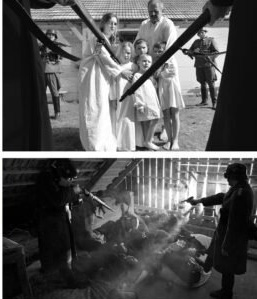
Their selfless attitude came to a tragic end on March 24, 1944. Then the German Nazis broke into their house, cruelly shot the Jews they were hiding and then Józef and Wiktoria were murdered in front of the children. The tragedy was the murder of children. Józef and Wiktoria Ulma, fully aware of the risk, sacrificed their lives to save Jews in need. Their heroic attitude is a testimony that love is stronger than death.
Markowa: a people of the righteous among the nations.
It is not about trying to beatify a nation, nor to expose the positive side of a large part of Polish society during the Great War. It is to prepare a beautiful ceremony of beatification of a family who sacrificed their lives to save the Jews.
The database of the Institute of Polish Memory has on file the names of some six thousand people who paid with their lives for hiding Jews during the Second World War. So the Ulma family is no exception.
The Christian-inspired role of the peasant movement in shaping the attitudes of Józef and Wiktoria should be noted (Józef was, among others, chairman of the Agricultural Education Committee of the District Youth Board of the Republic of Poland "Wici").
There is a list of people from Markowa who hid Jewish families. They were Michał and Maria Bar, Antoni and Dorota Szylar, Józef and Julia Bar, Michał and Katarzyna Cwynar, Michał and Wiktoria Drewniak. In addition to the Ulma family, about 9 families participated in the help. Thanks to this probably 21 Jews were saved in Markowa. The families who took in Jews, including children, amounted to almost 36 people.
Some described Marków as "the town of the righteous among the nations". It is better to say that it was a town where many Righteous lived. However, those who actively participated in helping the persecuted Jews did not constitute the majority of the inhabitants, because at that time the town numbered about 4,000 people, ten percent of whom were Jews. Of course, this is not surprising, because heroism is not an attribute of the majority of society. It is always the great heroes who are in the minority, which is why they are so highly esteemed.
Among the Poles there were also people who handed over Jews to the Germans, or informed on Polish families hiding Jews, or even participated in those murders. The occupier encouraged them. However, on the occasion of the Ulma's beatification, we want to remember that there were other families in Poland who, contrary to German law, helped Jews. There were many Poles who dared to help. The Ulma family is the most famous, but there were many others and thanks to this beatification the world can discover that human and Christian behavior up to heroism is not the property of a few.
What is the Ulma family telling us today?
The Ulma family is an example of a "very large phenomenon" that was the rescue of Jews by the Poles during World War II. Not tens, not hundreds, not thousands, but hundreds of thousands of people participated in this activity. 'Save the Jews' can be said to have been a motto for many Poles. This activity was systematically organized and carried out by the Polish underground state and government-in-exile. Helping Jews was officially one of the goals of the underground state.
The Ulma family and their behavior is seen today as a special ethical attitude that should be maintained in Poland. The Ulma attitude, in which today we see the greatest heroism, could have been perceived differently during the war.
At the time, many did not see it as heroism. It is necessary to know the context of prewar Polish antisemitism-both popular antisemitism and elite antisemitism-and the context of the cruel German law prohibiting aid to Jews.
The Ulma family should be a model for the world, their example must continue to be present in Poland. In pre-war Poland there were anti-Jewish attitudes, there was a real conflict of national and economic interests, but never to the point of legal discrimination as in the Third Reich. Even people with anti-Jewish attitudes before the war, like Zofia Kossak-Szczucka, asked for help to the Jews persecuted by the Germans.
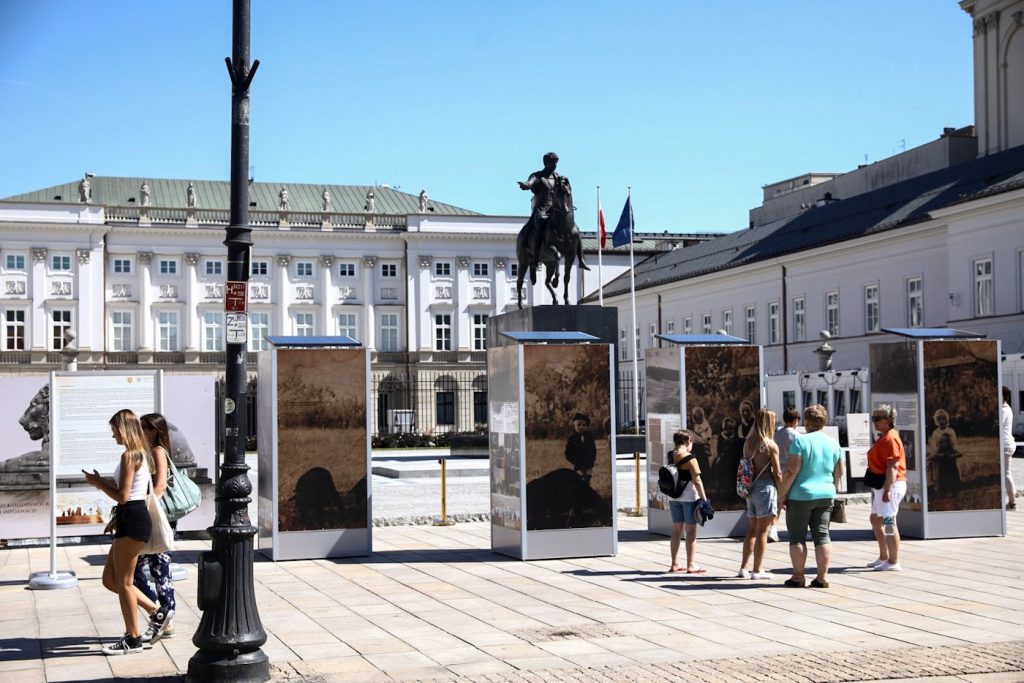
It is worth noting that the Ulmas are an example of holiness in everyday life, a holiness that history has put to the test. It should be known that in Markowa normal and neighborly relations prevailed between Poles and Jews. It is impossible to understand the history of the Ulma family without knowing the history of the people of Markowa.
As we await beatification, let us look at the example of an extraordinary family who achieved sainthood in ordinary life circumstances. It is an inspiration for modern marriages and families. Józef and Wiktoria Ulma show, above all, the beauty and value of marriage based on Christ, where God's grace is the foundation of everything.
Their love realized in daily life can also motivate them to be open to life and to take responsibility for the education of the younger generation. The heroic attitude of love towards our neighbor should stimulate us to live not so much for our own comfort or the desire to possess, but to live as a gift of ourselves to others.
La entrada La familia Ulma: una vida normal, base de su entrega extraordinaria se publicó primero en Omnes.
]]>La entrada Gorzkie Żale. Un tesoro de la espiritualidad y de la cultura polaca se publicó primero en Omnes.
]]>The Gorzkie Żale or Bitter Regrets
A popular way of living and expressing Christian faith in the Passion of Jesus Christ, in Poland, is the Gorzkie Żale which has been translated as Bitter Lamentations.
This popular devotion consists of a meditation on the Passion of the Lord together with chants in the form of a sorrowful lament. This pious practice is lived the six Sundays of Lent, always in the temples, before the exposition of the Blessed Sacrament, and lasts more than half an hour depending on the length of the passion sermon led by the preacher on duty.
Meditation on the Lord's Passion has been an uninterrupted practice since the beginning of Christianity.
The Eucharistic celebration, especially the anamnesis, the memorial, recalls and actualizes the paschal mystery, that is, the Passion, Death, Resurrection and Ascension of our Lord Jesus Christ. For this reason, some saints used to repeat that meditation on the Passion of the Lord, even for a very short time, is worth more than a rigorous fast of bread and water for a whole year.
St. John Chrysostom maintained that what he could not obtain by his merits was granted to him by the wounds of Our Lord Jesus Christ and he wanted to sing unceasingly the victorious sorrows of our King. "He, on the cross, has conquered his ancient enemy. Our swords are not bloodied, we were not in the fight, we have no wounds, the battle we have not even seen, and behold, we gain the victory. Theirs was the fight, ours the crown. And since we too have won, we must imitate what soldiers do in such cases: with voices of joy we exalt the victory, we sing hymns of praise to the Lord" (PG 49, 596).
This popular and pious meditation on the Passion, the Gorzkie Żale or Bitter Lamentations, was composed in the early 18th century with a structure similar to the liturgical office of Lauds.
The first time they were prayed was in 1707 in the church of the Holy Cross in Warsaw, on Krakowskie przedmieście Street.
For those who have ever seen photos of the destruction of Warsaw after the Second World War, surely have in mind the total ruins of a street with a church, and standing out the figure of Christ fallen among the rubble embracing with one hand the cross and the other raised towards the sky, with the inscription Sursum Corde.
Whoever walks along this famous Warsaw street today can see that Christ, with the cross and the inscription precisely in front of the Church of the Holy Cross.
The craft of the Gorzkie Żale
The Office of the Bitter Lamentations has three parts. The first part is sung on the first and fourth Sundays of Lent, the second part is celebrated on the second and fifth Sundays of Lent, and the third part is sung on the third and sixth Sundays.
The structure of each part is as follows:
1. Exposition of the Blessed Sacrament in the Monstrance.
2. Song of the "Invitation" (common to all three parts).
3. Recitation of the intention (different in each part)
4. Singing of the "Hymn" (different in each part)
5. Song of the Lament of the soul before the suffering Jesus" (different in each part but with a common refrain).
6. Song of the "Dialogue of the soul with the Sorrowful Mother" (also different but also with a common outline).
7. The chanting of the ejaculatory "For your painful passion" (three times and common to all three parts).
8. The sermon or meditation on the Lord's Passion.
9. Blessing with the Blessed Sacrament.
A moment of prayer
I have participated several times in the Gorzkie Żale and once I was invited to lead and preach. I can say that it is exciting, it is a devotion full of pietism and feeling, which moves and invites to pray and atone for our sins that have been and continue to be the reason for the Passion of our Savior.
The one who actively participates in the Bitter Lamentations easily, moved by grace, is filled with sorrow for one's sins and desires reparation.
I will quote some of the sentences in my own free translation only from the first part.
Singing of the "Invitation".
It can also be translated as Callin this first and common chant, which gives rise to the name - Gorzkie Żale, Bitter Lamentations - is prayed and sung more or less in this way: "Bitter lamentations penetrate our hearts, and let springs of living tears flow from our pupils. When contemplating your passion, Lord, the sun loses its warmth and is even covered with pain. And the angels also break into tears at such great suffering. The rock cracks, and the Lying One rises without a shroud! What is happening? All creation is trembling. Christ, seeing your Passion fills my soul with pain. Strike now without delay our hard hearts and may the blood of your wounds save us from falling. When I enter into your Passion, my heart breaks".
Recitation of the intention.
I now transcribe the intention of the first part.
"With the help of divine grace we begin the meditation on the Passion of Our Lord Jesus Christ. Let us offer it to the heavenly Father to the praise and glory of His Divine Majesty, humbly thanking Him for His great and unfathomable love for the human race by deigning to send His Son to endure cruel torment by accepting death on the cross.
We also offer this meditation in veneration of the Blessed Virgin Mary, Mother of Sorrows, as well as the saints who have excelled in devotion to the Passion of Jesus Christ.
In this first part we will meditate on what Jesus Christ suffered from the moment of his arrest in the Garden of Olives until the accusations in his wicked trial.
These outrages and offenses towards the Lord, who suffers for us, we offer them for the Holy Catholic Church, for the Supreme Pontiff with all the clergy, as well as for the enemies of the Cross of Christ and for all the infidels, so that the Lord may grant them the grace of conversion and repentance".
The singing of the "Hymn".
There are five sung stanzas of which I translate the first one: "Sorrow penetrates the soul and the heart breaks with pain. The sweet Jesus on his knees in the Garden prays with sweat of blood and is ready to die. My heart breaks".
The Song of the "Lament of the Soul before the Suffering Jesus".
"Jesus, to a cruel death prepared, meek Lamb sought by all, Jesus my good beloved / Jesus for thirty coins delivered, for an unfaithful disciple betrayed, Jesus my good beloved/ ...'.
Thus we sing and pray up to ten stanzas to finish repeating: "May you be blessed and praised, Jesus incarnate and mistreated. Be forever adored and glorified, my good and beloved God!".
What sticks in my soul the most is the continuous repetition of "Jezu mój kochany!" Jesus my good beloved! A refrain, a refrain, which is repeated incessantly like lovers who tirelessly say to each other: I love you!
The Song of the "Dialogue of the Soul with the Sorrowful Mother".
In this sung dialogue between the Virgin and the Christian soul, Saint Mary begins the first verse and it is sung only by women. The second verse is the disciple's response and is sung only by the men. In this way the six verses alternate. "Oh, I am the suffering Mother, in agony of immense pain, with a sword piercing the heart / Why dear Mother do you suffer such great sorrows / Why is your heart so wounded / Why do you tremble with cold / ..." The canticle ends with the desire of the Christian soul: may I weep with you! This is the purpose of the canticle and meditation of the Bitter Sorrows: that the Christian may know how to look at Christ in pain and at his Mother, that he may move his heart to compassion, to conversion, to sorrow for his own and others' sins, to pious weeping, to tears of love.
Next comes the preaching on some mystery of the Passion.
According to the Polish custom it usually lasts between twenty and half an hour, but nowadays it is tried not to exceed fifteen minutes so that the whole ceremony of the Gorzkie Żale does not exceed the limit of one hour. It ends with the blessing with the Blessed Sacrament.
Music in the Polish liturgy
Logically, all chanting is always accompanied by organ music. In Poland, in any mass, even daily, there is always an organist who sings and plays. Music is very present in the Polish liturgy.
The Chair of the Hispanic World of the Catholic University "John Paul II" of Lublin has edited a Spanish version of the Gorzkie Żale, Bitter Lamentations, with all the texts of the three parts and adding musical scores. It has a prologue by Cardinal Omella and its third edition is from the year 2020. Logically what I have written is based on that edition, but the small parts of translations into Spanish of the Gorzkie Żale, present in this article, are my own, not those of the authors of that publication.
La entrada Gorzkie Żale. Un tesoro de la espiritualidad y de la cultura polaca se publicó primero en Omnes.
]]>La entrada La familia Ulma: siete mártires de la fe cristiana se publicó primero en Omnes.
]]>After Hitler's decision to carry out the inhumane "final solution" of extermination of all Jews, the Ulma, aware of the risk and in spite of their economic straits, but moved by the commandment of love and the example of the Good Samaritan, helped the Jews.
As early as the second half of 1942 they hid Saul Goldman with his four adult children, and also Lea Didler and Gołda Grünfeld with their infant daughter. The Goldmans were neighbors of the family home of Józef Ulma, who was known for his kindness towards Jews. Earlier, he helped another Jewish family build a hiding place.
The Ulma family also witnessed how in 1942, in the neighboring plot where animals were buried, the Nazis shot 34 Jews from Markowa and the surrounding area. Among the more than 4,000 inhabitants of Markowa, the Ulmas were not the only family to hide Jews. At least 20 other Jews survived the occupation in five peasant homes.
Before World War II, about 120 Jews lived in Markowa. In 1995, Wiktoria and Józef Ulma were posthumously honored with the title of Righteous Among the Nations.
Józef Ulma was born on March 2, 1900 in Markowa, he was the seventh child of Marcin Ulma and Franciszka Kluz. First, he completed four classes of elementary school and then, after military service, he graduated with a final award from the agricultural school in Pilzno. In 1935, Józef married Wiktoria Niemczak, also from Markowa.
Wiktoria was born on December 10, 1912. At the age of 6 she lost her mother. She studied at a public school in Markowa. She also attended courses at the People's University in nearby Gać. After her marriage she devoted herself to working at home and caring for children.
In the nine years of marriage to the Ulma family six children were born: Stanisława (born July 18, 1936), Barbara (born October 6, 1937), Władysław (born December 5, 1938), Franciszek (born April 3, 1940), Antoni (born June 6, 1938, 1941) and Maria (born September 16, 1942). They brought them up in the spirit of Christian faith and love, teaching them love of work and respect for others. In the spring of 1944, Wiktoria was expecting another child.
Józef and Wiktoria were farmers on a small farm of several hectares that they owned, as is customary in Poland. Józef was an extremely hardworking and inventive man. In addition to growing vegetables, he was also involved in fruit growing, of which he was an active promoter in the village. He founded the first orchards and a fruit tree nursery, where he demonstrated gardening techniques every week.
He willingly offered advice and help, passing on his newly acquired knowledge to others. He knew beekeeping and kept a good number of hives. His innovation was also revealed in the fact that he was the first in the village to introduce electricity into his home, connecting a light bulb to a small hand-built windmill.
Józef had a lot of social initiative and actively participated in the affairs of the local community. He was a librarian in the Catholic Youth Club, an active member of the Union of Rural Youth of the Republic of Poland "Wici". He also managed the Marków dairy cooperative and was a member of the health cooperative in Markowa. His greatest passion was photography, an activity that was extremely rare in Polish villages at that time. He learned about photography from books. Wiktoria, on the other hand, was an actress in the amateur theater group of the Association of Rural Youth of the Republic of Poland "Wici".
Józef and Wiktoria were active members of the parish of St. Dorothea in Markowa. Their faith life was based on the two commandments: love of God and love of neighbor. Already as a teenager, Józef participated in the activities of the Mass Association of the Diocese of Przemyśl. He was also a member of the Catholic Youth Association. As spouses, they deepened their faith through family prayer and participation in the sacramental life of the Church. Both also belonged to the Sisterhood of the Living Rosary. For Józef and Wiktoria the Christian life of their children was the most important thing. They passed on to them a living faith in Christ and love for everyone without exception.
In a few minutes in the early morning of March 14, 1944, 17 innocents were murdered. Józef and Wiktoria died at the hands of gendarmes, staunch and ruthless guardians of the German Nazi system.
Along with them, their children and the Jews they had sheltered were also shot. The Ulmas' unborn child also died.
The entire Ulma family are martyrs, they gave a testimony of Christian life until they died. It is not easy to give one's life for fidelity to the Christian faith and to the evangelical commandment of love of neighbor, but it is even more difficult to risk and give the life of one's own family for love of God and neighbor. They succeeded, with God's grace.
La entrada La familia Ulma: siete mártires de la fe cristiana se publicó primero en Omnes.
]]>La entrada Una tradición de luz en los hogares de Polonia se publicó primero en Omnes.
]]>Children learn the language of faith as they learn to speak: through continuous dialogue with their parents. I think that some ways of transmitting the faith in Poland and in other Slavic peoples can enrich other countries, so that they can introduce these or similar ways with wise prudence and according to the way of doing in other Christian peoples.
In the time of Advent I would like to highlight in Poland the Rorate Masses and, at Christmas time, the custom of the pastoral visit to the houses called Kolenda. Let us begin by talking about the custom of the Rorate Masses.
As is well known, the Rorate Mass takes its proper name from the first word of the Introit, that is, from the entrance antiphon: Rorate caeli desuper et nubes pluant iustum - Pour down the dew, O heavens, from above, and let the clouds rain on the righteous (Isaiah 45:8). It is celebrated before dawn and is always the votive Mass of St. Mary in Advent. With white vestments and the singing of the Gloria.
I remember that some years ago a priest friend of mine, parish priest of a small village of six hundred souls, invited me to preach and celebrate the Rorate Masses for three days. I left Dworek, where I lived, before five o'clock in the morning, to cover a distance of twenty kilometers with snow, ice and a freezing wind, we were at minus ten. When I arrived in Guzef I was impressed: a crowd of children with lighted lamps in their hands, and the temple in darkness. The small, cold and beautiful church, full of worshippers: that was the only heating the church had. Mass started on time: at six in the morning. When we sang the Gloria, always with the organist, all the lights came on: a spectacle of light and joy. I remember that I could not keep my hands open during the Eucharistic prayer, they would freeze, and from time to time I would piously collect myself in prayer, rubbing my palms together to warm them.
In Poland, the Rorate masses in honor of St. Mary have the flavor of the hope of the ChristmasThese Masses are especially prepared and directed to children. They are Masses in which there are always surprises and little reminders of the presence of children: like a kind of game in which the faithful are challenged to come every day to the Advent Rorate Mass, from Monday to Saturday. At the end of the Mass, something hot, milk or chocolate, is usually prepared for the children in the parish halls next to the church.
More than a few parents have told me how it is their children, and sometimes even the youngest ones of five or six years old, who wake them up at five in the morning, pulling them by the sheets to tell them: "Dad, Mom, wake up: we are going to the Rorate Mass!
The Rorate Masses, votive of St. Mary in Advent, are celebrated every day of Advent with the exception of Sundays and the Solemnity of the Immaculate Conception. Since December 8 is a school day in Poland, the Mass is also celebrated at dawn, although, logically, the texts are those of the Solemnity of the Immaculate Conception. In all the Rorate Masses there is always a homily for the children: with dialogue and questions, lasting ten to fifteen minutes. It is a good occasion for children's catechesis and for instructing parents. Another characteristic element of the Rorate Masses is the lighting of a specially decorated and large candle, called Roratka. This candle is placed near the altar only during Advent and symbolizes the Blessed Virgin Mary. Children come to mass with lighted lanterns. The Rorate mass begins only with the light of candles and lanterns with the lights off in the temple, and with the hymn "Glory to God in the highest" all the lights in the church are turned on.
Secondly, I would like to explain what the pastoral initiative called 'Kolenda' consists of. The Church in Poland always has something to offer to its faithful, it has a way of being that leads it to go out of the parishes, to look for the faithful - those near and those far away - wherever they are.
A concrete example of this parish initiative are the pastoral visits to homes on the occasion of Christmas, called 'Kolenda'. The Christmas period lasts - according to a Slavic custom - until the day of the presentation of the Lord, that is, until February 2. During these forty days - in accordance with the duration of the other important liturgical seasons, such as Lent and Easter - pastoral visits to families are made. All the parishes in the country prepare for these pastoral visits. The parish priest and the vicars visit their parishioners by going to their homes. The visits are prepared in detail, a plan is made of streets and houses with days and times of visitation, so that no one is caught unawares. The priest is accompanied by some assistants, usually altar boys, who sing Christmas carols -that means kolenda- and go ahead calling the houses and asking if they are willing to receive the priest who comes for the pastoral visit.
Nationwide, sixty percent of Poles open their doors to the priest. He leads a short prayer, sprinkles the house with holy water and sits down for a family chat. He asks if there is anything he can help them with, he is interested in the catechesis for first communion, confirmation or marriage. He talks about Sunday Mass and the teaching of religion in schools, or other topics that come up. The family usually presents him with typical products of those feasts. At the end he blesses the family and the house by marking on the door lintel the signs M+G+B 2012. There is no set time of duration but the average is about ten to fifteen minutes per family. The visits are usually in the afternoons from three to nine o'clock in the afternoon, in an intensive schedule without breaks, except on Sundays, and so on for forty days: something exhaustively exhausting and spectacularly effective. There is no better way to bring people closer to God than by going to their homes, getting into their living rooms and even their kitchens.
La entrada Una tradición de luz en los hogares de Polonia se publicó primero en Omnes.
]]>La entrada El último rosario de Jerzy Popiełuszko se publicó primero en Omnes.
]]>One idea emerges alone and clearly: the totalitarian communist system is responsible for the death of that priest. A system based on lies cannot bear to be told the truth, a truth without hatred, without anger, without revenge.
That event remained strongly imprinted on me in the young years of my priesthood: Popiełuszko martyr of the Truth, of a Truth imbued with Love, of strength and audacity, a courageous truth.
Christ died on the cross for our sins and rose again for our salvation. In these two sentences is contained the source of salvation and truth for every person. The death of the martyr is in the Church the greatest fidelity to the Christian ideal: identification with Christ the Victim.
The first Christians were willing to give their lives and many made that willingness a reality, not for their own pleasure or whim, but as a result of the injustice of oppressive political systems that did not understand, or did not want to understand the Christian truth, as opposed to their religious, political and worldly pretensions.
Among them were many martyr priests who received the vocation to seal with their own blood the sacrifice of the Blood of Christ, a sacrifice that constitutes the foundation and root of priestly being: the offering of Christ on the Cross.
It is not easy to be a martyr, it is not easy to be a witness to the Truth of Christ with one's own life and blood. We also know very well that we are all called to the vocation of martyrdom, of witnessing to the truth, in ordinary life without shedding blood but with a heroism that is no less small. Some are also called to martyrdom in its fully literal sense: to the surrender of their lives. How many martyrs we have had in the twentieth century! One of them is Popiełuszko.
The painful mysteries of Popiełuszko
October 19, 1984. Popiełuszko had accepted an invitation to celebrate Holy Mass with homily in the city of Bydgoszcz 250 kilometers north of Warsaw. Although he had the homily written, he decided not to preach it.
At the end of the Eucharist the recitation of the Holy Rosary is celebrated and before each mystery Popiełuszko makes a brief consideration in a loud voice and coming all from his heart -.ex abundatia cordis os loquitur.
A few hours later, on his way back to Warsaw, he is kidnapped and murdered. These are his last words, this is his last message.
Contemplating the first painful mystery -the prayer in the garden- Popiełuszko spoke of human dignity and freedom. "We must guard human dignity so that good may increase and thus overcome evil. We must remain free inwardly also when external circumstances are lacking in freedom. We must be ourselves in every historical situation. Our divine filiation carries in itself the inheritance of freedom".
Freedom as a gift of God and as a task, the task of defending it when freedom is kicked, snatched and confused: the passion for truth is at the same time a passion for freedom. And he ended his meditation on the first sorrowful mystery with these words: "Let us pray that we may know how to behave every day according to the dignity of the children of God".
In the SECOND MYSTERY -Popiełuszko speaks of the justice that emanates from truth and charity. "Where there is a lack of love and of good there are the germs from which hatred and violence swarm. When someone is motivated by hatred and violence one cannot speak of justice."
For the Christian the source of justice is God himself, therefore it is unjust to impose atheism as a system. "Everyone, without exception, has the duty to live in justice and to ask for justice, for as the ancient thinker said: these are bad times when justice is locked up in silence. Let us pray for justice to guide us every day of our lives".
The consideration of the third mystery The crowning of thorns - the crowning of thorns - revolved around the truth. We move towards it by an impulse of God himself. Truth unites, truth triumphs even though for centuries we have been engaged in a fierce struggle against it. "
Christ chose a few to proclaim the truth. Only the multitude of lies demands untold words. Lies are sold in filthy markets of buying and selling, like merchandise displayed on store shelves. The lie must always be new, it needs many servants to learn it today, tomorrow and a month from now, to remake it again with the violent program of other lies".
It is not easy to distinguish truth from falsehood in the presence of censorship, of which the very words of the primate or the pope fall victim. "It is the Christian's duty to stand by the truth, even if it costs him a lot, because the truth must be paid for. Only the chaff alone costs nothing. The grain of wheat of truth carries with it a great price. Let us pray that our ordinary life may be filled with truth".
The cross at a cost -The fourth mystery is the starting point for meditating on the virtue of fortitude. "The Christian should remember that there is only one thing to fear: the betrayal of Jesus Christ for a few silver coins of hollow tranquility. The follower of Jesus Christ must be a witness, spokesman and defender of justice, for it is not enough to condemn evil. If the Christian renounces the virtue of fortitude, he harms himself and all those who depend on him: his family, his co-workers, his nation, his state and his Church. Woe to you rulers who want to win over the citizens with the price of threats and the slavery of fear! Such power denigrates itself and debases its authority. The practice of fortitude should be in the interest of the rulers as well as of the citizens".
The dominant motif in the meditation of the fifth and last sorrowful mystery -The crucifixion and death of Christ - constitutes the opposition to violence. "He who is not given to convince with the heart and the head tries to win with force. Every manifestation of violence speaks to us of moral abasement. Every idea capable of giving life is maintained by its own strength. And so it was with Solidarity, which, on its knees and with a rosary in its hands, fought for human dignity more than for bread. In Poland, in recent years, the fundamental rights of the human person have been curtailed. When this cornering made everyone feel its painful pressure, then the cry of freedom burst out. Solidarity arose, demonstrating that in order to build a society and its economy it is not necessary to do without God. Let us pray that we may be free from fear, from threats and above all from the temptation of revanchism and violence".
Finishing the holy Rosary and after the prayer "Under your protection we take refuge", Popiełuszko prayed to St. Joseph that he who with the work of his hands maintained the Holy Family may grant all of us Christians "to sanctify all our actions with love, patience, justice and the realization of good".
His last words of farewell were: "May the evangelical principles of justice and social charity direct the actions of all the people of our country. Amen.
Last hours
Once in the adjoining parish house, a brief informal meeting was held for a few people where he was asked about Solidarityfor his safety and health. Someone asked him if he could not get a battery for his car. Popiełuszko laughed heartily, replying, "You could have told me earlier and I would have brought one from Warsaw along with everything I needed to power the microphone, because it often happens that the power is cut off just when I am preaching the homily."
Although he was tired and somewhat ill, and despite the parish priest's insistence that he spend the night in Bydgoszcz, Popiełuszko wanted to return immediately to Warsaw as he had work the next day.
When someone warned him to be careful on the way back to Warsaw, Popiełuszko reassured him by commenting, "Besides I travel with my cassock on which in this country still means something."
A few hours later, his murderers beat him to death with his cassock on, and with it on, they threw him into the pond, another sign of the reason for his condemnation: to be a priest who bears witness.
On other occasions of persecution of priests, if by chance someone was found wearing a cassock, the first thing they did was to take it off, after which they would sentence him to death.
This was not the case with Popiełuszko who died with his cassock on.
La entrada El último rosario de Jerzy Popiełuszko se publicó primero en Omnes.
]]>La entrada Sienkiewicz: sus obras, su personalidad y el final de su vida se publicó primero en Omnes.
]]>The aforementioned Polish national trilogy by Sienkiewicz- With blood and fire, The Flood, A Polish herois for many the masterpiece of this writer. It consists of three historical novels spun with fantasy figures. What is most striking is the deep knowledge of 17th century Polish history - Sienkiewicz methodically documented himself -, the use of a beautiful and archaic language, the passionate love story found in them, as well as their periodical publication by chapters in the magazine Słowo between 1883 and 1886. They are historical novels, and as for many people history is made by wars, there is a continuous presence of battle scenes, with explanation of their motives, description of landscapes and a psychological presentation of the characters. The most important moments in the history of Poland in the 17th century, its national heroes, nobles and knights are depicted. All under the motto "to strengthen hearts", i.e. Sienkiewicz intends to encourage his readers to defend their homeland in the 19th century as their ancestors did two centuries earlier.
In blood and fire - Ogiem i mieczem (1883-1884) is a historical novel of the time of the Cossack Wars and with Ukraine in the Dnieper region, during the years 1648-1654. The loss of what could have been the Republic of the three nations (Poland, Lithuania and Ukraine). Sienkiewicz's first great success that put him already then at the top of the Polish prose writers. The love affair of the military nobleman Skrzetuski fills the whole narrative with the abduction of the beloved - a theme he repeats in his works - with his continuous search and the happy ending: "The king pays very well for services but the King of kings pays them with the best of gifts". Sienkiewicz sees women as a gift, a gift from heaven.
Pope deluge - Potop (1884-1886) which narrates the fight against the Swedish invasion and the defense in the sanctuary fortress of Jasna Góra in Częstochowa in 1655. The anxious waiting for the chapters and their astonishing dissemination and reading awakened patriotic consciousness among the peasants. Let us remember that at that time ten percent of the population were nobles and had a deep awareness of their Polish identity. The rest, the peasants, were from the countryside and did not care much whether the Russians, Prussians or Austrians were there, as long as they were allowed to live well and with their customs. But reading The Flood awakened in many of them their identity, in such a way that he would say to Sienkiewicz: you have made us Poles!
Publishing chapter after chapter of the The FloodThe writer struggles against the devastating illness of his beloved wife Maria, who dies in October 1885 at the age of thirty-one at the Balneario de Reichenhall in Bavaria. Henryk is devastated but has to keep writing, according to the narrative thread, pages full of hope.
A Polish hero (1887-1888) the original title is Pan Wołodyjowski (Mr. Wołodyjowski). It tells the story of this military knight in the Turkish war and ends with Sobieski's victory over the Turks at Chocim (1673). As the then republic of Poland had a king elected by the nobles, something unique in Europe, Jan III Sobieski was elected king and defeated the Turks again in the battle of Vienna (1683), and paraphrasing Julius Caesar he said: venimus, vedimus, Deus vicit. Nevertheless, Sienkiewicz narrates in this last part of his trilogy less history and traces a whole adventure romance.
The Trilogy gave Polish readers a strengthening of their hearts, of their hopes for the recovery of their state, an artistic lesson in patriotism, a faith in the value of human beings and heroism. In his stories, ordinary people become heroes to be imitated, defenders of justice, victors over their enemies, men of prayer and Christian faith, pious observers of the law of God and the Church. Thanks to the Trilogy, Sienkiewicz began to be a great national figure, becoming a recognized literary and political authority, some saw him as the spiritual leader of the nation. No one has better matched the sense of national pride of Polish readers of all classes and generations. His books were widely read then and to this day. The Trilogy is a flowing read, read with pleasure and effortlessly.
Quo vadis
It is interesting to think about what a book, a classic work of literature, consists of. It is not only something material or now with electronic support in many of its different formats. A literary work really exists when a person reads it and lives it. That is why there are as many readings and interpretations as there are readers. Each one of us remembers the moment in our lives when we read a work of world literature that moved us strongly.
My first memory of Quo vadis goes back to June 1975, a month of many exams in my third year of mathematics at the Complutense University of Madrid. At that time I had a personal struggle with the subject of Mathematical Statistics, which I managed to pass in June. This confirms that study, in addition to the intelligence, is above all an effort of the will to want to learn. I used to study hard in a library where there was a law student who was reading Quo vadis without stopping. -Don't you have exams in June? - Yes, but I can't stop reading this novel. I came to the conclusion that Law could be passed without studying and that this novel must be exciting.
The winter of 1995 in Krakow was the coldest winter I have ever spent in Poland. For several months the thermometer varied between minus twenty and minus ten. I remember one day when it was minus five all day and it was great. During that time the heating in the student academy where I lived broke down, and until it was decided to buy an electric stove, it was cool for two weeks. I was in my room sitting at my desk, with my coat, gloves, woolen hat and double socks on my feet, reading in Polish, for the first time in my life, Quo vadis. The person in charge of the house arrived with a thermometer and said: "Father, you can't complain, your room is at zero degrees, neither hot nor cold. I didn't care, because I was engrossed in my room, absorbed by Quo vadis. Exciting reading. But let's leave personal memories aside and return to the article.
With the experience of the Trilogy and its success, Sienkiewicz is going to change the setting: instead of the history of Poland in the second half of the 17th century, let's go to Rome, to the last years of Emperor Nero (63-68). However, the system works the same way: real history and fictional history intertwine in a thread of love affair that gives continuity, consistency and tension to the reading.
Quo vadis According to a legendary tradition, during Nero's persecution of the Christians, Peter was fleeing from Rome along the Appian Way. He then saw the risen Lord going in the opposite direction, towards Rome, and said to him: Quo vadis, Domine? To which Jesus replies: "I am going to be crucified in Rome for the second time because you are abandoning my flock". Ashamed of his cowardice, Peter returns to Rome to face his destiny: martyrdom.
Quo vadis masterfully narrates what Rome was like in the first century. The historical thread of the novel focuses on the person of the Roman Emperor Nero, as well as the persecution and spread of the Christian faith. The contrast between the Roman Empire and the early Christians is presented. There is a contrast between the pagan debauchery of the imperial palace with the power of the moral reasons of the followers of Christ, which would later become the basis for the construction of European civilization.
The main plot of the novel is the love story between Marcus Vinicius and Lygia. They belong to two separate worlds: Vinicius is a Roman patrician, a member of the army, Lygia belongs to a barbarian tribe and is a hostage in a Roman and Christian family. The love plot, which is logically fictitious, decisively influences the development of the action in which Ligia's escape, Vinicius' search for his beloved, the kidnapping attempt, Vinicius' transformation and baptism, and Ligia's miraculous salvation in the circus stand out. The climax of the plot is the confrontation of Ursus, Lygia's protector, with the bull. The man's victory over the animal in the circus arena symbolizes a happy ending to the plot since, from then on, Lygia, Vinicius and Ursus himself are in the hands of the Roman people. This is a key event since, at that very moment, the people turn their backs on Nero and declare themselves in favor of the Christians.
An important figure in the play is Petronius, a Roman patrician, a close advisor to Nero, who is an example of the taste and elegance of classical antiquity. arbiter elegantiaePetronius, symbolizes the classical culture of the past, grandiose in comparison with the one that reigns during Nero's rule, a culture in constant decadence. Throughout a constant struggle between life and death, Petronius criticizes the idea of the emperor and loses.
The most tragic and comic character is Chilon Chilonides, a skeptical sophist with no moral principles. He pretends to be a Christian to betray them. He sells as slaves the family of Glaucus, a Christian doctor of Greek descent, who also betrayed dies a martyr by forgiving Chilon. Thanks to this example a radical change occurs in the despicable sophist and in the end he dies on the cross in defense of those he has betrayed: the Christians.
In this great novel it is worth noting how well represented and written is the Rome of the first century. Sienkiewicz was very well documented. There is a great praise for the greatness of the Roman Empire with its virtues and defects. Secondly, how well he describes the early Christians. Men and women passionate for Christ: the virtues of justice, honor and dignity, purity and poverty are admirable in them. They were Christians who believed and prayed. In a good review of this novel the author wondered if the description of these early Christians, of their exemplary life, is really an invention of Sienkiewicz or if it actually happened.
It is a narrative full of Christian values. Perhaps the first of them is the love between Vinicius and Lygia. Vinicius, who has met Lygia in the Roman family of which he is a hostage, guest and even relative, falls madly in love. He wants to possess her by abusing her in Nero's orgies, but Lygia is not willing. Vinicius discovers little by little that he loves Lygia because there is a secret in her, something that makes her strong, pure, just. Vinicius discovers Lygia's great secret: she is a Christian. Vinicius is desperately looking for Lygia and wants to conquer her love, so he begins to learn about Christianity. What he discovers astonishes him: a whole new world, a new way of thinking, living and treating people. Vinicius, seeking and loving Ligia, is as if unconsciously seeking and loving her secret: Jesus Christ.
For those who have not yet read Quo vadisI think this is a fundamental lack, but if you want to confirm that being a novel of classical literature it is also a novel of deep Christian values, I recommend reading chapter VIII, three pages in my Polish version, which in quiet reading takes ten minutes; and chapter XXXIII, five pages, about fifteen minutes. Chapter eight describes the impression of Akte, Nero's former mistress, when she sees how Ligia prays and finds herself in a desperate situation. Akte has never seen anyone pray like that and feels that she is addressing her words to Someone who sees her and that only He can help her.
In chapter thirty-three there is a declaration of love between Vinicius and Lygia together with the apostles Peter and Paul. Some of the Christians harshly criticize Lygia for falling in love with a pagan but "Peter came to her and said, 'Lygia, do you really love him forever? There was a moment of silence. Her lips began to tremble like those of a child who is about to burst into tears, who, knowing that he is guilty, realizes at the same time that he must acknowledge his guilt. -Answer me! insisted the apostle. Then humbly, with a trembling voice and whispering, she knelt down before Peter: "Yes, that's right... Vinicius at the same moment also knelt down before her. Peter stretched out his hands and laid them on their heads, saying: "Love one another in the Lord and for his glory, there is no sin in your love".
The narrative ends with the death of Nero and the final epitaph: "And so Nero passed away as the wind and the storm, the fire and the plagues pass away, but St. Peter's Basilica continues to dominate the city and the world from the Vatican hill. Where once stood the Capena door now stands a small chapel with a vague inscription: Quo vadis, Domine?"A topical question that Sienkiewicz links to the Quo vadis, homine?Where does the human being go if he loses his humanity? But there is still hope and the suffering and martyrdom of the Christians bore fruit, as will the suffering of the Polish heroes.
The novel quickly became an incredible success all over the world. More than a hundred editions were published in French and Italian. In 1916, at the time of Sienkiewicz's death, the print run of Quo vadis in the United States alone exceeded 1.5 million copies. It has been translated into more than forty languages and to this day enjoys exceptional popularity.
Sienkiewicz's personality
Many say that Henryk Sienkiewicz is quite identified with the character Petronius, arbiter elegantiaeof its Quo vadiswho really existed. Cultured, distant, elegant, somewhat skeptical, with a taste for beauty, especially in women but always with a delicate, respectful treatment. He uses an ironic and humorous criticism of the reality in which he lives.
After completing the Trilogy, Sienkiewicz published two contemporary novels: Bez dogmatu - No dogma y Rodzina Połanieckich - The Polaniecki family. In the form of a diary, they collect a lot of autobiographical data. No dogma is the diary with the thoughts of a rich Polish count who lives with his father in Rome, an assiduous visitor of the European salons, an example of the "Slavic unproductiveness" in constant analysis of beauty and the human spirit.
Someone asked me lately if Sienkiewicz was a believer. I didn't know how to answer him, neither to the question if he was a practicing Catholic, being this second one easier to find an answer because it is an empirical fact. What is clear from his works is that the history of Poland cannot be understood without Christianity, just as Sienkiewicz cannot understand his own life without the Catholic faith and devotion to the Mother of God. His thought is Catholic but theologically poorly thought out. It seems to me that the philosophical currents of the time, of which he was also a very assiduous reader, led him to a skepticism that he wanted to overcome with a voluntarism: I want to believe.
Write in No dogmaI am waiting to be given a state of my soul in which I can believe firmly and without any mixture of doubts, to believe as I believed when I was a child. I have noble motives, I do not look for any personal interest because it would be more comfortable for me to be a happy and fattened animal (...) In this great 'I do not know' of my soul, I try to fulfill all the religious norms and I do not consider myself as an insincere man. I would be if instead of saying 'I do not know' I could say: I know that there is nothing. But our skepticism is not an open denial, it is rather a painful and painful intuition that there may be nothing, it is a dense fog that surrounds our head, presses on our breasts and covers us from the light. So I reach out my hands towards that sun that behind the fog shines. I think that I am not alone in this my situation, that the prayer of many, of many of those who go to Mass on Sunday, could be summed up in these words: Lord, disperse the fog!"
The Polaniecki family is a defense of the social role of the nobility and the bourgeoisie, as well as an open apotheosis of Catholic traditionalism. The protagonist of the novel is an impoverished nobleman doing business in Warsaw. While writing this novel he met Maria Romanowska, the adopted daughter of a rich man from Odessa. Henryk is already forty-six, Maria eighteen. Both have doubts, but the mother, fascinated by the reading of No dogmapressures his daughter to get married. The wedding took place in Krakow in 1893 and they were married by the cardinal bishop of that city. The mother-in-law went from fascination with Sienkiewicz to reprobation. She took steps to have the marriage annulled by the Vatican, which was achieved less than a year after the wedding ceremony. Sienkiewicz received the papal confirmation of the non-existence of the sacrament of marriage with sorrow and pain. The unpleasant adventure of a mother-in-law who makes and unmakes is portrayed in the pages of The Polaniecki family.
The crusaders
Shortly thereafter, the writer planned to visit the Grunwald camps - he was writing Krzyżacy - The CrusadersThe story of the Teutonic Knights in the 15th century - but he did not get permission from the Prussian police. Instead, he met another Maria: "A beautiful woman from Wielkopolska, Miss Radziejewska, who made an electrifying impression on me." She was a journalist, then twenty-three years old, Sienkiewicz, fifty-three. She was a very beautiful and intelligent woman but Henryk, despite being very much in love, discovers in her some psychic anomaly. After the sad experiences of the second marriage, the writer decided to break off this relationship. Years later, the imbalance of this fourth Maria would be tragically confirmed.
The combination of chivalrous adventure and romance can be found in The Crusaders (1900). It is a large historical painting with a broader, deeper and more accurate content than any of his previous works. The epic tells the story of the Polish-Teutonic struggles, full of strong patriotic feeling, and is Sienkiewicz's response to Prussian abuses.
The idea of writing The crusaders arose from seeing the abuses committed by the Prussian authorities against the Polish population. The strongest was the cruel persecution of children and their parents in Września, a town near present-day Poznań, who protested against the teaching of religion in German at school. It was not allowed to speak Polish in school, but that the teaching of the Catholic religion was in German, for the Poles broke the camel's back. Henryk took an active part in protest actions against them. The final description of the victorious Battle of Grunwald (1410) caused the novel to be adopted from the beginning as a politically topical work, and subsequent historical events - with the defeat of Germany in both world wars - made it almost prophetic.
The last Maria and her social activity
In 1904, Sienkiewicz, 58, married Maria Babska, 42. This woman was his cousin, and she had been in love with him for a long time, since logically as relatives they had known each other for a long time. The wedding was intimate, only in the company of loved ones. The Sienkiewicz reunited to live together for twelve happy years, until the death of the writer.
Henryk Sienkiewicz was a great social worker promoting and financing many social initiatives: museums, foundations to promote culture, scientific research or the promotion of young writers. He promoted sanctuaries for tubercular children and financed the construction of churches. In the last years of his life he intensified his cooperation in social projects with the help of his wife.
The outbreak of World War I (1914) surprised Sienkiewicz in Oblęgorek, his palace residence - Dworek - near Warsaw, from where he left for Switzerland via Krakow and Vienna. With the participation of Ignacy Jan Paderewski, he organized in Vevey the Swiss General Committee for Aid to the Victims of the War in Poland, sending money, medicine, food and clothing to a country devastated by fighting armies.
His last great novel: Through the Jungle and the Steppes.
The novel for young people W pustyni i w puszczy - Through the forest and the steppes (1911) is the last great adventure novel with which he concluded his more than forty-year writing career. This adventure romance, which shows the influence of Jules Verne, is about the journey of two children kidnapped by Muslims during the Mahdi uprising in Sudan (1881-1885). They manage to escape and cross the entire African continent to be found, already on the verge of death, by a rescue team. The author uses his own experiences from his trip to Africa. It has all the mastery of his great works, very easy to read, especially for young people.
Love of his homeland and his death in Switzerland
In 1905, in response to an interview with the Parisian newspaper Le Courrier EuropéenHe said: "You must love your homeland above all else and think first and foremost of its happiness. But at the same time, the first duty of a true patriot is to ensure that the idea of his fatherland not only does not oppose the happiness of mankind, but becomes one of its foundations. Only under these conditions will the existence and development of the Fatherland become a matter of concern to all mankind. In other words, the slogan of all patriots must be: for the Fatherland to mankind, and not: for the Fatherland against mankind."
Henryk Sienkiewicz died as he lived, working abroad. His last writing is a novel of the Napoleonic era. Legiony – Legionsa work that was published posthumously. He died at his temporary residence in Vevey, Switzerland, of a heart attack. In 1924, in free Poland, the writer's ashes were solemnly brought from Vevey to the country. His mortal remains rest in the Cathedral of St. John in Warsaw.
Let us finish by emphasizing that the literary talent of Henryk Sienkiewicz is measured by his ability to use words borrowed from the language of past eras, with the use of terms that make the style of this writer unique. In addition, the author of the Trilogy made a decisive contribution to the formation of the national consciousness of 19th-century Poles. Witold Gombrowicz, a well-known writer and critic of Polish literature wrote these words in his Diary (1953 - 1956): "Who read Mickiewicz of his own free will, who met Słowacki? But Sienkiewicz is the wine with which we really get drunk. Here our heart beats... and whoever you talk to, a doctor, a worker, a teacher, a landowner, an office worker, you will always meet Sienkiewicz. Sienkiewicz is the last and most intimate secret of Polish taste: the dream of Polish beauty".
Henryk Sienkiewicz is still considered a classic of the historical novel, one of the greatest writers in the history of Polish literature and an unparalleled stylist. International bibliographic lists prove that Sienkiewicz is one of the most popular Polish writers in the world. His works continue to appear in reprints and new translations.
La entrada Sienkiewicz: sus obras, su personalidad y el final de su vida se publicó primero en Omnes.
]]>La entrada Henryk Sienkiewicz, la forja de un escritor insigne se publicó primero en Omnes.
]]>Undoubtedly, languages divide and form ways of thinking and communicating. The beauty of literature and of the novel is related to the ways of expressing oneself. That is why the Italians rightly say that traduttore-traditoreIs it possible to read Don Quixote in Polish? Is it possible to read Pan Tadeusz o Quo vadis in Spanish? The answer is affirmative because there is something common that unites all languages: the comprehensibility of reality and of the human being. However, it is necessary to add that their comprehension and beauty is limited by their translation-interpretation. In fact, every masterpiece of literature and thought should be read in the language written in its original, because every literary work is the fruit of a thought rooted in a language, culture and history. Let's take a look at the literary and historical cultural background in which Sienkiewicz lives.
Novelist, journalist, columnist and scholar. He is the first Polish winner of the Nobel Prize for Literature, admired by generations of his compatriots for awakening a sense of national community and patriotic spirit. He was born on May 5, 1846 in Wola Okrzejska, in the so-called Polish countryside halfway between Warsaw and Lublin, in the Podlaskie region of northeastern Poland, and died on November 15, 1916 in Vevey, Switzerland.
At the time of Henryk Sienkiewicz's birth, Kierkegard was writing his work Deadly disease with the analysis of the nature of existential anguish and the act of faith as something terrifying, a non-rational leap to reach a passionate, total and personal commitment to God. Auguste Comte finished his Positive philosophy courserejecting all theology and metaphysics to affirm that only positive science is capable of giving order and progress to the human being. Ernest Renan began the path of the search for the historical Jesus, without faith in his divinity, which would end up in his work Life of Jesus. The second half of the 19th century is a time of skepticism and doubts about the old faith, and in Poland it is a time of penance in expectation of a new birth.
It is not possible to understand Sienkiewicz and his Polish national trilogy - it is not possible to understand Sienkiewicz and his Polish national trilogy. With blood and fire, The Flood, A Polish hero -without briefly explaining some history of that country. The Republic of the Two Nations (Poland and Lithuania) disappeared from the political map when it was definitively divided between Russia, Prussia and Austria between 1772 and 1795.
The whole 19th century is a struggle for the Polish national identity to acquire its own state, its political independence, especially from Russia. That is why it is necessary to mention the two uprisings in armed struggle: the November Survey (1830-1831) and the January Survey (1863-1864). Both ended with the defeat of the Poles by the Russians, with huge deportations of the population to Siberia and great suffering of the people. However, they served to keep alive the flame of hope for liberties, for the birth of a new state.
For all of his literary work, not only for his Quo vadisSienkiewicz was awarded the Nobel Prize for literature in 1905. At the award ceremony, Sienkiewicz strongly emphasized his Polish origins.
To avoid repression by the Russian government he did not deliver his speech at the official award ceremony. However, three days later, in the presence of the King of Sweden and other writers he expressed his thoughts in Latin with these words: "All the nations of the world try to get prestigious prizes for their poets and writers. This great Areopagus which awards its prize in the presence of the monarch who presents it, is a coronation not only of the poet but at the same time of the whole nation of which that person is a son. At the same time it confirms that that nation takes part in this event, that it bears fruit and that it is necessary for the good of all mankind. This honor, important for everyone, is even more so for a son of Poland. It has been proclaimed that Poland is dead, but we have here one among a thousand reasons to affirm that she lives. It has been said that she is incapable of thinking and working, and here is the proof that she acts. It has been claimed that she is defeated, but now we have new evidence of her victory".
Origins
Henryk came from a family of impoverished noble landowners descended from the Tatars who settled in Lithuania. His parents were educated nobles with glorious ancestors who fought in the various uprisings for Polish independence.
From 1858 he began to study at different secondary schools in Warsaw, living in boarding houses. The family's difficult economic situation meant that he had to earn his living from a very young age as a tutor, giving private lessons. Here we have one of the fundamental traits of Sienkiewicz's personality: he was a tireless worker, always on the road, always busy, with great social initiative.
Already in his early youth he was interested in history and literature, starting to write and winning a national prize for literature at the age of 18. The authors who influenced him most at that time and forever left a trace in his writings were Homer, Adam Mickiewicz, Juliusz Słowacki, Walter Scott and Aleksander Dumas. He received the highest grades in humanities and did not pay much attention to other subjects.
After obtaining his secondary school certificate in 1866, in accordance with his parents' wishes, he enrolled in the medical department of the Main School in Warsaw. However, he quickly switched to law and in the end chose philology and history, thanks to which he became thoroughly acquainted with ancient Polish literature and language.
Interestingly, in the same year and School began their studies Bolesław Prus and Aleksander Świętochowski. The latter recalled his university studies in an article published in. Prawda in 1884, when Sienkiewicz was already famous: "There was a student in the small group of the Faculty of History and Philology, who did not bode any great talent and lived completely outside this circle of choice. I remember, once walking with him in the street, I was amazed by his ability to recognize coats of arms on aristocratic buildings and carriages, and his considerable knowledge about the history of noble families. Slender, sickly. He took little part in student life and kept aloof. He attracted so little attention from his colleagues that when, after graduating from the university, Kotarbiński assured us that Sienkiewicz had written a beautiful novel In vainWe laughed heartily and did not attach any importance to the fact".
In 1869, while still a student, he began to publish articles of literary and social criticism in the weekly newspaper Przegląd TygodniowyIn the following years he established himself in the Warsaw press as a talented reporter and columnist. In 1873 he collaborated with the conservative publication Gazeta Polska. His insightful columns appeared in the cycles Untitled (1873) y Present moment (1875) under the pseudonym Litwos. He is present in the cultural salons of Warsaw, especially in the circle of the theater actor of Shakespeare's plays, Helena Modrzejewska. This was then the best known Polish actor, who later acquired American citizenship and also a well-deserved fame as a theatrical actor, performing Shakespeare plays but this time in English.
During this time he met Maria Kellerówna, from a wealthy and noble Warsaw family, the first of the five "Marias in his life". The understanding of Sienkiewicz's work is linked not only to his national roots, especially in Polish literature and history, but also to his passionate love for women, as well as to his roots in Catholic thought and tradition. In many of his works, autobiographical traits are constantly visible.
His first great love was Maria Kellerówna. These two young people loved each other madly. They were already engaged but when they asked the bride's parents for her hand, they refused and broke off the engagement, worried about their daughter's financial future. Henryk was not rich enough, not a good enough match. The young Kellerówna, deeply in love with Henryk, suffered greatly, could never forget him and never married.
Travel
Sienkiewicz also lived it painfully, rejected and humiliated, he had nowhere to turn his heart. Fortunately a trip with his friends from the theatrical culture and Helena Modrzejewska to America appeared on the horizon. Sienkiewicz got a contract as an editor of the magazine Gazeta Polska of his travel stories across the ocean. The two-year trip to North America (1876/1878) - the first Robinsons dream come true - had a great impact on the writer's work and the solidification of his personality.
Sienkiewicz with his friends attempted to create a cultural farming community in California and established their American "headquarters" in Anaheim, a city in Orange Country, not far from Los Angeles. It was a tiny town, surrounded by farmland. It was there that the whole troupe of Polish beauties, headed by Helena Modrzejewska, arrived.
Attempts to cultivate the estate did not last long and ended almost bankrupt, which was to be expected, but somehow our romantic travelers did not think of that before. And although his entire stay in Anaheim lasted less than a year, the grateful town later erected a monument to the great Polish artist.
The project collapsed, which turned to Helena Modrzejewska's advantage as she had to return to the stage. Her performances were warmly received by American audiences, and Sienkiewicz meticulously reported in correspondence for the national press on the phenomenal success of the Polish actress in her artistic turns.
It was during this biannual American sojourn that Sienkiewicz acquired a characteristic characteristic of his writing. He always wrote on the road, on a journey, without stopping. His future literary works, as Dumas did in France, were periodically published in chapters in the Polish press. He spent more than 17 years traveling outside Poland and writing.
The company's Letters from a trip to America (1876 -1879) that carried with them a contemporary account of American life with its achievements and threats. With a sense of detail and not without humor, Sienkiewicz recounted the mores of the America of that time. In his eyes, however, America's technological and civilizational drive did not justify the deep social contrasts.
The writer expressed it in his texts condemning especially and energetically the extermination of the Indians. I am reading this book these days and as a sample button I translate a small text of one of those letters, which has made me especially funny. We are in the year 1877.
"In Southern California without Spanish you do nothing. In addition, I was encouraged to study this language by dealing with different 'señoritas' with whom I began to speak in their native language. Señorita America and Señorita Sol helped me with a lot of enthusiasm and thanks to them I have made admirable progress. They also gave me a French-Spanish dictionary, so I didn't need anything else. Nor did I lack the desire, because I loved this language, which I consider one of the most beautiful in the world of languages. Each word has a sound like silver, each letter vibrates with its own melody, so manly, so noble and musical that it easily remains engraved in the memory, attracted by the words as a magnet attracts iron. He who has gone through all the difficulties of English, bending the tongue like a distaff, pronouncing sounds without any identity, and now begins with Spanish, it seems to him to pass through brambles and thorns, to find himself suddenly in a garden full of flowers. I know of no language easier to pronounce and to learn".
Publications and stories
Sienkiewicz did not limit himself to publishing in the Polish press from America. On September 8, 1877, he published the article Poland and Russia in the California newspaper Daily Evening Post. In it, he condemned the deceitful policy of the Russian authorities, who acted as defenders of the Slavs in the Balkans, at the same time that they persecuted the Poles in the territory of Poland. In 1878 he returned to Europe. He stayed in London and then in Paris for a year. He also visited Italy.
After returning to Poland in 1879 and traveling to Lviv he meets Maria Szetkiewiczówna and falls in love. Learning that her family was going to Venice, he followed them. After the engagement period, on August 18, 1881, Maria and Henryk were married in the Church of the Congregation of the Canonical Sisters in Theater Square in Warsaw. They had two children Henryk Józef and Jadwiga Maria. The wife, ill with tuberculosis, died in 1885.
Already as a bride and groom in 1880 Henryk continuously accompanied his beloved and sought for her the best places in Europe for her medical treatment. After the death of his beloved wife, he continued to travel with his children to Austrian, Italian and French spas.
Continuously on the road, he writes tirelessly from every corner where he finds himself. In 1886 he travels via Bucharest to Constantinople and Athens, then to Naples and Rome. In 1888 he was in Spain. From this trip he wrote his book BullfightingThe book, which has recently been translated into Spanish, was published. At the end of 1890, he left on a hunting expedition to Zanzibar, and publishes his Letters from Africa. Of the Polish cities, he especially liked Zakopane, although he constantly complained about the overly rainy climate of the Tatras.
Sienkiewicz began his literary work with short stories, he wrote more than forty. He liked the humorous way of telling stories, describing what he saw as if it were a diary. In addition to many specific facts of the time, there is a patriotic note in them, which will be a specific feature of all Sienkiewicz's work.
Humorous works are characterized by rhetoric and didacticism, but contain grotesque elements, revealing the satirical talent of the writer. It is also seen in the later prose, especially in Szkice węglem - Charcoal sketches (1877), where the grotesque and caricatured contrasts with the tragic meaning of the story about the extermination of a peasant family, by the nobility and the clergy, together with the tsarist and municipal officials. The fate of the peasants, confused and helpless, treated as cannon fodder by the armies of the divisive powers, is an important theme for Sienkiewicz. In the story Bartek Zwycięzca - Bartek the winner (1882) accuses the Polish elites of betraying national interests and describes the plight of a peasant facing the Prussians. The tragic fate of peasant emigration in America was sketched in his essay Za chlebem – For bread (1880). Included in these masterpieces is an excellent study of patriotic sentiments. Latarnik – The lighthouse keeper (1881).
Sienkiewicz's stories were an eloquent testimony to the vivacity with which he reacted to matters that touched public opinion, and at the same time demonstrated a profound knowledge of human psychology.
He had a keen sense of the nature of the fairy tale, was able to dramatically summarize a real-life situation, explain it by saturating it with tension, and end it with an unexpected ending. With his prolific works, he contributed significantly to the magnificent flowering of the Polish short story at the end of the 19th century and created a large collection of widely read classic tales.
La entrada Henryk Sienkiewicz, la forja de un escritor insigne se publicó primero en Omnes.
]]>La entrada Vía Crucis Extremo se publicó primero en Omnes.
]]>A different Way of the Cross
The idea is to consider the Stations of the Cross outside of a church or ecclesiastical environment to be done in the countryside, walking at night along a previously prepared path. The walk should be about 40 kilometers long, in silence and in a solitary manner, although in a group or team of about ten people. For this form of Lenten piety to have the name of Extreme Way of the Cross, the propagators of this devotion demand five conditions: 1) That at least 20 kilometers are walked, 44 km are recommended. 2) That each participant walks for at least eight hours. 3) That the walk should not be through urbanized areas. 4) It should be done at night. In addition to these conditions, it is good to explain the concrete way to proceed.
Whoever organizes the Extreme Stations of the Cross must carry out the following steps: 1) Invite a group of friends or acquaintances, it is advisable not to be too many, for example, no more than ten. 2) Prepare the route to be followed and the 14 Stations of the Cross where all the participants will gather to meditate on the text of the Stations of the Cross. 3) Give each of the participants a link with all the indicated places so that they can reach each station with their cell phones. 4) Prepare the texts of the Stations of the Cross that will be read together at each station, and then each participant will meditate on them in silence.
An adventure of faith
In Poland, the Extreme Stations of the Cross began to be held in 2010. Each year, the texts of the Extreme Stations of the Cross are prepared according to a central idea or motto. Until 2021 these have been the themes: "Overcome evil with good, The strong side of reality, Ideals and dedication, The mission, The measure of man and his greatest challenge, Christian leaders, The way of change, On the way to a beautiful life, The Church of the 21st century, The way of forgiveness: from the fall to salvation, The revolution of the whole person".
More than one hundred thousand people have already covered the Extreme Way of the Cross. I can attest that this devotion is spreading more and more because recently, when I was helping in a parish during Holy Week, I was invited to participate. I asked if it wasn't a bit dangerous and they told me yes, that everything has its risks because in the dark and in the countryside you don't know very well what vermin you are going to find. I was also told that there are safety measures. For example: each participant is equipped with a flashlight and a powerful spray that scares away all kinds of animals, has fluorescent signs on his clothes and is advised to always have in sight the participant in front of him a few hundred meters away. In addition, everyone is
The stations are connected to each other and all meet at each station of the Extreme Stations of the Cross, so the risk of accidents, loss or animal attacks is greatly reduced.
Renunciation, fortitude and prayer
The routes of the Extreme Way of the Cross are very varied. Eighteen groups of routes have been established, 16 of them within Poland and two of them outside Poland. One of the groups distributes routes through the rest of Europe, and another through America. There are European routes planned from several major cities, including Poland.
mo Amsterdam, Birmingham, Cardiff, Eindhoven, Munich, Oslo, Prague, or Tallinn.
A sample of the hardness of the challenge are the recommendations offered from the website: "Remember that the whole way is in silence. During the walk, meditate on 14 Stations of the Cross that can be downloaded from the website. Walk in small groups, less than 10 people. You can go with acquaintances or look for someone after the sending Mass. Inform someone in your family or friends that you are going to the Extreme Stations of the Cross. Because it is during the night, it is important to know that it is very difficult to return home if someone is tired and cannot follow the way. That's why it's important to have someone who can come with a car just in case."
Practical advice
It is necessary to carry a flashlight, the best solution is a headlamp. Most of the way is off-road, but just in case it is important to have something reflective. The important thing is to bring appropriate shoes (the best are "trekking" shoes with a thick sole) because the route can be muddy and slippery. Bring warm clothes with you (it can get cold during the night).
It is suggested to bring something to eat (sandwich, fruit, chocolate) and drink (at least 1 liter). It is necessary to have a recharged cell phone (best with a powerbank). At least one of the people in the group must carry the map, the downloaded GPS track (see the page with your route) and the application that shows the way. Think about how you are going to get back from your destination. Remember that each participant goes at his or her own risk. Contact the person in charge of the trail if you have any doubts or need more information".
The basic idea of the organizers is to pray in silence, alone, walking in the dark and meditating on the texts heard during the previous station. A way of the Cross in struggle against the temptation of discouragement and of not being able to, against the temptation of fleeing from the cross to live a comfortable life without problems. Undoubtedly this is a pious exercise that demands renunciation, fortitude, prayer and a good physical condition. More detailed information can be found in the Via Crucis Extreme website.
La entrada Vía Crucis Extremo se publicó primero en Omnes.
]]>La entrada Mons. Fernando Ocáriz. Doctor honoris causa por la Pontificia Facultad Teológica de Breslavia se publicó primero en Omnes.
]]>A bit of history
One of the earliest documents we have of Wroclaw (Wrocław in Polish and Breslau in German) dates back to the 10th century. The Czech prince Vratislav erected a castle that gave the city of Vratislavia its name.
In the year 1112 the Polish Chronicle of Galla the Anonymous writes that the main seats of the kingdom of Poland are Krakow, Sandomierz and Vratislavia.
In the year 1335 after three hundred years of belonging to Polish princes and kings, Wrocław fell under the rule of the Czech kings and later under the Habsburg dynasty. In 1741, during the Silesian Wars, Frederick II annexed this city to Prussia.
Its university was founded in 1702 by Emperor Leopold I of Habsburg as a School of Catholic Philosophy and Theology under the name 'Leopoldina'. This Catholic institute in Protestant Breslau was an important instrument of the counter-reformation in Silesia. In 1811, with the reorganization of the Prussian state, this university was merged with other universities and renamed the Friedrich Wilhelms University of Silesia.
Five new faculties were created: philosophy, law, medicine, Protestant theology and Catholic theology. Half a century later it was still growing with chemistry, technology, physics, veterinary medicine, etc. Ten students of this university have received the Nobel Prize, among them we mention Max Born and Erwin Schrödinger.
The new university in Wrocław
At the end of the Second World War, with the change of many borders and inhabitants, Breslau became Wrocław, with a complete change of inhabitants and institutions. The present University of Wrocław was established with professors coming from Eastern Poland (from Lviv and Vilnius).
Today, its faculties of mathematics, physics and the polytechnic school are distinguished. The famous mathematical school of Lviv (Lwów in Polish, Lviv in Ukrainian), with such distinguished figures as Stefan Banach or Hugo Steinhaus, passed to this University of Wrocław.
In the new University of Wroclaw there was no place for the Protestant and Catholic theological faculties that existed at the former Frederick William University of Silesia. In 1968 the Pontifical Theological Faculty of Wroclaw - Pontificia Facultas Theologica Wratislaviensis, which does not belong to the University of Wrocław, was established.
Among her students, Edith Stein
It is also worth mentioning Edith SteinEdith Stein studied German studies, history and psychology at the University of Breslau (1911 - 1918) under the tutelage of Professor William Stern, a pioneer in the field of personality and intelligence psychology. Edith Stein obtained her doctoral degree and habilitation at this university.
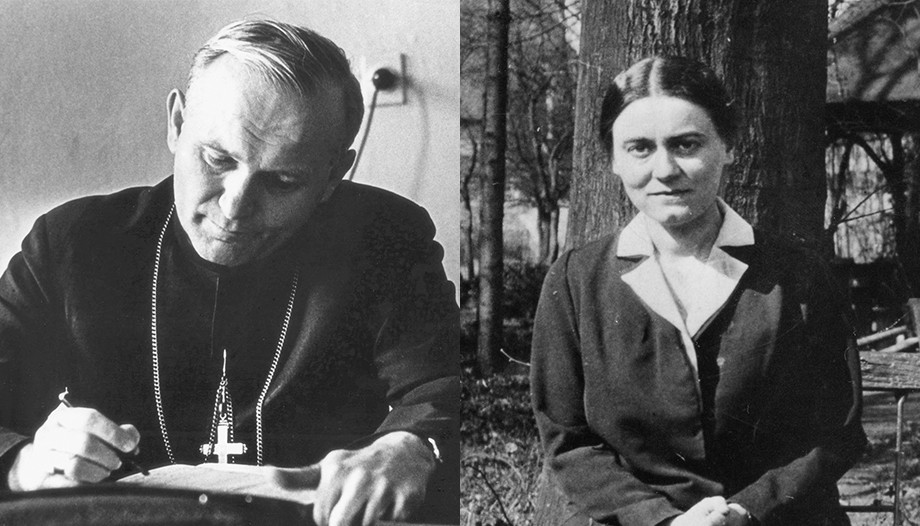
Her studies took her to the University of Göttingen, where she collaborated with Edmund Husserl, founder of phenomenology. She also had academic contacts with Max Scheler and Martin Heidegger, exposing a proper anthropology in which she highlights some of man's own characteristics such as freedom, consciousness and reflective capacity.
The future Carmelite martyr saint, Teresa Benedicta of the Cross, patroness of Europe, was the eleventh child of a well-to-do Jewish family from Breslau. He converted to Catholicism in a process where grace, studies and his intellectual restlessness led him to the discovery of the Truth. It is worth quoting two sentences from his religious experience.
The first, when entering a Catholic church: "For me it was something quite new. In the synagogues and temples I knew, we went there for the celebration of a service. Here, in the midst of daily business, someone entered a church as if for a confidential exchange. This I will never forget.
The second, when he read for a whole night the autobiography of St. Teresa of Avila, a book that he had taken at random from the library in the house of a married friend, converted to Catholicism: "When I closed the book, I said to myself: this is the Truth". Later she would write: "My longing for the truth was already a prayer".
The city of Wrocław
Wroclaw had a great urban, industrial and cultural development in the nineteenth century and early twenties. During World War II it was seventy percent destroyed. It was the last city to capitulate after Berlin, on May 6, 1945. Months before the Nazis had made Breslau a Festung, an impregnable fortress, and to better defend themselves they built an airport in the center of the city, in the largest square.
After the war Wroclaw became a Polish city, under the name of Wrocław. It was rebuilt and renovated, especially in the last thirty years of democracy. This city of one eight hundred thousand inhabitants is worth a visit. It still retains much of its grandeur.
In a special way, the oldest part, the Cathedral Island (Ostrów Tumski), has always through the centuries preserved its Catholic identity and respect for the Polish minority. In fact, the last German Catholic bishop of Breslau, Adolf Bertram (1945), required the German priests of his diocese who lived in Polish-speaking Silesia to learn Polish in order to explain the faith in the original language of the faithful.
Honorary Doctorate
Let us now talk a little about what an honorary doctorate is. It is an honorary degree awarded by a university or academic institution to eminent persons.
The Latin name honoris causa -for cause of honor- , refers to a quality that leads a person to the fulfillment of his duties, respect for his fellow men and himself, it is the good reputation that follows virtue, merit or actions of service, which transcend families, individuals, institutions and the actions themselves that are recognized.
The awarding, in the ritual ceremony of investiture, of various objects related to the classical university contains a whole exaltation of teaching and wisdom.
As a knight of learning, the doctoral candidate is imposed, in succession: the biretta - "...so that you may not only dazzle the people, but also, as with the helmet of Minerva, be prepared for the fight"; the ring - "Wisdom with this ring offers herself to you voluntarily as a spouse in perpetual alliance"; the gloves - "These white gloves, symbol of the purity that your hands must preserve in your work and in your writing, are also a sign of your singular honor and worth"; the book - "Here is the open book so that you may discover the secrets of Science (....) here is the closed book so that you may keep these secrets, as appropriate, deep in your heart".) and here is the book closed so that you may keep these secrets in the depths of your heart".
After the ceremony, and with the concession to the new doctor of the faculties of reading, understanding and interpretation, he is instructed: "Take a seat in the chair of Wisdom, and from it, standing out for your science, teach, guide, judge and show your magnificence in the university, in the forum and in society".
The Pontifical Theological Faculty of Wrocław has awarded honorary doctorates to renowned theologians, among others, Cardinals Joachim Meisner (born in Breslau), Joseph RatzingerMarian Jaworski or Gerhard Ludwig Müller
Academic profile of Bishop Ocáriz
To better understand the reasons that led the Pontifical Theological Faculty of Wroclaw to award Professor Ocáriz this title, it is good to know a little of the biography of the man honored. Physicist, theologian and university professor.
Consultor to the Congregation for the Doctrine of the Faith (since 1986) and to the Pontifical Council for Promoting the New Evangelization (since 2011). He was a consultor to the Congregation for the Clergy from 2003 to 2017.
In 1989 he joined the Pontifical Theological Academy. In the eighties, he was one of the professors who initiated the Pontifical University of the Holy Cross (Rome), where he was ordinary professor (now emeritus) of Fundamental Theology.
His numerous articles and books revolve around Christology, Ecclesiology and the understanding of the world from the perspective of faith and the philosophy of being. His theological publications include books on Christology, such as "The Mystery of Jesus Christ"; "Children of God in Christ. Introduction to a theology of supernatural participation".
It is also worth mentioning his Thomistic philosophical formation, which can be seen in his book "Nature, Grace and Glory", and his critique of Marxism from the philosophy of being in his study: "Marxism: Theory and Practice of a Revolution". He also has ascetic theological books such as "To love with works: to God and to men".
There are three points that Professor Ocáriz expressly comments on in his master class. In the first place, the centrality of Christ. In relation to Christology, it is worth recalling the words of St. Augustine in his commentary on the Gospel of John: Qui enim tam tuum quam tu? Et quid tam non tuum quam tu? - What is so much yours as your own you? And what is so not yours as your own you? The reality of the person as relationship already speaks to us of a mystery that only the Redeeming Incarnation in its filial relationship with the Father can shed some light on.
Professor Ocáriz tells us: "The union between humanity and divinity in Christ demands that, in some way, there be something in common between the divine Person and human nature; otherwise, instead of incarnation, we would have to speak simply of the indwelling of God in man. This something in common is precisely the Being of the Word which, however, does not become part of human nature, since it does not belong to the formal level: it is the energy (act) that makes it exist (...) for this reason we can affirm with foundation that the humanity of Jesus Christ is a way of being of God: the non-divine way of being that the Son of God has assumed in Himself. It is God's way of being human, which is the fullness of the revelation of God himself, so that "every work of Christ has a transcendent value: it makes known to us God's way of being" (St. Josemaría Escrivá, Christ Is Passing By, no. 109).
Secondly, Professor Ocáriz is credited with important ecclesiological contributions, especially in relation to two documents of the Congregation for the Doctrine of the Faith. In the first place, the "Communionis notio"which is a letter to the bishops of the Catholic Church on some aspects of the Church considered as communion (1992). Secondly, the declaration "Dominus Iesus"on the uniqueness and salvific universality of Jesus Christ and his Church (2000).
The new Doctor honoris causa of the Pontifical Theological Faculty of Wroclaw writes: "In his work, the theologian proceeds rationally, entering into dialogue with the most diverse forms of knowledge and, therefore, with intellectual rigor, freedom and creativity. At the same time, with the conviction that the truth he studies does not belong to him; indeed, that he is in communion with this truth only through the Church and in the Church. Bearing in mind that being in communion with the Church also entails communion with those who have the function of Magisterium".
New Marxism, gender ideology and scientific atheism
Finally, his vision of today's world from a theological and philosophical perspective is suggestive and precise. Specifically three interrelated topics: the new Marxism, gender ideology and scientific atheism.
The new Marxism returns to the continuous temptation of man to reduce everything to the material, it is "historical and dialectical materialism as the ultimate explanation of the nature of man and the world, and, on the other hand, the denial of the existence of God and of any transcendent reality, a necessary implication of materialism".
As far as gender ideology is concerned, Professor Ocáriz understands it as "a derivation, perhaps the ultimate derivation, of the philosophical conception, especially formulated by Hegel, according to which truth is not a presupposition but a result of action".
And the new scientific atheism "arises in a complex cultural and social situation, in which the method of the physical-mathematical sciences is often presented as the only properly scientific method".
In the granting of an honorary degree of Doctor honoris causa there must be affinities of thought and closeness in the field of research between the institution and the person named. This is the case with the academic lines of the Pontifical Theological Faculty of Wroclaw.
Logically, in addition to the scientific merit, there is always the human factor that is so important when making decisions. The professor of systematic theology Włodzimierz Wołyniecthe rector of the Pontifical Theological Faculty in Wrocław from 2014 to 2022, proposed this appointment to the Senate of the Faculty on his own initiative.
Włodzimierz Wołyniec had Professor Ocáriz as the promoter of his doctoral thesis. And from there arose a continuity in the theological field of Christology under the light of the metaphysics of St. Thomas Aquinas.
La entrada Mons. Fernando Ocáriz. Doctor honoris causa por la Pontificia Facultad Teológica de Breslavia se publicó primero en Omnes.
]]>La entrada <b>Włodzimierz Wołyniec</b>: «Mons. Ocáriz combina el estudio de la Teología con la contemplación» se publicó primero en Omnes.
]]>Translation of the article into English
On Wednesday, June 22, 2022, Msgr. Fernando OcárizThe prelate of Opus Dei, has been awarded an honorary doctorate by the Pontifical Faculty of Theology of Wrocław. One of the promoters of this recognition was its rector until a few weeks ago, Włodzimierz Wołyniec, whom Omnes interviewed on this occasion.
A native of Oława and a Doctor of Theology, Wołyniec has carried out his priestly work as rector and spiritual director of the Metropolitan Higher Theological Seminary in Wrocław. From 2014 to 2022 he has been the rector of this Faculty.
The Pontifical Theological Faculty in Wrocław, whose history dates back to 1565 with the establishment of one of the first seminaries of the Church on Polish soil, has Archbishop Dr. Józef Kupny as its Grand Chancellor and is one of the leading centers of theological studies in Eastern Europe.
Professor Wołyniec, you have been the main promoter of the appointment. Honorary Doctorate of Professor Ocáriz. I would like to ask him first of all about the meaning and importance of awarding a doctorate. Honoris Causa.
- The granting of the title of Honorary Doctorate is the highest academic distinction for outstanding achievements in the field of science and didactics.
Priest-teacher Fernando Ocáriz is the twenty-fifth Honorary Doctorate of the Pontifical Theological Faculty in Wrocław.
I would like to mention that this group already includes Cardinal Joseph Ratzingerwho received this title in 2000, and recently also Cardinal Gerhard Ludwik Müller (2015).
The Grand Chancellor of the Pontifical Theological Faculty of Wroclaw, Archbishop Józef Kupny, notes that many generations of students benefited from the theological knowledge and wisdom of Prelate Ocáriz, including numerous Polish students.
Taking advantage of this occasion, the Church of Wrocław would like to thank the new Doctor Honoris Causa and the. Prelature of Opus Dei the assistance given to students of the Archdiocese of Wrocław to pursue specialized theological studies abroad, in the Pontifical University of the Holy Cross in Rome and in the University of Navarra in Pamplona.
The studies carried out in these universities founded or planned by St. Josemaría Escrivá enjoy worldwide fame and bear very good fruit in the higher education of graduates with adequate spiritual attention.
The profile of the new doctor
From the new Doctor, what aspects of his theological work would you highlight? What lines of research at the Pontifical Theological Faculty of Wrocław are in line with the thinking of Professor Ocáriz?
- Prelate Ocáriz emphasizes in his theology the supernatural dimension of Christianity and Christian humanism. In his publications he shows that man is introduced by Christ into the Trinitarian life of God and participates in the communion of life and love with the divine Persons. A very important theological theme for him is divine filiation, which is the full transcendence of man and the summit of his personal development.
The theological reflection of the Reverend Professor is profound. It is not only a description of reality, but a discovery of the truth and meaning of reality in the light of the word of God. His theology is characterized by a metaphysical thinking that asks the question of the causa et ratio of all that exists.
However, metaphysical thinking does not distract him from everyday life. On the contrary, it allows you to find answers to the ultimate and deepest questions of contemporary man. At our University, we also want to practice a theology that is close to life and help people find the meaning of life.
In your opinion, what theological aspects should be highlighted in the figure of Professor Ocáriz?
- I would especially like to emphasize one: the contemplative dimension of the theology of our new theology. Honorary Doctorate. It combines the scientific study of theology with the contemplation of the Word of God incarnate.
The Professor wants to know with his mind and heart the mystery of God in Jesus Christ, so that in this way he can "comprehend with all the saints what is the breadth and length and height and depth, and know the love of Christ" (Eph 3:17-19). Therefore, its scientific study is always linked to the mystery of Christ in prayer.
Could you tell us some anecdote or personal memory of your meetings with Professor Ocáriz.
- During my studies at the Ateneo Romano della Santa Croce in Rome in 1987-1992, Professor Ocáriz helped me write my doctoral thesis and was my doctoral supervisor during the first years.
Years later, when I came to Rome to invite him to the honorary doctorate ceremony, he said to me, "Look, I gave you a doctorate in theology and now you are giving me a doctorate in your faculty."
La entrada <b>Włodzimierz Wołyniec</b>: «Mons. Ocáriz combina el estudio de la Teología con la contemplación» se publicó primero en Omnes.
]]>La entrada Tradiciones de los días santos en Polonia. La Tumba del Señor se publicó primero en Omnes.
]]>Last Holy Thursday, I was deeply moved by the Eucharistic celebration of the Chrism Mass in the Co-cathedral of the Diocese of Warsaw-Prague at ten o'clock in the morning. A very careful liturgy, with the Gloria, Sanctus and Angus Dei of the Mass de Angelis, as well as the singing of the Pater Noster in Latin. The entire nave of the Church of St. Mary of Victory was full of priests, I counted more than six hundred, many very young, all in cassock and dressed in alb and white stole.
A devotion lived with the naturalness of one who is praying was palpable. Among the concelebrants, who are in the presbytery, there are three priests celebrating their fiftieth anniversary of priesthood, eleven of the thirty-one who were ordained in Warsaw on May 28, 1972 together with Blessed Martyr Jerzy Popieluszko, and there are also more than twenty priests celebrating their silver jubilee of priesthood. All with their hands together as if they were first communion children.
The idea came to my mind that we priests, when we celebrate or concelebrate, do not know where to put our hands during the ceremony. The simplest and most pious thing to do is to keep them together as so many pious priests used to do in the past and some still do today. At least in the Co-cathedral of Santa Maria de la Victoria today I have seen so many young reverends, and of those who paint gray hair, with their hands piously joined as a sign of prayer.
We prayed especially for the end of the war in Ukraine and we have done it in that temple by an explicit wish of Bishop Romuald. That St. Mary who defended Warsaw from the Soviet army in 1920, the so-called Miracle of the Vistula, may defend today Kijowa and Ukraine from the 'Russian military operation'.
Grób Panski. The tomb of the Lord
Yes, Poland is different and I would now like to comment on two customs introduced into the liturgy of the Church in Poland that respond to a popular desire of the faithful.
I am referring to what in Polish we call the 'Grób Panski' - the tomb of the Lord, at the end of the liturgical celebration of the Lord's Passion on Good Friday and also of the 'święconka'.
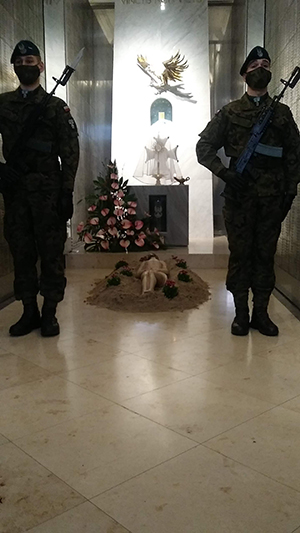
Some time ago I commented that in order to better understand the Church in Poland it is necessary to know the meaning and value in society of two words - kolenda and plebanie - now I would like to add two others peculiar to Holy Week - Grób Panski and Święconka.
At the end of the Good Friday liturgy begins what is called 'The Tomb of the Lord'. A procession is made with the Blessed Sacrament in the Monstrance and it is deposited in a prepared chapel in which, together with many different motifs of the religious, social and political life of the country and the world, there is always the representation of the Lord lying and dead. At his side is placed the Monstrance covered with a white veil. Soldiers or firemen stand guard.
Hours depend on each parish. On Friday until midnight and on Saturday from the early hours until one hour before the beginning of the Easter Vigil. During this time, the faithful come to the church to pray and contemplate the mystery of the Death of the Lord in his Tomb together with the adoration of the Blessed Sacrament. In my long years in Poland, I have become convinced of the theological meaning of this popular custom.
Święconka. The blessing of food
Every Holy Saturday has also taken root in me the tradition, as so many Polish families do, to visit the Lord's Tomb in various churches and to go, also on Holy Saturday, to the blessing of food, that is to say to the 'Święconka' which I will explain below what this custom also 'fuori norme' consists of. But first I would like to clarify that the day of the year that most faithful go to Church is precisely the day on which no liturgy is celebrated, Holy Saturday. Really, Poland is different.
Years ago, while living in Krakow, an Aragonese television program called Aragonese around the worldThe program makers were amazed to see the crowds of families in the streets with their food baskets in the churches to receive the priest's blessing and a short homily. The producers of the program were amazed to see the crowds of families in the streets with their baskets of food coming to the churches to receive the priest's blessing together with a short homily explaining the meaning of the Easter feast. The times I have listened to those little talks I have found them to be an impressive mystagogical catechesis.
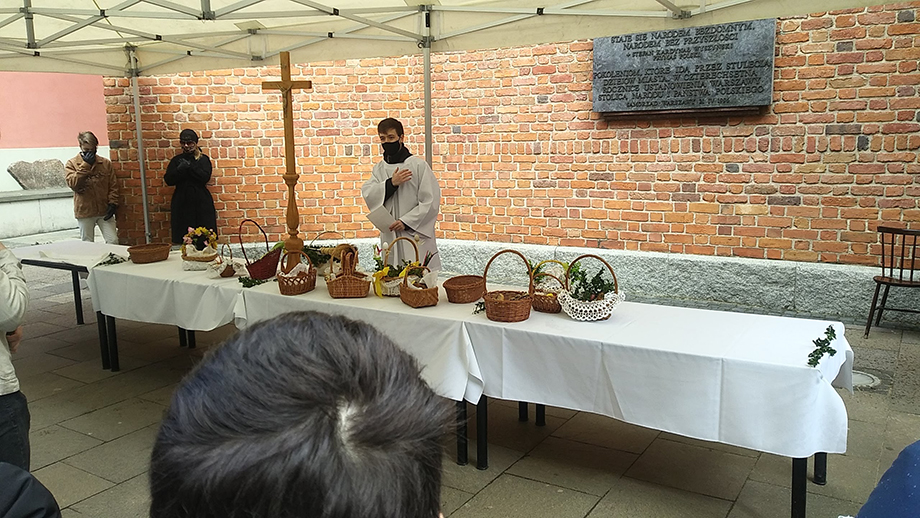
The main idea is that the faithful participate in the liturgical celebration of Easter and that they are filled with joy, not only in the church, but also in their homes. The presence of the Risen One is invoked so that the whole family sits together to eat the first food of Easter Sunday together with the Lord. And they use, as a sign, those foods that were taken in the basket to be blessed the day before, that is to say, on Holy Saturday.
Święconka is a tradition present in several Catholic countries, including the whole territory of Poland, which consists in blessing various foods on Holy Saturday. Food such as meat, bread, eggs, salt, etc., are placed in wicker baskets and taken to churches where priests bless them during a special service. The blessed food is consumed the next morning during the solemn Easter breakfast.
The blessing imparted by the priest more or less reads as follows: "Lord Jesus, the day before your passion and death, you sent the apostles to prepare the Passover and, on the day of your resurrection, you sat at table with your disciples. We ask you to let us live your presence in faith during Easter Sunday breakfast in our homes. You who are the living Bread, who came down from heaven and give life to the world, bless + this bread as you blessed the loaves you gave to eat to those who listened to you in the desert. Lamb of God, you who have washed the world from sin, bless + this meat and all the food we shall eat in memory of the Passover lamb as you gave your blessing to all the food you ate with the Apostles at the Last Supper. Christ, our life and resurrection, bless + these eggs, sign of new life, so that, in sharing them, we too may share the reciprocal joy of your presence. Open the eyes and hearts of those who suffer because of pandemics or war, help those who serve the poor and the cause of peace and justice in the world. And so may we all enjoy the eternal feast in the Father's house, where you live and reign forever and ever. Amen.
La entrada Tradiciones de los días santos en Polonia. La Tumba del Señor se publicó primero en Omnes.
]]>La entrada Stefano Wyszyński y la madre Isabel Rosa Czacka, los ojos de la fe se publicó primero en Omnes.
]]>Following one of the above-mentioned summer customs, the young priest Wyszyński went on a trip to Europe in early September 1929. It was not only a vacation, but also part of his theological studies on the social doctrine of the Church and its application in different European countries. He was in Austria, Italy, France, Belgium, Holland and Germany. His main idea was to collect material for the study of Catholic Action and the different European Christian initiatives in the social field, and to unite it with the idea of the lay apostolate that would serve as a basis for explaining Catholic Action, so promoted by Pope Pius XI.
In Rome
It was in Rome where Wyszyński stayed the longest. At the Institute of Social Sciences of the Pontifical University of St. Thomas, the Angelicum, he participated as a listener in the classes of Catholic social ethics. He himself recounts in his diary: "In Rome, at the Angelicum, in the classes of Father Gillet there were six colored Africans and the rest were like in the tower of Babel: English, French, Dutch and others. I counted forty people of thirty different nationalities. The Africans sat alone at the back of the classroom. All around them there were empty seats because no one wanted to sit next to them. So I decided to sit next to them. Then the others came up to me and said: "What are you doing, how come you are sitting with them? And I answered: well, because nobody wants to sit there. It's an invented reason - a Frenchman answered me. And I answered: go on, you go and sit with them. And indeed he did not go. Father Gillet spoke in a really wise way. Once in the corridors of the University I commented to him: Father, why don't you say something that moves the students in such a way that they want to sit with the Africans? Father Gillet who knew languages answers me in Polish: Polaki zawsze walczą za naszą wolność i waszą - Poles always fight for their freedom and ours. I left Rome for Paris and the Africans were still sitting alone...¨.
This episode in the life of the future Primate, Cardinal and Blessed gives an idea of his talent: he was a man determined for freedom, a freedom that has its foundation in the dignity of the human being according to Christian doctrine. He would later write: "At present two worlds, two orders, are fighting against each other: atheistic communism and Christianity. For the Church the struggle is neither new nor extraordinary, for she has never been afraid of confrontation and has never withdrawn from the combat. The Church carries within itself the tradition of the Gospel boat, capsized by tides, from which Christ continues to teach. The Church boat is accustomed to storms and setbacks, and is calm about the outcome of the new and international war of humanity. Why? Because the outcome depends on the foundation. Two great principles are confronted: hatred and love.
Blessed Mother Czacka
Of the life of Cardinal Wyszyński we have a certain knowledge. In this magazine I have published, if memory serves me correctly, two articles on the Primate of Poland explaining his figure and importance in the Polish history of the 20th century. Perhaps it would be good to briefly present the biographical profile of the new Blessed Mother Czacka, her charisma and what unites her with Wyszyński, since she is surely a figure almost totally unknown to the Spanish-speaking reader.
Rosa Maria Czacka was born in 1876 in Biała Cerkwa, in what is now Ukraine. She belonged to a noble, wealthy and intellectual Polish family. She herself was a countess. From childhood she received a deep Christian formation and careful instruction, she spoke five languages. The copy of the Imitation of Christ that she read in French in her childhood is preserved. At the age of seven her family moved to Warsaw where she actively participated in the life of the Warsaw high society at the end of the 19th century.
As a result of a fall from her horse and a congenital disease, she became totally blind at the age of twenty-two. And here is shown one of the main facets of her character and her holiness: fortitude and a determined spirit to get out of evil goods. She learned the Braille system and adopted it to the phonetics of the Polish language, continued her education and wanted to achieve maximum independence from the very beginning. At the same time he dedicated himself to helping other blind people so that they could be useful to society, as he later wrote: "From the intellectual point of view, the blind are not inferior to the sighted. Their intelligence and clarity of judgment, their capacity for abstraction and proper reasoning are not diminished by their blindness, they are on the same level as those who have the visual capacity¨. In his efforts to help the blind, he traveled to Belgium, Austria, Switzerland and Germany to study the new teaching methods used in those countries for the blind. He also obtained information from specialized magazines and books on this subject from England and the USA.
As a result of this work, in 1911 he founded the Society for the Care of the Blind. The fundamental criterion of the new society was realized in the maxim - The blind man, a useful man. Contrary to the usage of the beginning of the 20th century, that the blind person was incapable of working and of a life full of usefulness to society, Rosa Czacka wanted this association to promote the human dignity of the blind and help them to integrate into society. A few years later she discovered her vocation as a religious in the work she was doing. She became a Franciscan changing her name from Rosa Maria to Isabel Rosa and in 1918 she founded the Congregation of the Franciscan Sisters Servants of the Cross whose charism was related to that association but with a vision of the Christian faith as true light. She wrote in her statutes: "The main purpose of the congregation is to make reparation to our Lord Jesus Christ for the spiritual blindness of men. We observe the third rule of our father St. Francis, obtaining graces for our blind, we serve them to help them in their own and our support.
With the passage of time, Mother Isabel Rosa was directing her formation so that the blind would want, as she herself did, to accept the weight of the cross of blindness as an offering to God to make reparation for those who see but do not have faith, and in this way be apostles of the blind in the soul, making them see the values of the spirit. We want to realize the ideal of the blind person who totally assumes his blindness and carries it as a cross of which he is neither ashamed nor rebels, but accepts it as coming from the hands of God and in this way, by his good acceptance, becomes a source of grace and strength for himself and for others. We do not want to treat the affairs of the blind only in a supernatural way or as alms. Seeing things in a modern way we want to understand the psychology of the blind person to show him all the human possibilities he has, his place in society, his work and obligations. We also treat the problem of the blind person as a social problem. In 1922 he bought a large estate on the outskirts of Warsaw, near the Kampinoska woods in Laski. And to this day they have their main center of action there, to which they gave the name Triuno in honor and glory of the Triune God. In this center, since its beginnings, three groups of people are gathered and formed: blind people, sisters of the Congregation and lay people, among the latter, Mother Isabel Rosa dedicated special attention to the intellectuals. Its three goals are: education, apostolate and charity.
What unites Blessed Mother Czacka and Wyszyński.
What unites Mother Elizabeth Czacka with Cardinal Stefan Wyszyński? The war, and in particular the Warsaw Uprising. At the beginning of the world conflict, in September 1939, Mother Elizabeth suffered severe wounds as a result of Nazi bombing. She offered all her ailments so that the evil of war would cease and love would overcome hatred. She said to her spiritual daughters: "We must not allow the least bitterness or bad feelings against anyone, not even against our enemies whom we are obliged to love and pray for. Let us ask the Heart of Jesus to fill us with his grace, a grace so great that we can love everyone and especially our enemies. Her attitude of Christian love towards the invading army did not consist in a total resignation before the unjust occupation, Mother Elizabeth always defended the right to self-defense. She encouraged to pray and offer sacrifices so that the "animosity of the enemies" would change and when a necessary encounter arose, it would always be necessary to behave before them "with the dignity proper to a man who is virtuous, well educated and knows how to treat his neighbor".
These were not empty words. In fact a few wounded soldiers or lost parachutes of the German army were cared for in Triuno. In the archives of the Franciscan Sisters Servants of the Cross is a letter from a German officer thanking them for the help given to wounded German soldiers in September 1939. In the first months of the beginning of the war, this German officer approached Laski to thank her for the humane care the wounded had received. The Foundress, unaware of the reasons for his presence, did not want to receive him. She agreed to attend to him when she learned the reason for his visit. From then on the German officer always addressed her as 'sehr heilege Mutter' - very holy Mother.
With the Warsaw Uprising, in the forests of Kampinoska began the battle on the part of the National Army AK (Arma Krajowa). For the reader unfamiliar with the Second World War, I would like to remind that in Warsaw there were two uprisings against the Nazi occupation. The Warsaw Ghetto Uprising (19.IV-16.V 1943 - 7000 Jews killed and 40.000 deported to concentration camps - German casualties: certainly less than a hundred soldiers - ghetto in a 100% destroyed) and the Warsaw Uprising (1.VIII-2.X 1944 - 70.000 Polish soldiers killed, 200.000 Polish civilians killed, 550.000 civilians deported from Warsaw - 30.000 German soldiers killed - city in a 85% destroyed). The data give an idea of the drama experienced.
Isabel Czacka gave her full consent for her employees in Laski to collaborate with the AK guerrilla soldiers. Despite the risk she ran, she allowed weapons and supplies for the guerrillas to pass through her land. To the doubts of the AK commander, if they did not risk the lives of the nuns, the children and the blind of Laski, Mother Elizabeth replied: "The decision to fight was resolved in 1939: fight for freedom, and that decision obliges us today and now". However, as the person in charge of the entire compound, she did not allow any violent action against the enemy to take place within the vast grounds of Triuno. The complex was guarded and frequently searched by the Gestapo who were looking for AK soldiers. Even in the moments of greatest danger no AK soldiers who took refuge there were ever surrendered. Mother Elizabeth with her presence and dignity gave courage and security to all, and she also made sure that everyone would be confessed in case the worst happened.Mother's availability was also manifested when the German troops sent their division consisting of Ukrainians and Mongols through that area. Many young girls and women with children came to the Laski complex seeking protection and were always welcomed there. One of them recalls that "Mother Elizabeth had a strong faith that nothing bad would happen in her compound. And so it was: the madness of the soldiers did not reach us, there was like an invisible barrier protecting Laski.
This article will be continued with a second part.
La entrada Stefano Wyszyński y la madre Isabel Rosa Czacka, los ojos de la fe se publicó primero en Omnes.
]]>La entrada El Cardenal Wyszyński y la madre Rosa Czacka se publicó primero en Omnes.
]]>During the Warsaw uprising Mother Elizabeth decided to organize a field hospital within her compound. There also took refuge the priest Wyszyński continuously persecuted by the Gestapo. Stefan Wyszyński remained in Laski for two years serving as chaplain of the Sisters and priest of the AK. It was then that he met and treated Mother Elizabeth Rose and would later recall, "I would look at Mother and wonder: where does this woman get such strength and audacity to do this work facing continuous danger with her cooperation to the Uprising? It was not only the hospital, but there was also a supply and liaison center, a continuous coming and going of people. Mother thought that it was necessary to be filled with strength, for that is what the world needed at that time. She made me discover then the figure of a totally new woman, dedicated before to prayer and to the care of the blind and now, in a continuous mortal danger, she was still doing all the acts of piety but actively helping everyone. She was for us in Laski a Mother, a source of peace, serenity and promptness in service".
Mother Elizabeth Rose always, but especially in those moments, encouraged us to unite ourselves to the Cross of Christ: "At the feet of the Crucified One we cannot be inactive. Jesus Christ does not only want us to meditate on His Passion, to have compassion before His image, but to help Him save souls. Jesus wants us to use His redeeming blood to cleanse our sins and the sins of those around us, the sins of our enemies and those of the whole world. We must allow ourselves to be soaked by this Divinity. We must let ourselves be soaked by this Blood, and offer it to God for our salvation and that of the whole world".
Peace and joy at the Cross
Mother Elizabeth's motto is on the Congregation's coat of arms: Pax et gaudium in cruce. For the new Blessed, those words were rooted in trust in God and in uniting herself ever more intensely to the passion of Christ. "Suffering is inevitable. One cannot attain holiness without suffering. The man who wants to live with God needs to carry his cross, the cross that God sends him. That is why to remain close to the cross of Jesus is our way and our vocation. And I am referring to the cross that comes from the hands of God: the loss of health, of freedom. It is a hard cross, but it is good, it is a saving cross that we need to embrace".
We have in these two new Blesseds, so closely linked to the city of Warsaw, similar characters. Stefan Wyszyński always began his homilies with the greeting "Dear children of God" and his figure full of strength and dignity, especially in the face of the communist system imposed in Poland after the Second World War in Yalta, stands out with one trait: paternity. He was a Father. Mother Elizabeth Rose, also full of fortitude in the face of the Nazis and defender of the dignity of the handicapped is shown for many with a continuous reference: she was for all a mother full of fortitude, the Mother.
Cardinal Stefan Wyszynski officiated at the 1961 Mass of suffrage on the occasion of the death of Mother Elizabeth. In his homily he said among other things the following words: ¨Mirabilis Deus in sanctis suis! - God is admirable in his saints. The life of Mother Elizabeth, for many of us had only this title: Mother, speaks to us of the wonders that God does in his saints. There is always in the life of every person the hidden mystery of God. He himself is the Deus absconditus. He acts silently in the depths of the soul. He is never inactive, he is continually at work. He forms, chooses and helps people. He sends them out and causes them to be surrounded by others to serve. God chooses the instruments to cooperate. No man of God is alone, for God himself causes many to be found beside him, like bees around the queen mother of a panel¨.
Wyszyński, a man of the Polish people, Czacka, a woman of the aristocracy. Both were intellectuals, Christians of deep faith and constant prayer, full of admirable fortitude for the defense of the rights of God and of the person. I conclude with a few words of the new Blessed speaking of the Christian layman who acts in the world: "It is not a matter of being a man dominated by feverish activity, tired and mercilessly tiring others, absorbed by continuous occupation. The modern man of Christian action must have in himself more than the peace and measure of a diplomat, he must have the assurance that comes from conscience, that he helps God to save the world to the same extent that he allows God to act in his own life.
Stefan Wyszyński was ordained alone because he was unable to do so on the scheduled day of ordination, whether because of a relapse of his tuberculosis disease or because he was a few days short of his 23rd birthday, is not known for sure. The minimum canonical age was 24, but the bishop could grant a dispensation of one year, no more. Stefan was therefore ordained on his 23rd birthday, August 3, 1924. However, with all his companions, many of them future martyrs of the world war and some of them beatified, he made the obligatory spiritual exercises before ordination. He wrote down ten resolutions in his notes. He always kept this sheet in his breviary and every day he examined himself on these ten maxims or resolutions:
1. Speak little - live quietly - silence.
2. Do a lot, but without haste, with peace.
3. Work systematically.
4. Avoid dreams - don't think about the future, it is in God's hands.
5. Do not waste time, for it does not belong to you; life has a purpose and so does every instant.
6. In all things discover a good intention.
7. Pray frequently when you are at work - sine me nihil potestis facere (without me you can do nothing).
8. Respect every person, for you are worse than every person: God resists the proud.
9. Omni custodia custodi custodi cor tuum quia ex ipso vita procedit (Guard your heart with all care, for from it comes life).
10. Misericordias Dei in aeternum cantabo (I will sing the mercies of the Lord forever).
His devotion to the Virgin
An interesting anecdote about Cardinal Wyszyński, is the following:
There is a photo in which Cardinal Wyszyński is seen smiling and next to him the two future bishop prelates of Opus Dei, Blessed Álvaro del Portillo and Javier Echevarría. It was in September 1979. They traveled by car and were accompanied by the priest Joaquín Alonso and Javier Cotelo as driver. The latter recounts his memories in a family recorded interview. Here is the transcription:
"That is the photo of Cardinal Wyszyński with don Álvaro and don Javier. -Do you remember anything about that meeting? - Yes, of many things. That meeting took place the day before we left on September 7. They wanted to see the Cardinal simply to tell him that we had passed by and that the President General of Opus Dei wanted to greet him. We arrived at the bishop's palace and were met by the secretary who spoke Spanish. He told us: the cardinal is about to leave by car, he is about to leave because he has a meeting with bishops in another diocese and of course, he cannot receive them and if he does receive them, it will only take a minute.
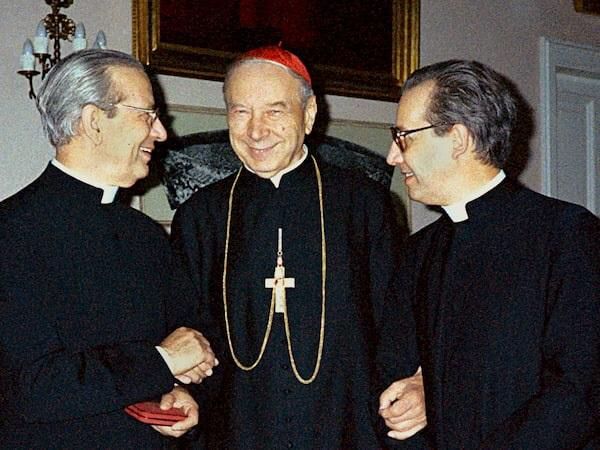
And indeed he came out and put us in the hall of the photo. Behind us there was another picture, if I remember correctly, of Częstochowa in which you see a seat, an empty chair in the middle and a lot of people, a lot of people in front of that throne. It was his throne, the seat of the Cardinal, but it was empty because he was in prison. While we were looking at these and other photos, the Cardinal soon arrived. He received us a little dryly, saying: "What are these Italian priests coming to Warsaw doing here? I am very grateful that they come dressed in cassock, because usually the priests who come from Italy come dressed in any way". He liked the fact that they were in cassocks, but he liked Don Alvaro's answer much more: "I don't want to take a minute away from you. We have come to pray to Our Lady of Częstochowa to pray for Poland and to pray above all for Pope John Paul II, and to bring Opus Dei to Our Lady's feet, renewing the Work's consecration to her Most Sweet Heart.
Then the Cardinal was moved when he heard about the prayer and Our Lady and placed his hands on the shoulders of Don Alvaro and Don Javier at the same time. And he was transformed, he totally changed his appearance. Before, he was a bit dry, as if tired of receiving tourist priests. And when he heard about prayer, about Our Lady, he got excited and told them that he had enjoyed hearing about Our Lady and that they had come to pray, that he was happy to meet people from Opus Dei and its president general and those accompanying him, and that he apologized for not being able to be with them any longer because he was about to take the car and go to another province, to another city where he had a meeting.
He gave each of us a rosary and then said goodbye with a hug and a kiss to the priests. He only gave me a hug. Then don Joaquín said to him: "And could we take a picture of him? -Yes. Get in right away. And as you can see, he put himself between Don Álvaro and Don Javier. I took two pictures of him because Don Alvaro said to me: "Take another picture just in case the first one didn't come out well. We left there very happy and rejoicing as if we had really been with a saint because he reminded us of our Father by his smile and his gaze. When we were with Cardinal Wyszyński we had the impression that it was like with our Father: you could really feel that we were with a saint".
La entrada El Cardenal Wyszyński y la madre Rosa Czacka se publicó primero en Omnes.
]]>