



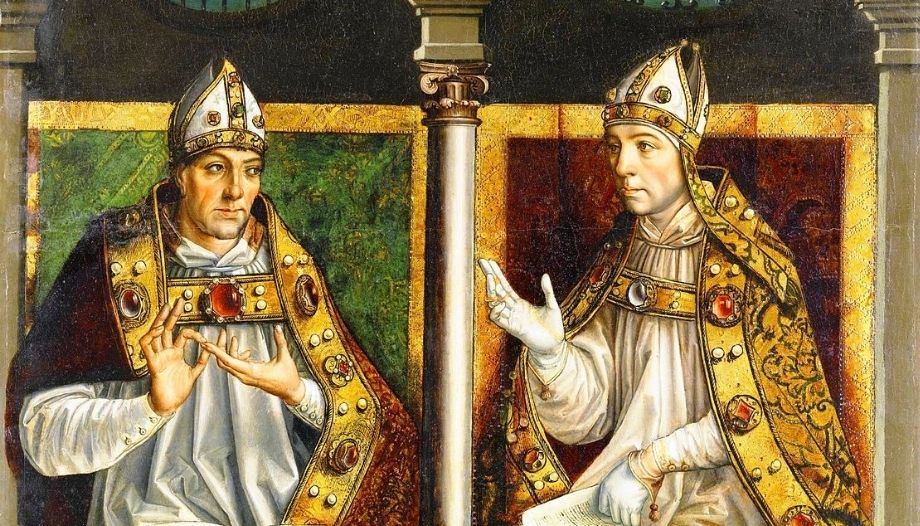
Saint Ambrose, bishop of Milan (Italy), is one of the most influential figures in early Christianity and a Doctor of the Church. His life and work have been extensively documented by official sources of the Holy See and by the Augustinian tradition. In particular, Saint Augustine's Confessions recounts the decisive role that Saint Ambrose played in his conversion.
The son of a Roman Christian family and educated in rhetoric and law, Ambrose arrived in Milan as governor of the province of Liguria and Emilia. His election as bishop in 374 was swift and almost sudden. According to ecclesiastical sources, he was still a catechumen when the community acclaimed him to occupy the episcopal see. After receiving baptism and holy orders within a few days, Ambrose served as bishop for more than two decades.
He stood firm against the emperors Theodosius and Valentinian II, always insisting on the primacy of Christian conscience and the need for rulers to submit to moral law.
Impact on San Agustín
The Confessions‘ narrate the impact produced by the eloquence, intelligence, and spiritual interpretation of Scripture that Saint Ambrose offered in his homilies. St. Augustine He was initially a skeptical intellectual, and found in Saint Ambrose a living testimony of the Christian faith.
It was Saint Ambrose who finally baptized him on Easter Vigil in the year 387. The Augustinians say that “if we did not have Saint Ambrose, we would not have the Augustinian Order as we know it today.‘.
“Where Peter is, there is the Church.”
Saint Ambrose always recognized the primacy of the Bishop of Rome, affirming: “Ubi Petrus, ibi Ecclesia” (‘Where Peter is, there is the Church’). Sacramental theology, liturgy, and sacred music—including the famous ‘Te Deum,’ traditionally associated with him—made Saint Ambrose a pillar of the Latin Church.




 Español
  English
  Italiano