



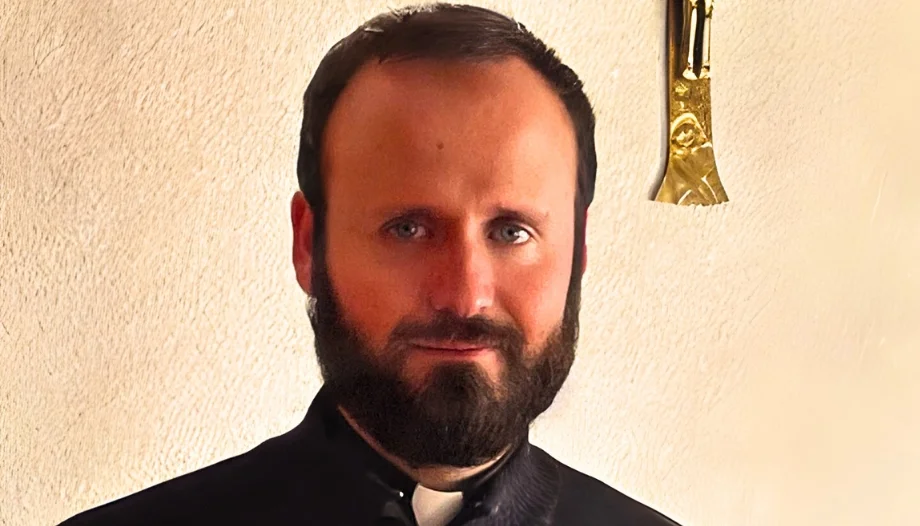
Father Miguel Pérez is the parish priest of the Church of Saint Justin Martyr in the Palestinian town of Nablus. At the age of 18, he left Spain for the Redemptoris Mater seminary in Galilee, from where he was sent to Jordan and then to Palestine, where he has been for four years.
Amidst a climate of political and social uncertainty, Christians in the Holy Land continue to live their faith amid challenges that test their hope. In conversation with Omnes, the priest shares how he encourages the faithful who are tempted to despair and reflects on the silent witness of the Gospel in a predominantly Muslim society.
In a context where tension and uncertainty are part of everyday life, how do you live and convey Christian hope to the faithful who may be tempted to despair?
I believe that faith in God is essential now, that is, people are losing hope because the future is very uncertain. I believe that what can keep us strong is the certainty that everything is for the best and that the Lord will bring everything to a good end. This is not escapism, but rather faith in God is what can give us the strength and courage to continue building our country. Let's say that even in everyday conversations, I try to convey the idea that we must continue to be involved in social life and work to move forward, and I see that in general people have that attitude, but what we must not do is fall into victimhood.
In a predominantly Muslim society, how do you perceive that Christians can bear witness to the Gospel without words, simply through their way of life?
Christians are witnesses to the Gospel in the Holy Land to the extent that they carry their cross. The conflict situation here is a cross. Staying here without rebelling and without raising cries of hatred is, I believe, the best way to evangelize at present. On the other hand, it is true that many Christians are emigrating in search of a more peaceful life. As Christ says, «the spirit is strong but the flesh is weak.» Therefore, first of all, it is necessary to continue evangelizing Christians so that they remain salt. This means living through the Israeli occupation with patience and loving those Muslims who despise Christianity.
You talk about how the state's mentality is being passed on to small groups, thus causing offense in your parish. What is the relationship with the Muslim authorities like?
The mentality of Daesh (the so-called Islamic State) is spreading, affecting above all those who are mentally more vulnerable. For now, it is not a threat to Christians; we are not being directly persecuted. However, because of some people who tend toward fanaticism, Christians are sometimes encountering uncomfortable situations in schools and workplaces. But this is not the general situation that defines relations between Christians and Muslims in Palestine and Nablus. In fact, the Muslim authorities are very respectful of churches and Christians.
Many young Palestinians, including Christians, emigrate due to a lack of opportunities or fear of conflict. What “strategies” does the local Church have to keep the faith alive among the young people who remain?
There are no specific strategies, but there are many activities for young people in parishes, especially through the youth group «La Patria de Jesús» (The Homeland of Jesus), which strives to bring together university students and train them to be catechists for children and adolescents in the parish. This movement also connects parishes and creates bonds between Christians throughout the country.
You have said that Christians live “abandoned to God's will.” What have you personally learned about the faithful in Palestine?
We could say that this war began in 1948, so most of the population was born into war and is accustomed to these situations. Several times, they have been the ones to comfort me with words of faith. Although it is also true that people are more discouraged after the bombings that have devastated Gaza and after the supposed peace agreement signed in October of this year (2025), which does not seem likely to help the Palestinians. The pessimism is quite noticeable, but let's hope that people will regain their spirits.
The Christian community in Nablus brings together Catholics, Orthodox Christians, Greek Catholics, and Anglicans. What spiritual fruits have you seen in this close and practical ecumenical coexistence?
I believe that Christians must work together as brothers and sisters in Christ. Each church must preserve its own heritage, but I believe that in places like Nablus we must move ahead of the times and begin to see ourselves as one Christian family. People greatly appreciate this constant communication between parishes, and it enables us to better fulfill our role in society. Furthermore, considering ourselves a community means that the institutions and activities of each church are a source of enrichment for the others. In addition, divisions among Christian denominations are a source of scandal both for our Muslim neighbors and for Christians themselves, since the faithful of different denominations are often linked by family ties.
Despite the difficulties, you and other priests remain there, supporting small communities. What does it mean to you to be in the Holy Land today, and how do you experience the mission of being a sign of unity and hope?
It is a blessing to suffer for Jesus Christ. It is true that in my daily life I am not exposed to danger, but there are many kinds of hardship, especially the insecurity of the roads, which are full of Israeli checkpoints. I believe that we are a sign that our life is not meant to build a paradise on earth, but to give ourselves to others, thus announcing the coming of the Kingdom of Christ. Furthermore, here we have to live day by day, because we know nothing about tomorrow and it is almost impossible to plan anything because the situation is very precarious. Violence by settlers in the Palestinian territories is increasing and roads are frequently blocked. We only know that we have to live today in God's grace.



 Español
  English
  Italiano