


 "Learning Rome" through the early Christians.
I stopped by the Pantheon just a few days ago. Actually, it is almost impossible not to pass by if you frequent the center of Rome. And, faced with the incredible queues of tourists, I remembered how beautiful it was, years ago (before the tourist invasion), to enter early in the morning, when the light from the oculus drew an almost perfect circle on the floor; or in the evening, for Mass, when the naves were filled with a golden gloom and the coming and going of visitors gave way to the silence of the faithful. Now...
Before continuing, a small clarification: in Rome we have the Pantheon, not the Parthenon! And it makes me laugh to think that an American comedian has made a video precisely about this misunderstanding into which many tourists fall!
A millennial embrace
In the articles that we have devoted to the basilicas of San Clemente y San Sebastian We have defined certain buildings in Rome - if not the entire city - as an “archaeological lasagna”, due to the different artistic and historical layers that characterize the city's buildings, from the archaic in the depths to the baroque and modern on the surface. Well, the Pantheon is an exception, since today it appears exactly as it was two thousand years ago: a Roman monument converted into a Christian church and Renaissance mausoleum without the oldest layer being buried under the most recent ones.
The temple of all gods
The Pantheon derives from the Greek “pan” (“all”) and “theòs” (“god”). It was, in fact, the temple of all the gods, even the lesser-known ones from the farthest corners of the Roman Empire. Rome, in fact, was like a sponge: it conquered, yes, but it absorbed the customs, habits and religious traditions of the subjected territories: a true globalization “ante litteram”.
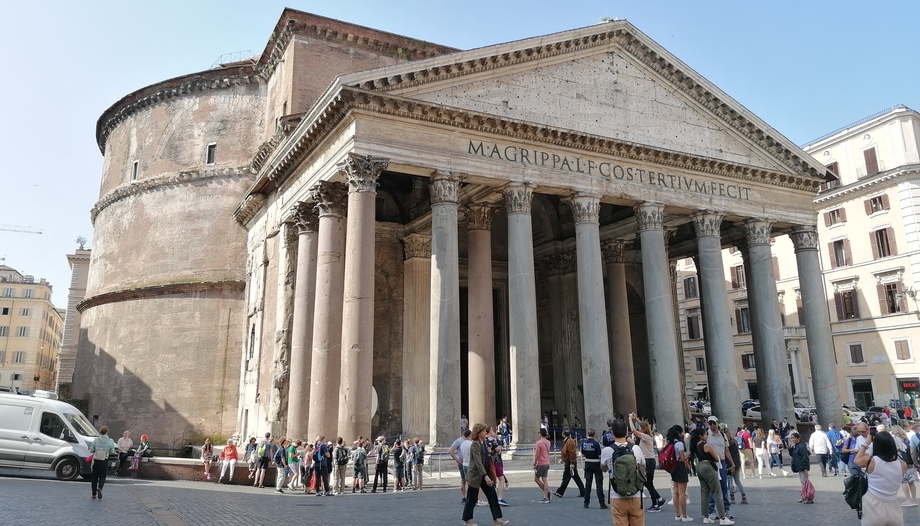
The present building is not the oldest. The first one was built by Marcus Vipsanius Agrippa between 27 and 25 B.C., but was destroyed by fire. Hadrian rebuilt it between 118 and 125 A.D., preserving Agrippa's original inscription on the pediment: M-AGRIPPA-L-F-COS-TERTIVM-FECIT.
What is immediately striking about the Pantheon is its simple perfection, or its perfect simplicity: a portico with sixteen pink and white granite columns, and then the rotunda (the square in front of it is called Piazza della Rotonda), that is, a cylinder topped by a hemispherical dome 43.3 meters in diameter, which is exactly the same as the interior height of the building: an ideal sphere.
In the center of the dome, the oculus: a circular hole of 8.7 meters, the only source of light. The oculus has no glass. When it rains, water enters but drains through the holes in the marble floor, without flooding the interior. When it is sunny, however, a circle of light moves slowly along the walls throughout the day like a giant sundial. It has been calculated that on the day of the Natale di Roma, April 21, the circle precisely illuminates the main entrance.
When there are few people, the atmosphere is incredible: the dim light filtering through the oculus creates a muffled, almost palpable half-light, and the acoustics reinforce that sense of protection, almost like an embrace in which sound and light come together in perfect harmony to welcome those who wish to enjoy a moment of tranquility in the midst of the bustle of the city.
609: from pagan temple to Christian church
In 609 A.D., Emperor Foca donated the Pantheon to Pope Boniface IV, who consecrated it as a Christian church: Santa Maria ad Martyres. This is probably why the building has survived intact to the present day, unlike so many other monuments of ancient Rome.
In fact, it was not touched: simply, the niches that had previously housed the statues and effigies of the Roman gods were converted into chapels of Christian saints.
Foca also donated to the pope a Byzantine icon of the Madonna and Child, which was probably already inside the Pantheon, adored like other sacred figures and is still kept there today.
As it is the time of Pentecost, we can recall what is still a centuries-old tradition in Rome: on Pentecost Sunday, the firemen climb the dome of the Pantheon and throw, through the oculus, thousands of red rose petals on the faithful gathered in the temple, to symbolize the flames of the Holy Spirit that descended on the apostles gathered in the Cenacle. This tradition dates back to the most ancient of Roman floral ceremonies, the Rosalia, which were celebrated in spring on the occasion of the feast of the dead.
The Arab pantheon converted into a temple of monotheism
Even the Kaaba of Mecca, that is, the stone cube around which the rites of Islamic prayer and the Hajj, the pilgrimage, are celebrated, was, in pre-Islamic times, a polytheistic sanctuary that housed statues and effigies of numerous tribal deities, including Allah, considered at that time as one of them. Pilgrims and worshippers from all over Arabia flocked to Mecca and the Kaaba, especially on the occasion of the poetic contests, in which famous local poets, representing the different tribes, gathered in the city to compete with wonderful verses and compositions: true Arabian poetic olympiads!
In 630, Muhammad conquered Mecca and ordered the destruction of the statues of the pagan deities, but not the structure that housed them, i.e. the Kaaba, and also ordered the preservation of the Black Stone and the rite of circumambulation around the quadrangular structure. Medieval Islamic sources, including Al-Azraqi, also report an important anecdote: inside the Kaaba, at the time of the Islamic conquest, the effigy of a Madonna and Child was found, which Muhammad did not destroy, but had it covered with a cloth. The historical veracity of this episode is a matter of debate, but it is entirely plausible if we take into account that Christianity had already taken root in various parts of the Arabian Peninsula, as had Judaism, that the Kaaba was precisely a pantheon for all the deities known and venerated in those places and that, above all, the veneration of Mary would have been maintained in the Islamic era, to the point that the mother of Jesus was the only female figure explicitly mentioned in the Koran.
That Arab Pantheon was destined for the same continuity as its Roman counterpart, and precisely in the same century, since Boniface IV, a few years before Mohammed, had left in the new Christian temple only the image of the Virgin, after having removed the pagan idols.
For those of us who live in our times, marked unfortunately, as already mentioned in a previous article, by fundamentalisms of every tradition, polytheistic societies, Rome in the first place, may seem more inclined to religious tolerance. The theological basis of polytheism, in fact, is that of the coexistence of many divinities. Moreover, in the so-called “interpretatio romana”, it was always better to have one more! The foreign divinity, therefore, was integrated and assimilated (from the Greeks to Mithras and other Eastern cults, including Christianity itself).
Monotheism, on the other hand, starts from the opposite assumption: there is only one God, all others are false. This would be, according to various scholars, the cause of the monotheistic drift of religious intolerance: not a cultural pathology, but the consequence of an exclusive revelation. David Hume and other thinkers such as the philologist Maurizio Bettini, who, in his In Praise of Polytheism, defines polytheism not as “more primitive” than monotheism, nor less complex, but simply different.
Obviously, it is not a question of making an apology for polytheism, among other things because each form of polytheism and each form of monotheism should be analyzed separately and in depth.
The dome and the world
The dome of the Pantheon held, for more than 1,300 years, an unbeaten record: the largest unreinforced concrete dome (lightened towards the top with tuff and pumice stone) ever built and preserved intact.
It was the inspiration for the builders of Hagia Sophia in Constantinople, Isidore of Miletus and Anthemius of Tralles, between 532 and 537, with the difference that the dome of the Pantheon covers a circle, while that of Hagia Sophia covers a square, which caused the collapse of the first dome of Constantinople in 558, later rebuilt.
The Pantheon was only surpassed, as we have already written, by Filippo Brunelleschi in 1436, with the dome of Santa Maria del Fiore in Florence, but the model continued to be imitated all over the world: Villa Capra in Vicenza (Palladio), the Rotunda of the University of Virginia (Jefferson), the Capitol in Washington, the Pantheon in Paris and the Basilica of San Francesco di Paola in Piazza Plebiscito, in Naples, and its form became an architectural symbol not only religious, but also political and cultural.
Raphael, the kings and the memorial of a nation
The Roman Pantheon itself, in addition to being an ancient pagan temple and a Christian basilica, is a memorial to the culture and history of Italy. In 1520 Raphael Sanzio was buried there, whose epitaph, attributed to Pietro Bembo, reads: “Here lies Raphael: of him, when he lived, nature feared to be vanquished; now that he is dead, it fears to die with him”.
In 1878 Vittorio Emanuele II, the first king of Italy, was buried there, followed by Umberto I in 1900. This allowed the Pantheon to become also the civil shrine of the young Italian nation.
The Pantheon: four functions, four eras, four value systems that have coexisted over the centuries in harmony under a dome open to the sky.




 Español
  English
  Italiano