


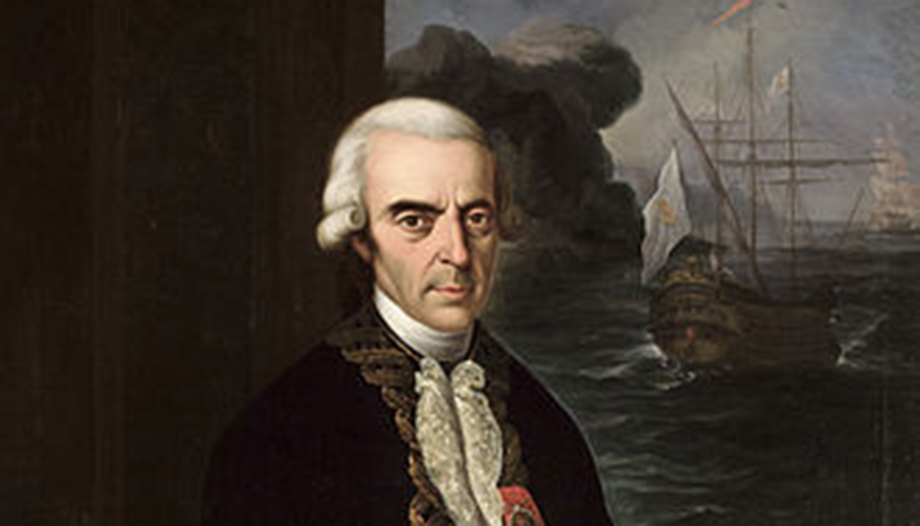
Antonio Ulloa (January 12, 1716 – July 5, 1795) was born in Seville into a deeply religious family. Two of his sisters became nuns, and another brother became an Augustinian friar. As for him, he studied at the Colegio de Santo Tomás, run by the Dominican Fathers.
He joined the Spanish Navy at a very young age, and at just eighteen he was commissioned as a lieutenant. At that age, he set out alongside Jorge Juan on the famous expedition organized by the Paris Academy of Sciences to measure the arc of the meridian at the equator, in what was then the Viceroyalty of Peru. After completing the main measurements, Ulloa remained in South America for more than a decade, compiling valuable astronomical, geographical, and natural data. There, he became the first person to scientifically document platinum, a metal he later introduced to Europe, and it appears he was also the first to observe the southern auroras.
His reputation as a scientist grew rapidly: he was admitted to the academies of sciences in London, Paris, Berlin, Stockholm, and Bologna. Upon his return to Spain, he held prominent positions in the Navy and in scientific administration, organizing the first Cabinet of Natural History and Metallurgy, the precursor to the current National Museum of Natural Sciences. He also promoted the modernization of the printing press and the production of highly accurate maps and nautical charts, which were essential for Spanish navigation.
Ulloa always displayed a clear Catholic identity. He was a knight of the Orders of Santiago and Calatrava, and he knew how to interpret natural discoveries in harmony with the faith. For example, he interpreted the marine fossils found in the Andes Mountains as part of a gradual process of natural history compatible with the Bible, in line with other enlightened Catholics such as Father José Torrubia. Ulloa, a key figure within the 18th-century Spanish Universalist School, embodies the synthesis of a sailor, a scientist, and an enlightened Catholic: a man who served his country and contributed to the progress of science without ever abandoning his faith, convinced that both pursuits—the pursuit of human knowledge and the pursuit of God—complement one another.
Public University of Navarra and SCS-Spain / Researcher at the CSIC.





 Español
  English
  Italiano
  Français
  Deutsch
  Polski
  简体中文
简体中文