



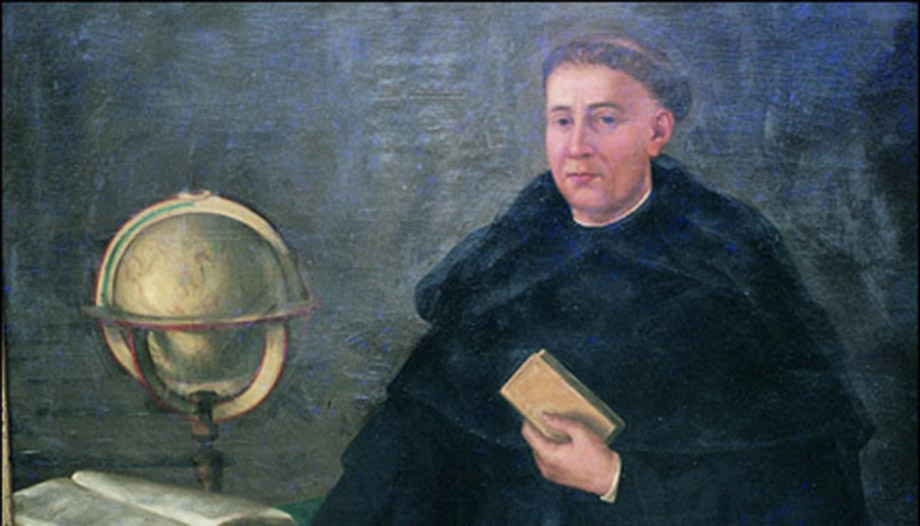
Martín de Rada (July 20, 1533 - June 8, 1578) was born in Pamplona into a noble family who sent him to study with his brother at the University of Paris, where he studied Greek, mathematics, physics, natural sciences, geography and astronomy. De Rada proved to be an outstanding student and later continued his studies at the University of Salamanca. However, he finally opted to enter the Augustinian convent (1554). It was a great change of course, although he returned to the University of Salamanca, this time to study theology.
He then enlisted in the missions. Mexico and the Philippines were his destinations. It was in the latter place that he demonstrated his scientific knowledge. He had not completely abandoned what he had learned before becoming a friar. He took with him the book of Nicolaus Copernicus, De revolutionibus orbium coelestium, The Spanish had already conquered the islands and began their evangelizing work, but the Portuguese arrived claiming jurisdiction over them in accordance with the Treaty of Tordesillas. The Spaniards had already conquered them and started their evangelizing work, but the Portuguese arrived claiming their jurisdiction in accordance with the Treaty of Tordesillas. Then Martin de Rada, with the help of the work of the Polish astronomer, deduced that the Philippines, the Moluccas and Japan fell within Spanish territory.
With today's more precise astronomy, it is known that this is not so, but that scientific demonstration was useful at the time and showed the great knowledge of the Augustinian friar. In fact, one of his works is entitled “De latitudine et longitudine locorum invenienda”, “On how to find the latitude and longitude of places”. Martin de Rada also stood out as a defender of the rights of the indigenous peoples against the abuses of some colonizers, he was elected provincial of the Augustinians in Manila, and was even part of the first Spanish embassy to China in 1575, where he was received with honors and wrote a famous Relación del Reino de la China, in which he described its provinces, riches, customs and religion. This work was the first to identify contemporary China with Marco Polo's Cathay. He is also credited with pioneering attempts to create vocabularies of the Cebuano-Chinese languages.
Public University of Navarra.
Society of Catholic Scientists of Spain






 Español
  English
  Italiano
  Français
  Deutsch
  Polski