


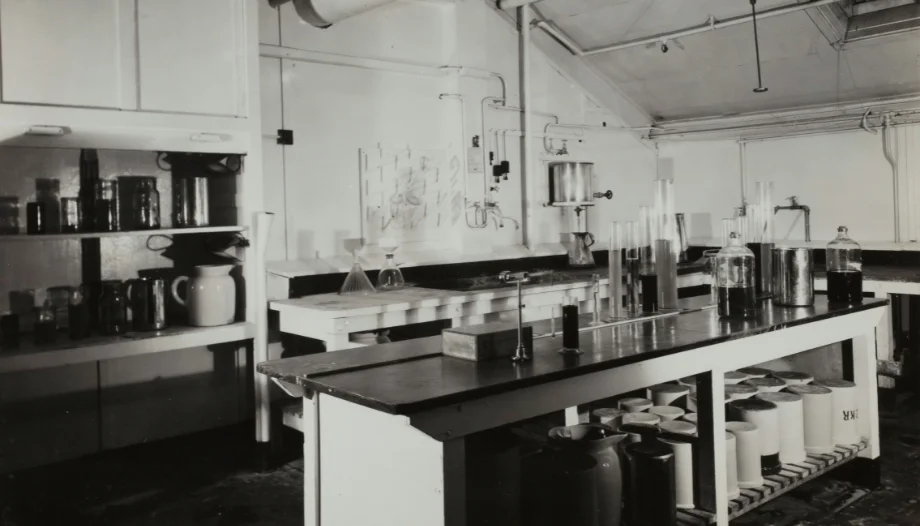
María del Pilar Aznar Ortiz (1914 - 2005) was a microbiologist from Madrid who lived all her life near the Basilica of the Christ of Medinaceli, in Madrid, to which she was so devoted that she visited it daily on her way to and from work. She also belonged to the Catholic Action Youth, was a Slave of Our Lady of Almudena and contributed to the support of the Catholic Church with abundant alms during her life.
Pilar attended high school at the Instituto Escuela, and graduated in Pharmacy in 1941. She then came into contact with the Consejo Superior de Investigaciones Científicas (CSIC) under the direction of the CSIC's founding vice-president Juan Marcilla Arrazola, like her a fervent Catholic. Thus she became the first non-teaching female scientist and microbiologist at the CSIC.
Pilar studied how to produce yeasts for human and animal food or various aspects of the influence of physical agents such as ultraviolet light on pathogenic bacteria. She also analyzed the biochemistry of the vinification of sherry wines, which spend time in contact with the veil-forming yeasts in the barrels during the aging phase. At the same time, he collaborated in the study of citric fermentation, a line of research at Marcilla, and defended his doctoral thesis in 1945.
He also presented new methods of analysis to the International Office of Vine and Wine (OIV). Much of his scientific production was disseminated in the National Congress of Microbiology and in the journals Spanish Microbiology y Work of the Biology Laboratory, Santiago Ramón y Cajal, both published in Madrid.
In 1946 she took up a position as Scientific Collaborator. Shortly thereafter, she participated in the founding of the Spanish Society of Microbiology (SEM), which started with only five female founding members, one of them Pilar. She was also lucky enough to contribute with her work to the institutionalization in Spain of microbiology as a scientific branch, as she was the founding scientist of the Institute of General and Applied Microbiology (IMGA) of the CSIC in 1946, and promoted the scientific profession to the female world.
Spanish National Research Council (CSIC).






 Español
  English
  Italiano
  Français
  Deutsch
  Polski