



 The Church as defender of truth: Newman, Plank, Spaemann and RatzingerObituary: Tatiana Goritchéva, a brave womanThe last days of Orwell
The term McCarthyism refers to accusations of disloyalty, communism, subversion or treason in which there is no due respect for a fair legal process where the human rights of the accused are considered.
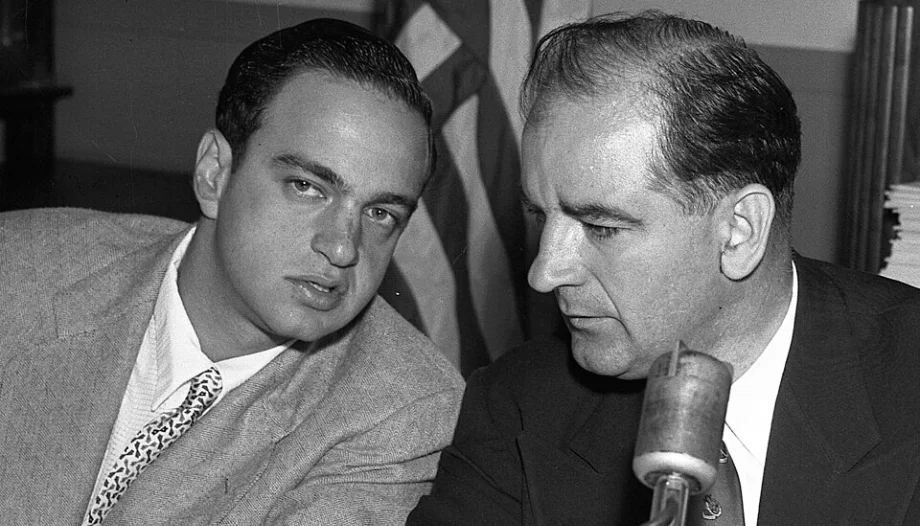
It has its origins in an episode of U.S. history that took place between 1950 and 1956, during which Republican Senator Joseph McCarthy (1908-1957) unleashed a process of declarations, unfounded accusations, denunciations, interrogations, irregular processes and black lists against people suspected of being communists. The sectors that opposed McCarthy's irregular and indiscriminate methods denounced the process as a "black list". «witch hunt», episode that was described, among others, in the play The Witches of Salem (1953), by playwright Arthur Miller.
What is McCarthyism
By extension, the term is sometimes applied generically to situations where a conservative government is accused of persecuting political opponents or failing to respect civil rights in the name of national security.
Joseph Raymond McCarthy was the fifth child of a large Catholic family consisting of his father, Timothy McCarthy (born to an Irish father and German mother), his mother, Bridget Tierney (Irish from County Tipperary, in the province of Munster), and seven children. Joseph was born on a farm in Grand Chute, Wisconsin, near the town of Appleton. He had to leave school at the age of fourteen to help his family in farming. When he was able to resume high school, he was able, thanks to his natural intelligence, to graduate in only one year, at the age of 21.
He first studied engineering, without finishing his degree, and later studied law at Catholic University (run by the Jesuits) in Marquette, Milkwakee, until he finished his degree in 1935, and was admitted the same year to practice law.
In 1936, working for a Shawano (Wisconsin) law firm, he ran for the Democratic Party for District Attorney but lost the election. In 1939 he ran for election to the position of judge of the 10th District Circuit and was elected, finding in his new position a considerable backlog of cases, which he struggled to clear up in sometimes unorthodox ways.
According to Pulitzer Prize winner David M. Oshinsky (A Conspiracy So Immense: The World of Joe McCarthy) Judge McCarthy rounded out his income through his gambling, which is at least partly explained by the difficult economic conditions in America as it struggled to emerge from the Depression.
In 1942, and despite the fact that his profession made him exempt from military service, McCarthy enlisted as a volunteer in the U.S. Marine Corps. He would later declare that he chose this corps because he considered it the destination that could best help him in a political career that he had already decided to pursue. Because of his position as an experienced judge, he automatically earned the stripes of officer - second lieutenant, equivalent to ensign - after his period of training. He served as an information officer in a bomber squadron on Solomon and Bouganville (Solomon) Islands, and was discharged with the rank of captain. It has been shown that McCarthy subsequently lied repeatedly about his military career.
The McCarthy Legacy
He later served as a U.S. Senator representing the state of Wisconsin from 1947 to 1957. During his ten years in the Senate, McCarthy and his staff became famous for pursuing individuals in the U.S. government and others suspected of being Soviet agents or communist sympathizers infiltrating the civil service or the military.
Given to drink, Senator McCarthy miscalculated his strength in trying to investigate the military in 1953. That same year, as chairman of the Senate Subcommittee on Investigations, McCarthy continued his allegations of Communist activity and influence - which came to affect President Eisenhower - and in April 1954 accused the Secretary of Defense of covering up foreign espionage activities. Republican President Dwight D. Eisenhower decided to act against him. The awareness that this «witch hunt» endangered the essence of democracy also led the leaders of his own party to allow a motion of censure against him to prosper in 1954.
That same year, McCarthy lost what little prestige he had left when the Senate hearing against Army officers for alleged communist activity was broadcast on television. His demagogic and brutal style was exposed. He continued for another two years in his duties as senator, but his colleagues avoided him, and what happened weighed like a burden on his spirits and health. His biographers point out that, after the reprobation, he was never the same; hospitalized at the Bethesda Naval Hospital for chronic alcoholism problems, he died at the age of 48, victim of cirrhosis and hepatitis.
There is an ancient ethical principle that the end does not justify the means. Unjust methods should never be used to achieve supposedly good ends. Not even in politics or in business, under the excuse that it is a very difficult world where everyone uses them. Using immoral means (lying, treating people badly, exercising a Bonapartist style of government) may seem profitable in the short term, but in the long run it always turns out badly and the damage done is far greater than the supposed good pursued. The McCarthy case should not be forgotten.







 Español
  English
  Italiano
  Français
  Deutsch
  Polski
  简体中文
简体中文