



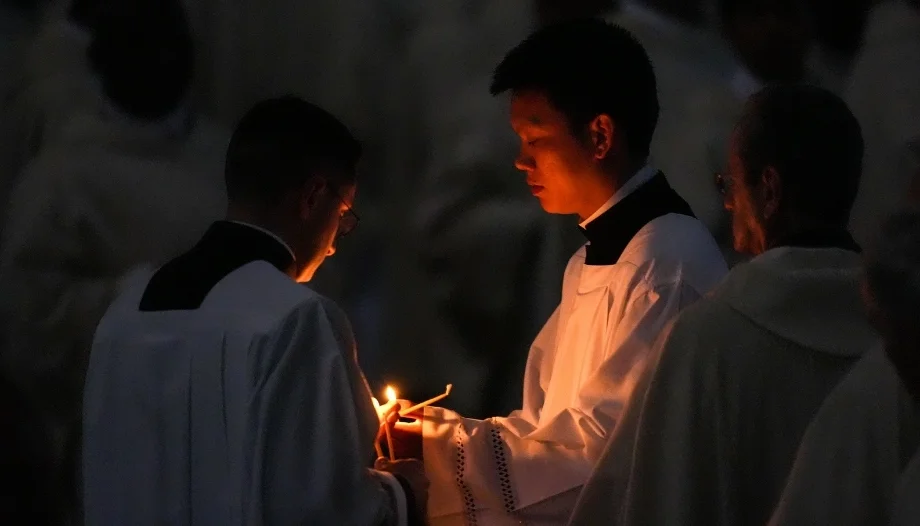
Pope Leo XIV, in his first homilies and in his catecheses for the month of October 2025, frequently insists on the fact that «the paschal mystery is the axis of the Christian life».». Its message, although simple, contains an important revolution: “The Easter proclamation is the most beautiful, joyful and moving news in history.”. However, many believers live their faith looking more to Good Friday than to Easter Sunday. The cross occupies their horizon, but the light of the empty tomb is too dim.
This observation opens a profound question: do we live as if Christ had risen or as if he were still in the tomb? The whole spiritual life is at stake in this difference. There are pre-Easter Christians, who live the faith from fear, norm and renunciation, and Easter Christians, who live it from love, hope and joy. It is the same faith, but breathed in a different way.
An anecdote will help us understand this. In 1985, Prince composed Nothing Compares 2 U, but this song went unnoticed. The voice was very good, but it was accompanied by chords that were a bit rough. Five years later, Sinead O'Connor performed Prince's song with such deep emotion that it became a world anthem. The melody and lyrics were the same; the soul was different. The same could be true of Christianity: some live it in a minor key, somber and fearful; others sing it in a major key, joyful and hopeful.
Faith before Easter: the weight of fear
The disciples of Jesus before the Resurrection represent the pre-Easter mentality. They followed him, loved him, admired him, but did not understand his message. When he told them about his death and resurrection, they only heard the first part. The cross was understandable to them; the victory over death was not. Their way of thinking betrays many shortcomings: they fight to see who is the greatest in the kingdom of heaven, they urge to cast fire from heaven on a people, or they prevent children from approaching Jesus. This way of believing is that of one who trusts in God, but has not yet discovered the transforming power of his love. Psychologically, this attitude is sustained by the desire for control that encompasses even one's own path to holiness.
For these Christians, wisdom and prudence continue to be Aristotelian dianoetic virtues, leaving little room for the action of the Holy Spirit who claims to have all the hairs on our head numbered. This believer seeks security, needs rules and certainties. His religion becomes a system of self-protection and the rules give him order, but not life. Faith is reduced to effort, fulfillment or merit and the norm or rule is fulfilled unconsciously, almost with a Kantian morality of “should be”. One lives with moral tension, as if the love of God depended on spiritual performance. It is a tired spirituality, which prays from fear and confuses obedience with trust. And all this is nothing more than succumbing to a subtle temptation against faith and hope. He asks favors from God, but negotiating in a mercantile way: if you give me I give you, and he becomes impatient if things do not turn out as he expects. He needs proofs and the mystery makes him uneasy. He forgets what the book of Wisdom teaches: “God manifests Himself to those who do not demand proof from Him and reveals Himself to those who do not distrust Him.” (Wis 1,2).
This mentality also generates a way of suffering. Those who live faith as an obligation interpret pain as punishment. The cross becomes a debt to be paid, not a redemptive embrace. The believer thinks that pain is a guarantee of holiness and distrusts joy, as if enjoying the things of the world were almost a sin. They think that every time they sin they sacrifice Jesus again, remembering the attitude of Moses who struck the rock twice in Meriva, and as a consequence did not enter the Promised Land. God is only struck once, he only dies once. Once Jesus is resurrected, he is spoken to, not struck, as God told Moses to speak to the rock before the water came out (Exodus 20). St. Paul confirms it: “we have died to sin on the cross. Jesus dies only once” (Romans 6:5-16).
But can a good father want his children not to enjoy the gifts he himself gives them and want to take them away immediately? Do we really think that God acts this way? The emotional consequence is obvious: anxiety, rigidity and sadness. Some Christians live in a kind of permanent Lent, struggling, but without joy. They find it difficult to enjoy life, their family, their work, even prayer. They compare themselves, they judge themselves, they always feel at fault. They have turned faith into a moral burden, when it should be an experience of freedom. Thus, religiosity is impregnated with guilt and fear. The habituation with the things of God is a frequent warning where the pious lie and reckless judgment is at ease in this mean-spirited mentality. And I wonder is it possible to get used to being with God? If so, then we should be bored when we are in Heaven. If one is really with God, it is not possible to get bored or get used to it! With God there is no getting used to it, there is a lack of faith and hope that leads to sadness.
Pope Francis, in Evangelii Gaudium, he warned: “Some Christians live a Lent without Easter.”. It is the spirituality of effort without rest, of duty without gratitude. Those who live this way are more afraid of making mistakes than of not loving. He looks at life with distrust, fears change, avoids risks and is unaware of “love and do what you will”. Pope Leo XIV summed up the pre-Easter attitude with a phrase from St. Isaac of Nineveh: “The greatest sin is not believing in the energies of the Resurrection.”. The great enemy of the spiritual life is discouragement and nothing produces more discouragement than not leaning on the risen Jesus and the hope of Heaven. The Christian faith was not born to protect us from life, but to launch us to live it with confidence.
The logic of the Resurrection: faith that liberates
In the face of this rigidity, the paschal mentality emerges as a new form of “breathing”. It is the faith of the disciples themselves, but after the Resurrection, when they understood that death was not the end, but the beginning. Their fear was transformed into joy; their guilt, into mission; their sadness, into praise. The Easter Christian has experienced God's passage through his life. He has discovered that grace is neither negotiable nor deserved: it is received and he no longer sees himself as a servant but as a son. And this awareness changes his whole psychology. He no longer measures himself by what he achieves, but by what he loves. He no longer seeks to control, but to trust. From the human point of view, it is the passage from the religion of effort to the faith of encounter. In the first, the person lives pending on his works; in the second, he rests on the love he has received. This does not generate passivity, but inner freedom. He who knows he is loved acts better, not out of fear, but out of gratitude.
Easter faith does not ignore pain, but interprets it differently. It integrates it into the history of personal salvation. It knows that suffering does not destroy, but matures, and to refuse to believe in the power of God's love is to remain locked in the night of Good Friday. The Easter believer trusts, prays without anxiety, is grateful for what he has, laughs at himself. He lives with spiritual freedom, not because he does not suffer, but because he knows that evil does not have the last word. Humor becomes a sign of Christian maturity: he who trusts in God can allow himself to smile in the face of his own weaknesses. In daily life, this mentality also translates into more human relationships. The Easter person does not judge so much, does not impose, does not impose, does not pressurize, does not constrain. His faith is communicated by attraction, not by conviction, because he lives with joy and contagious serenity. As Von Balthasar said, “love is only credible when it is beautiful”.
In the Mass, the Easter person does not remain in the sacrifice, but celebrates the encounter with the living Jesus Christ. It recognizes that in the Eucharist we do not witness a repeated tragedy, but the living presence of Jesus who unites Heaven and earth. Communion is the kiss of God to the soul as quoted in the Song of Songs. It seems to be the same encounter between the risen Jesus and Mary Magdalene. The same expressions are repeated and the place and time are the same: in a garden, in the evening and in search of her beloved (Song of Songs 1, 2). The liturgy ceases to be a duty and becomes a loving appointment and recognizes that the Passover meal does not end at the Cross but in Heaven, when Jesus takes the new wine, the fourth cup, in the Kingdom of his Father (Mt. 26:29).
From control to trust: an inner transformation
About ten thousand confraternities in the world focus on celebrating the Passion of Jesus and about five hundred on the Resurrection. And I ask myself again: can someone who truly feels himself to be a disciple of Christ, who pretends to attract others and to be the light of the world, but who fundamentally only preaches a suffering God who has died, make the Christian religion attractive? The passage from the pre-Easter mentality to the Easter mentality does not happen overnight. It is a vital process, often painful. It happens when security collapses: a loss, an illness, a personal or professional crisis. In that void, the believer discovers that only God's love matters. It is then that he or she deeply understands Easter. From the psychological point of view, it is about moving from the religious ego to the trusting self. The spiritual ego needs to control everything, even the relationship with God. It wants to be perfect, to accumulate merits, to master faith as if it were a technique. The trusting self, on the other hand, abandons itself, knows it is weak, but is sustained, and God wants to give us life “and that they may have it more abundantly” (John 10:10). It is not a matter of surviving or of going along for the ride. To go along is not Christian.
Such reconciliation produces serenity, gratitude and a sense of humor. Whoever lives the inner Easter does not cling to the past or fear the future. He has learned to look at life with tenderness. He knows that mistakes do not define him, that pain does not annul him and that God's love does not depend on his performance. An example of this spiritual maturity is in Joseph, the son of Jacob. Sold by his brothers, years later he forgives them and says to them: “You thought to do evil to me, but God changed it into good.” (Gen 50:20). This phrase sums up an entire paschal psychology: to discover the good hidden in evil, the light in the wound. This attitude has not only spiritual but also psychological effects: those who live with confidence develop greater resilience, face pain without sinking, and preserve inner peace. He does not flee from reality, he embraces it. He knows that God does not eliminate problems, but transforms them from within.
However, in order to maintain this mentality, humility becomes an essential virtue. Without it, one returns immediately to the desert, to the continuous “Lenten” exodus, desiring to return to Egypt: “Therefore let him who thinks he is secure beware of falling” (1 Corinthians 10:12). He feels like a child before God in such a way that spiritual childhood gives a lot of security. Now, he does not consider himself a saint, but “All to know him, and the power of his resurrection, [...]. Not that I have already attained or am already perfect: I press on, that I may attain to him, as I have been attained by Christ” (Philippians 3:10-12).
The joy of Easter
In the early Christian communities, Easter believers were easily recognized. They were joyful and serene, but not cold. They radiated a peace that did not depend on circumstances. In them the Pauline exhortation is fulfilled: "Rejoice in the Lord always." (Phil 4:4). Their joy is born of gratitude. They live from the risen Jesus and the Holy Spirit reminds them of this frequently. They see life as a gift, not as a burden. They do not speak much about God because they make him transparent in their lives. They enjoy the simple: a meal, a conversation, a job well done and have no difficulty in recognizing God in creation. They do not separate the sacred from the human, because they know that everything human can be sacred when it is lived with love. Finally, they know that Jesus did not come to say “love your neighbor as yourself” as described in Leviticus 19:18, the classic golden law, but that He came to tell us to love one another as He has loved us (John 13:34), which we could define as the platinum law.
One priest told us, with a contagious smile, that he did not marry “because my heart is so in love with God that I cannot give it to a woman”. This answer sums up the secret of the Easter Christian: a heart full of love for God does not need any more possessions and knows how to love without holding back. He does not deny the cross, but goes through it with hope and understands that without the cross there is no Easter, but also that without Easter the cross has no meaning. The spiritual life then resembles the movement of the heart: contraction and expansion. If we remain only in renunciation or effort, the soul suffocates. Resurrection is the great expansion of the soul.
Living from the sun, not only from the roots
The paschal mentality is not a theological theory, but a way of living. It means looking at existence with trust and accepting imperfection, discovering God in everyday life. It means moving from guilt to gratitude, from rigidity to tenderness, from complaint to amazement. The Easter Christian is not naive: he knows pain, but he does not remain in it. He knows that all suffering, embraced with love, is transformed into fruitfulness. And for this reason he can smile even in the midst of trials. To believe in the Resurrection is not to accept a past event, but to allow its power to act today in concrete life. It is to allow hope in Heaven to become a habit and joy to be the natural tone of the soul. This joy does not ignore the cross, but illuminates it. It has some roots in pain, but happiness blossoms with the hope of the possession of Heaven that the living Jesus gives us.
To live in an Easter key is to live reconciled with one's own history. It means opening one's eyes every morning and saying: “Today Christ is risen in me too. It is to look at the world with gratitude, to accept fragility as a place of encounter with God and to let the sun of grace illuminate every corner of the soul. Those who live in this way do not need to proclaim it in words: their very life becomes a proclamation because the Easter Christian does not simply repeat that Christ is risen: he shows it.
Full member of the Royal National Academy of Medicine of Spain.






 Español
  English
  Italiano
  Français
  Deutsch
  Polski
  简体中文
简体中文