


Recently when Pope Leo XIV was asked to his four favorite films. He replied quite directly, stating that they were “It’s a Wonderful Life” (1946), “The Sound of Music” (1965), “Ordinary People” (1980), and “Life Is Beautiful” (1997).
For context this question was posed to him on November 15th, during an event organized by the Vatican’s Dicastery for Culture and Education in close collaboration with the Dicastery for Communication and the Vatican Museums.
Seen together, the four films reveal an interesting moral connection. Each is centered on human resilience and the affirmation of life in the face of profound suffering. Their protagonists are placed in moments of emotional, social or existential crisis or they are confronting despair, war, guilt, oppression, and are forced to rediscover meaning when stability and certainty have been stripped away.
Each of these films also explore how love and responsibility to others grounded in moral integrity became the formula in which life regains meaning. Thus, it promotes a resolution which celebrates the dignity of life. Instead of choosing despair or suicide, the characters in these films show how suffering can be endured and even transformed through one's family, relationship with others, via sacrifices and when based on hope.
It's a Wonderful Life
In the film, “It’s a Wonderful Life”, George Bailey, played by actor James Steward, considers ending his life as he gets ready to jump into a cold river below during Christmas. The reason? Years of personal sacrifice with nothing to show for it with his moral strength exhausted due to a world ruled by money. Through no fault of his own, Bailey faces the risk of losing his house, wealth, reputation and being seen as a failed father all because his business partner, accidentally misplaced business funds, needed to sustain their bank. An angel, named Clarence, taking the form of a human, is sent to Bailey who shows him what the world would look like if he was never born. Seeing that his parents, wife and the local community who he supported over the decades would be worse off had he never existed. He is determined to keep living.
In essence, the film is about the true strength and power of empathy in the context of social fraternity. Its core message “No man is a failure who has friends”, remains a touching line and a firm reminder of the importance of friendship and community support in times of personal or economic struggle.
The Sound of Music
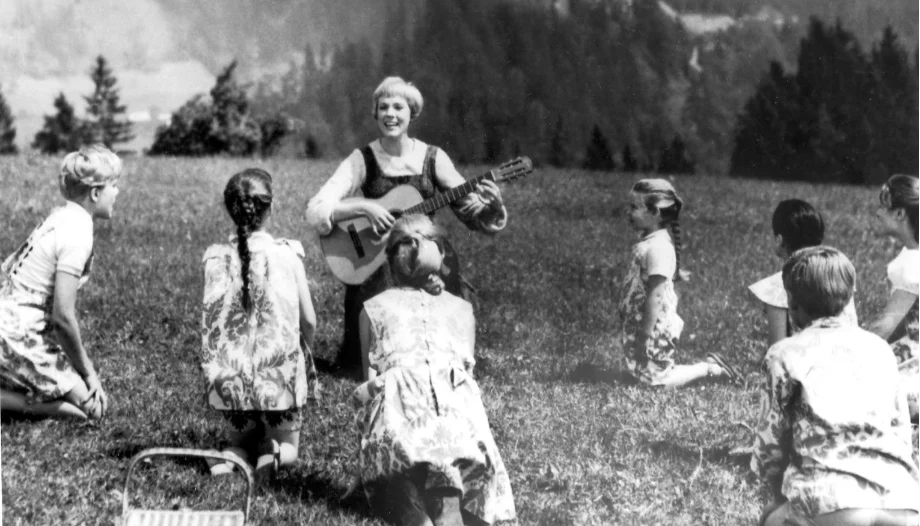
When viewing “The Sound of Music”, most audiences regard it primarily as a story about family values set against the backdrop of the early stages of World War II. Yet beneath its familiar surface lies a quiet form of social and moral resistance, embodied above all in Maria, portrayed by actress Julie Andrews. She is not merely a playful, free-spirited governess who delights in song, but a woman who deliberately chooses joy as an act of defiance during the grim period of Austria’s Anschluss, as Nazi Germany absorbs the country.
The film’s musical numbers become expressions of human freedom and emotional integrity, rooted in the warmth and stability of family life, suggesting that even in times of fear and political darkness, singing together in harmony with loved ones can still sustain hope and point toward a life worth preserving.
Ordinary people
In “Ordinary People”, the quiet anguish of suburban American life becomes the setting for a profound meditation on suffering, guilt, and the human need for mercy. The film follows Conrad Jarrett played by actor Timothy Hutton, burdened by the trauma of surviving a boating accident that killed his older brother, and by the emotional coldness that follows him home.
It is ultimately a film about the necessity of truth and reconciliation. Healing begins only when suffering is named and shared and by the film's conclusion, the audience understands that in most cases, redemption is not dramatic or triumphant but fragile and real.
In the film's case, Conrad's father learns to love his son without conditions, while Conrad learns to accept his survival as a gift rather than a guilt he needs to reckon with. Reminding viewers that grace often works silently, over time and when we respond positively towards the truth.
Life is beautiful
“Life Is Beautiful” is set against the horror of the Holocaust seen through the radical lens of paternal love and self-sacrifice. Guido Orefice played by actor Roberto Benigni, is a Jewish father, who confronts an environment of systematic dehumanization not with denial, but with a deliberate act of moral imagination. He transforms their concentration camp into a “game” so that his young son might be spared terror and despair.
The film resonates deeply with the theology of redemptive suffering: Guido accepts suffering freely, not to escape evil, but to shield the innocent from its full weight. His humor, much like “Sound of Music”, is a form of resistance rooted in love.
The film’s power lies in its quiet martyrdom. Guido’s final act is not survival, but total self-gift, mirroring the Christian understanding that love is proven not only in words, but in sacrifice. The film affirms that even in the most godless circumstances, human dignity can be preserved through love, and that hope, when grounded in self-giving, can become a means of salvation for others.
Taken together, Pope Leo XIV’s choice of films forms something like a quiet moral syllabus for the modern age. None of these works deny the reality of suffering, nor do they offer escape through power, wealth, or ideology.
Instead, they insist that meaning is recovered through relationship, responsibility, and self-gift, through fidelity to others when circumstances make such fidelity costly. Whether it is George Bailey rediscovering his worth through community, Maria resisting tyranny through joy, Conrad learning that true truth and love require confronting grief, or Guido transforming horror into an act of paternal sacrifice, each film affirms that human dignity is preserved not by control but by love.
From this perspective, Pope Leo XIV's selections reflect a pastoral vision deeply attuned to a world marked by isolation, despair, and moral exhaustion. They suggest that, in an age tempted by cynicism and fragmentation, the most radical response remains the same as ever: to choose life, to bear one another's burdens, and to trust that even the most discreet acts of love can redeem a wounded world.
Journalist and essayist born in the United Arab Emirates and based in Lithuania. He is a contributor to Omnes, EWTN News and CNA Deutsch.






 Español
  English
  Italiano
  Français
  Deutsch
  Polski
  简体中文
简体中文