


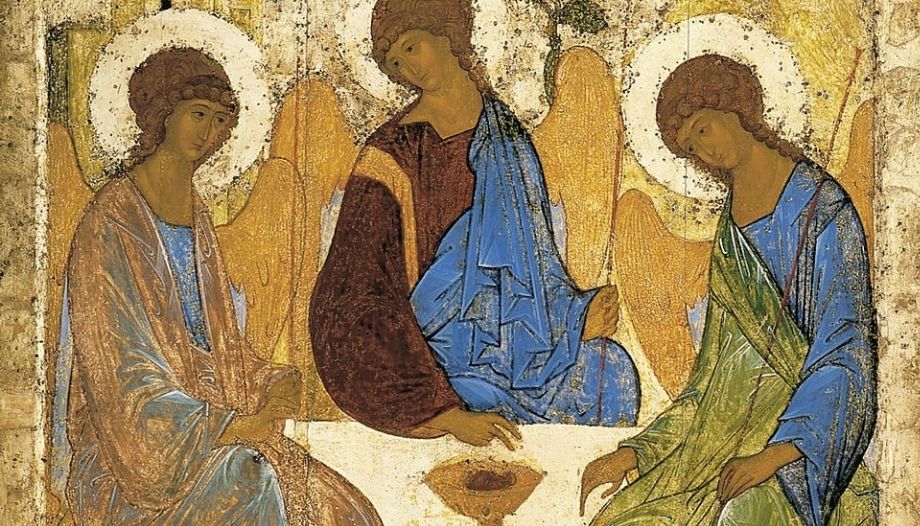
One of the most famous representations of the Trinity is Rublev's icon. Although it is not a narrative icon, but rather a contemplative one, I would like to focus on two details: God is family, he is Father, Son, and Holy Spirit, represented by three figures with youthful faces who seem to be enjoying peaceful dialogue. These three figures share a table. Is there anything more familiar than sharing a table? God is family, and God is familiar.
“Three persons and one beloved / among all three there was [...] / one love three have / whose essence was said to be: / that the more one loved / the more love there was” (St. John of the Cross). God is unique, but not solitary. This is the essence of God: a family that never stops loving each other. The Trinity is a constant overflowing of love. It is because of this overflowing of Trinitarian love that God created the earth and humankind.
Continuing with the metaphor of the table, God the family overflows with love and dwells among us and within us. “And the Word became flesh and dwelt among us,” says St. John in his Gospel. Further on: “If anyone loves me, he will keep my word, and my Father will love him, and we will come to him and make our home with him.”.
The place par excellence of God's family is the human heart, as the Catechism beautifully reflects. The Trinity, God's family, has made its home in our hearts, where heaven and earth meet. God overflows in my heart. The image of Rublev's icon is happening in my heart.
The indwelling of the Trinity in the heart
The indwelling of the Trinity within my heart is something so universal that not only is it beautifully expressed by Saint Augustine of Hippo or Saint Teresa when speaking of the dwellings, but it is also intuited and sung about by Rigoberta Bandini in her song “Too Many Drugs.” She states that she is always “trying to understand things that have to do with being” and concludes that “in the end, it all comes down to looking, that inside I have a royal palace, full of rooms to skate in.”.
If we learn to look within our hearts, we find ourselves in the Home of the Trinity, in the dwelling place of the Triune King, and with His grace, we have a palace full of rooms to skate in.
And once God is in my heart, does the overflowing love cease? No. This loving union in our hearts overflows and spills out, because the Trinity continues to overflow. And this heart, yours and mine, inhabited by the Trinity, where does it manifest the overflow of its love? In the thousands of little charms that home has (to paraphrase Silvio Rodríguez and his song “A dónde van”). If God is family, he will continue to overflow and leave his mark on the familiar.
The Lord walks among the pots and pans.
Today I came home from work as usual, with my computer bag, gym bag, and lunch box under my arm. After saying hello to my roommate, we decided to have dinner together. Yatekomo and a salad with whole wheat bread was the menu laid out on a white Ikea table, with a Chinese esparto grass placemat. We talked about our day, our plans for the future, and some deep concerns, and then we went to bed.
As I have in mind the indwelling of the Trinity, and its overflowing and expression in my reality, I am left thinking that “the Lord walks among the pots and pans.” I look at Rublev's table and then at my Ikea table and think about the charms of home. What would the Saint say now about the yacht? Does the Lord still dwell among the ready meals, the endless schedules, the infinite agendas, and the prefabricated tables? I certainly want to think so, and I will try to explain it.
After creating the world and humankind (we have agreed that He did so out of an overflow of His familial love), the Trinity gives us some keys to participating in that loving current. Genesis tells us that God placed humankind in the Garden of Eden “to work it, cultivate it, and care for it.”.
A digression: a broader view of the concept of work
I would like to make an important point here. We need to get rid of the idea of work that comes to mind, that thing I get paid for or where I am exploited, that thing my resume says I know how to do... and I encourage the reader to take a much broader view of the concept of work. Perhaps the definition of work we learned in high school physics class fits here: work is anything that exerts a force and produces a displacement or transformation.
Therefore, brushing my teeth, making the bed, raising my hand to greet someone on the street, putting on my socks, picking up my little boy, letting my grandfather lean on me, playing paddle tennis, eating, writing a poem, organizing the ideas in my head... everything is work, and we must consider it as such. End of parenthesis.
A divine conversation
God the family (r) tells us in Genesis to care for and cultivate the earth, to make it familiar, to take the world and make it our own, to turn it into a home. This is an important key. God the family (r), from Rublev's icon, is happening in my heart and asking me to do the same in my concrete, everyday reality.
We can imagine (purists abstain) God the Father chatting lovingly with the Son and the Spirit during that long after-dinner conversation, being a Father who loves surprises, saying to his Son: “Have you seen that soup Mary has made? She's worshiping me with it, it smells spectacular from here. Have you noticed Javier's crying? That's what I call crying with gusto; his tears bring me glory. And what about the disastrous report Teresa has presented? But she has made an effort... even disasters can worship me. And what about how well Victoria has dusted today? Have you seen it, Jesus? It was inspired by the Holy Spirit... what a rascal.”.
God the Father is the God of surprises, who every day gives us the world to care for and cultivate and give him a great surprise, which is to worship him. He is chatting at that table, waiting to see how, with its fruits, transformed by our work (in the broad sense, not just our profession), we worship him and fulfill his command: to care for and cultivate the Garden of Eden.
From home to home: from table to table
Another key that our family God gives us through his Son, which has a lot to do with family, is Holy Mass. “Gathered around your table” is a song we all recognize. At Holy Mass we are all gathered together, as God's family, around a table where there is room for everyone, as in the best families.
On the table we have bread and wine. I want to pause here. If God were not a God of surprise, he would have instituted Holy Mass with wheat and grapes, fruits of his own that the earth produces (though not without our work), but he wanted to make even more evident that he is a God of surprise who wants to need our transformation, our work, to come and dwell in him. With all the risks that this entails: that the bread may be defective, that the wine may be spoiled, and so on and so forth.
God does not want my perfection, but my love, my worship with what I have, working for love and giving it to him. He will come and dwell in it, and more than that, he will become bread and wine on a table to feed me. Is there anything more familiar than feeding your family with bread and wine?
At Mass
Our family God gives us the key in Holy Mass. The family Trinity overflows from your heart into the reality you touch. And you touch reality because you have “seen everything” in Holy Mass. What can we see in Holy Mass?
1. Holy Mass takes place in a sacred space., usually in a church. There is the Trinity overflowing and we worship it through specific decorations, lighting, light entering the building, sculptures or images, layout, cleanliness... and when Holy Mass ends, we all hear the words “Go in peace,” leave here and tell others what you have seen.
In Latin it is more precise, it says “Ite Misa est”, go out into the world to tell what you have seen, to do the same, to expand the family (and family values). God tells me: my Trinitarian presence is made visible through you. And one arrives home or at work and can then think about the arrangement of things, their harmony, whether there is light, whether there is cleanliness... I have learned that the harmony of the space I inhabit leads me to worship God, to make the space familiar. You are something like King Midas, that everything you touch, everything you work for out of love, God inhabits.
2. There are specific vestments for Holy Mass., The vestments of the priest, the altar, the pulpit, specific linens that have their purpose, their care for the Trinity. There are specific colors for festivities, higher quality vestments for solemnities, there are details that make up the Home.
We are flesh, just like God, who became flesh in Christ. Flesh needs to be clothed, sheltered, it has touch, it is capable of caressing. It is therefore fitting to follow the instruction when leaving, “Ite Misa est,” go and tell what you have seen, clothe yourselves in harmony, make yourselves beautiful, welcome the destitute as I have welcomed you, caress, heal wounds, clothe those who have no clothes, sew on a button, iron a shirt, fold some sheets, lay a tablecloth, even if it is plastic, have festive rituals because a friend, a son, a brother is coming.
3. In Holy Mass there is a specific meal, bread and wine.. I have already mentioned that it is a substance processed by man and not wheat and grapes. But the food of Holy Mass is special; it is the kiss of God, the family that nourishes us. The first thing each of us receives at birth is the kiss-food of our mother. We immediately seek to suckle from the breasts of our blessed mother.
Rigoberta sings it again in that provocative (not as much as a human Virgin breastfeeding a God) and profound song: “You who held your body tightly to my head, wanting to cry, but with strength... I don't know why our breasts are so scary, without them there would be no humanity and no beauty.” There, the act of kissing and eating merge into one, just as in Communion.
And after hearing the “Ite Misa est”? Kiss, because “all the kisses we give, all taste like You” as Siloé says. They all taste like Communion to me; that is where they originate. Show affection, and if the kiss is affection, at home that kiss is mediated by culinary culture. This culinary culture has a lot to do with domestic rituals, activities that allow us to glimpse the purpose of the family and feel its unity.
4. The times of Holy Mass are specific, There is a time for silence, a time for listening, a time for praying together, a time for walking to the table... What can this teach us? To cultivate time. Moving from time to ritual: this is expressed very well in a chapter of The Little Prince, when the Fox says to the Little Prince: “It would be better if you always came at the same time. If you come, for example, at four in the afternoon, I will begin to be happy from three o'clock. But if you come at any time, I will never know when to prepare my heart... Rituals are necessary.”.
Time can and should be tamed, cared for, cultivated, made into a home. Cosmic rhythms (day, night, seasons) harmonize with bodily rhythms (growing, eating, sleeping), and the internal time of the home is added. “Ite Misa est,” go forth, recount and tame what you have experienced, think about the importance of family time, of Sunday aperitifs where you always go, of coffee at the office at 12 noon, of celebrations, of home time, tamed, familiar, specific to each person. Only by taming time will we have it. Because the opposite of haste is not slowness, but having time.
Having time is the condition that makes care, study, imaginative daydreaming, and creation possible. While a fast-paced and saturated life weakens us, having time and room for maneuver is part of the health of good rhythms.
Home, a performance that brings love into play
Home is a performance that brings into play love and our talents for the encounter with the Beloved. With the thousands of charms that home and family have, we arrive at the contemplation of the Home par excellence, which is the Trinity. It is our way of
participate from the Son at the table of Rublev's icon. And only those who begin here below to recognize this Beauty will recognize the Beauty of Heaven, which satisfies without satiating, where we will finally be enveloped by Trinitarian love, seated together at the table.
Love as attention
Finally, I believe there is one characteristic that must be cultivated for all of this to make sense: love as attention. Simone Weil describes this concept. He talks about love and how it requires “putting down roots” in the other person and in reality, and for this, attention is essential. Only those who are capable of paying attention are capable of a loving gaze and are able to see beyond.
With an attentive, loving gaze, reality becomes beautiful, and we find traces of Beauty in everything, even in the midst of the greatest suffering. Loving attention makes us fly, makes us see that things are no longer “because they have to be that way,” but rather I glimpse the loving torrent of the Trinity and I want to join it. Attention to detail is no longer a kind of obsession or OCD, but is born of love and acceptance of reality.
It is this attentiveness that makes the beloved disciple the only one who recognizes the Risen Lord. St. John says: “Then the disciple whom Jesus loved said to Peter, ”It is the Lord!'".
Attention that appears in the Resurrection
That attention is the same as that which appears in the Resurrection: “Then the other disciple, who had reached the tomb first, also went in, and he saw and believed.” What was it that he saw and believed? What on earth must he have seen in the tomb to believe in that way?
A priest gave me an explanation: through the attentive gaze of the beloved disciple, he saw the folded shroud. We know that the Jews were very clear about the Passover ritual, with its cups and psalms at every turn. We also know that Jesus left the last cup undrunk, which he drinks on the Cross just before his death. We also know that depending on how you fold your napkin, you indicate whether you are coming back or whether you have already left the banquet.
Juan saw the folded shroud, a sign that a guest was returning to the banquet. Jesus left the Last Supper unfinished on Holy Thursday, completing it with his Resurrection. An attentive eye can see this. There is great significance and charm in folding a napkin, and we will only be able to see these beautiful charms of home by cultivating our gaze.
Attention, at its highest level, is the same as prayer; it is contemplation. Therefore, by cultivating an attentive, loving gaze, we can say with St. John of the Cross that “my soul has been employed, and all my wealth is at its service; I no longer keep livestock, nor do I have any other occupation, for my only exercise is in loving.”.





 Español
  English
  Italiano
  Français
  Deutsch
  Polski
  简体中文
简体中文