


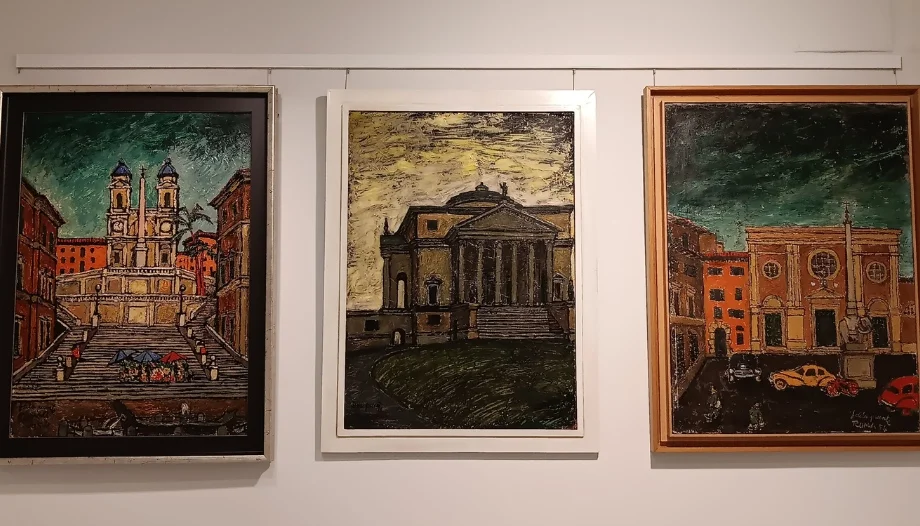
Fernando Delapuente Rodríguez-Quijano (Santander, 1909 – Madrid, 1975) painted 1,246 pictures and numbered them all. He was the perfect combination of engineer and artist: meticulous and organized, yet completely free in his creativity. The Illustrious Official College of Physicians of Madrid is hosting an exhibition, organized by the Methos Foundation, which brings together 70 of these pieces in a retrospective on the pictorial evolution of “a very original guy.”.
This is how Andrés Barbé, curator of the exhibition, explains it. Delapuente was the fourth of six siblings; he began studying law at his parents“ urging, ”but only lasted one semester.“ He enrolled in industrial engineering and, when he was in his second year, in fine arts. ”Politically uncommitted,” he lived through the war in a checa (a type of prison) and later took refuge in the Cuban embassy. ”He became a professor of drawing at the school, but what he really liked was painting," and he resigned from his professorship. He founded an engineering and architecture firm and, among other projects, designed the campus of the University of Navarra and was commissioned to design Torreciudad... But painting was always there.
The exhibition is organized into six areas that reveal the evolution of his painting. An initial, more academic phase, until he traveled to Italy in the 1950s, which completely changed his career path. In Ravenna, when he saw the sunrise reflecting on the mosaics of a basilica, he had, as he himself said, a “conversion to color and became a Fauvist [of Fauvism].” In the “do whatever you want” spirit of this type of style, Delapuente uses color, but unlike other painters, he does so with very defined lines. He moved from ochres and earth tones to focusing on Van Gogh, Matisse, “people who use color.”.
That is why the second part is Italy, and the third, Paris, with more gray tones, because the City of Love does not have the light of Rome, and Delapuente painted what he saw. This section features one of his few paintings with people, as the artist almost completely renounced figurative art to paint cities, lands, or seas. In fact, despite having obtained brilliant grades in anatomy, when he includes a person in a scene, he does so in an almost childlike way, without hardly working on it. This “urban fauvism” is what leads the curator to define Delapuente as an “innovative man.”.
“What mattered to him,” Barbé argues, “was the urban structure, although here he also does whatever he wants,” moving buildings around or placing together those that are distant in the real city. "Or he also paints buildings that no longer exist.".
Love for Madrid
An example of the artist's fondness for the city is the last part of the exhibition—after the seascapes and country scenes—which is the city of Madrid. He could be called, according to the curator, the painter of Madrid. “But the idealized Madrid that he liked.” “My Madrid,” said the artist, in which there were not as many people or cars as in his later years.
Barbé has located more than 120 paintings he did of the capital. In that Madrid he loved so much, Fernando Delapuente died at the age of 66 from a heart condition he had suffered from all his life, but which never prevented him from living a passionate, intense, and enthusiastic life.
“He was a very normal man. Very sociable. Very neat; he wasn't the typical scruffy artist. Endearing. He had supernaturalized his life; he was a member of Opus Dei and created friendly, positive, pleasant, and decorative paintings that look great. He had character. He was a man of friends; he had many. He lived life to the fullest, and this is reflected in his paintings. He was orderly, systematic, and a very hard worker.”.
A very carefully curated exhibition
This exhibition, which has been in preparation for over a year, consists entirely of loans from private individuals. Pieces have been brought in from Pamplona, Bilbao, Granada, Almeria, Valencia, and, above all, Madrid. The curator explains that Delapuente often painted the same subject. In other words, identical works (each with its own nuances), which he then sold. He has many seascapes, the curator acknowledges, and of different seas with their different colors. “At the end of his life, he became very much like Turner,” explains Barbé. This can be seen in his oil on canvas. Strong sea with seagull, from 1975, the same year he died.
Where to watch it
The exhibition is a tribute to Delapuente on the 50th anniversary of his death. It is a tribute in a clean and clear space, the exhibition hall of the College of Physicians, located in the heart of Madrid's art scene (Santa Isabel, 51).
It will be open until January 17, 2026, Monday through Friday from 10 a.m. to 9 p.m., and Saturdays from 10 a.m. to 2 p.m. Admission is free.






 Español
  English
  Italiano
  Français
  Deutsch
  Polski
  简体中文
简体中文