




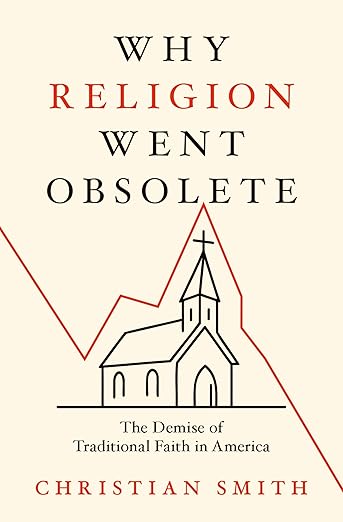
Christian Smith (1960), professor of Religious Sociology at the University of Notre Dame in Indiana, United States, is a specialist in the transmission of faith to new generations and the influence of Christian faith on social relations.
In this work, he will exhaustively quantify the sociology of religion to provide us with accurate data so that we can agree with or contradict his interesting conclusions (29).
The first conclusion of this work, derived from the exposition, tables, analyses, and reference authors, would be that sociologists of religion in the United States are closer to reality than Spanish sociologists of religion who, as we have had occasion to point out on other occasions, are heavily influenced by the political ideologies of the Spanish transition and the present day.
The critical realism of this professor of Sociology at the University of Notre Dame in the United States is not perfect, nor does it coincide 100% with reality, simply because only God has a complete vision of reality, since He scrutinizes the interior of our consciences and knows our deepest thoughts and the truth of our intentions. However, his realistic view and the minimal ideology with which he approaches problems certainly make it more relevant and, above all, capable of providing guidelines for reconnecting with God on a personal and family level (41).
Christianity is not obsolete: faith as a personal relationship
Christianity is certainly not obsolete, nor will it ever be, because even though people today may be less religious or less observant, or may have a weaker doctrinal and liturgical formation than in other times, they will always have the power of obedience to be found and loved by Jesus Christ our Savior, as St. Paul said to Timothy: “God desires all men to be saved and to come to the knowledge of the truth” (1 Tim 2:3-4).
On the other hand, there is and always will be an infallible bridge through which Jesus Christ connects with each of the men and women he has created and to whom he has given an immortal soul. This bridge, which can be crossed at any time, consists in the fact that we are “the image and likeness of God” (Gen 1:36). Therefore, through understanding and the heart, Jesus Christ passes through every day and invites us to a personal relationship with Him, to heaven on earth and heaven in heaven, as can be seen in our personal lives.
Christian anthropology
Now that we are celebrating the 500th anniversary of the founding of the School of Salamanca, since Francisco de Vitoria OP began teaching at the Faculty of Theology of the University of Salamanca in 1526, we must look at how the Salamanca master developed the concept of the dignity of the human person and, specifically, the fundamental concept of freedom throughout his classes, rulings, and lectures.
What is obsolete, therefore, is a concept of man and anthropology that may have been interesting at other times in history and facilitated coexistence and the construction of social order, but must now give way to anthropological models more in line with the thinking of our time.
Precisely for Victoria, man is essentially relationship, as God is in her intimate life: three subsistent relationships: the subsistent relationship of Fatherhood, the subsistent relationship of Sonship, and the subsistent relationship of Love. Hence, man, the image and likeness of God, is also essentially relationship with God and with others.
In fact, man matures in the most important of relationships, which is that of love. Let us not forget that “God is love” (1 John 4:8) and therefore, what we do is give love in our relationships as a fruit of the love received in our relationship with God.
Secularization, education, and the future of faith
Now let's return to Professor Christian Smith's analysis to note some of his interesting observations about the importance of promoting this anthropological concept we have just discussed.
Indeed, our author repeatedly returns to the subject of prayer and the things that young and old alike talk about with God in their prayers. Logically, drawing on the Spanish tradition of the Golden Age of Castilian mysticism and the universal call to holiness for all Christians from the Second Vatican Council (Constitution “Lumen Gentium” n.11), he proposes a renewed Christianity based on a personal and real relationship between Christians and God. Therefore, if there is a personal relationship, Christianity is alive; if not, it is dead and quickly disappears from the horizon of life (49).
Christian Smith will certainly tell us that the intellectual and educational level of believers has risen enormously over the course of the 20th and 21st centuries. Certainly, in Western civilization, the education we can impart to Christians is much higher and deeper than in other periods of history, and in that sense, it is assumed that in the coming years the doctrinal formation imparted by priests and pastoral agents will be more attractive and profound than it is today, and that this will have an impact on the appeal of Jesus Christ: for in order to love Jesus Christ, it is necessary to know him better. (99).
The way the chapters of the book are titled is interesting: “The 1990s, the beginning of the end,” which includes the technological revolution and the internet as accelerators of the divorce between neoliberalism and Catholicism (137). Certainly, in Europe, the process of secularization had begun earlier, and what it has really shown is that Christianity, being a personal relationship, cannot remain a set of ideas or a package of beliefs.
We will conclude with Jesus“ own question: ”When the Son of Man comes, will he find faith on earth?" (Lk 18:8). Certainly, if in liturgical and sacramental life, people will always find the beginning or nourishment for a life of knowledge and love of Jesus Christ and the communal experience of faith that will also break the strong individualism of our time.
Why religion became obsolete






 Español
  English
  Italiano
  Français
  Deutsch
  Polski
  简体中文
简体中文