



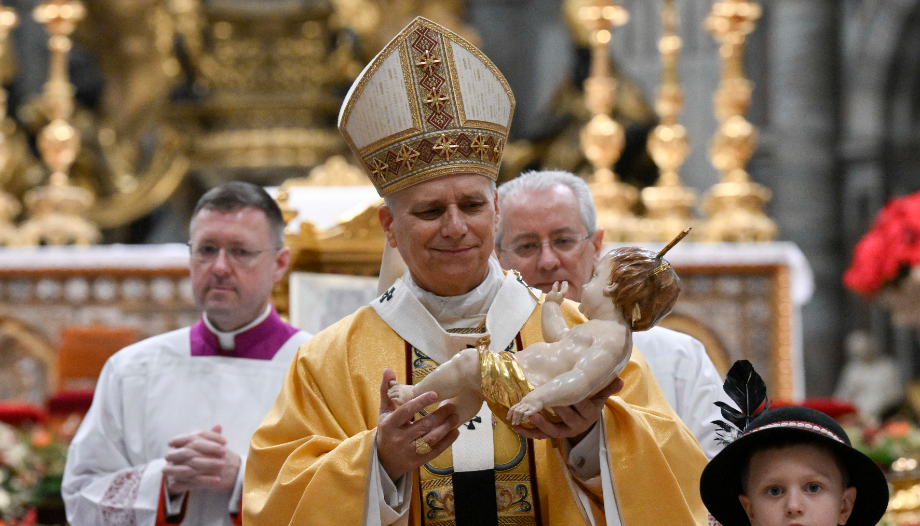
On the morning of December 25, inside St. Peter's Basilica, the Pope offered a homily placing the Christmas celebration in its most universal and human dimension, recalling that «throughout the world, Christmas is a celebration of music and song par excellence,» a time when joy is expressed as a proclamation that crosses peoples and cultures and draws us out of indifference toward our neighbors.
But that joy, he explained, is neither superficial nor evasive. It springs from God's gift itself, a gift that is not imposed, but calls and waits. «God's gift is fascinating, it seeks acceptance and moves us to surrender,» he said, emphasizing that its strength lies precisely in its vulnerability. It is a gift that «surprises us because it exposes us to rejection» and that «attracts us because it snatches us from indifference.» In that tension—between attraction and risk—the authenticity of the Christian faith is at stake.
Divine filiation
The Pope then delved deeper into one of the central ideas of his homily: divine filiation not as an abstract concept, but as a concrete capacity to live differently. «Becoming children of God is a true power,» he said, although he warned that this power is stifled when the heart is closed. That gift, he said, «remains buried as long as we remain indifferent to the cries of children and the frailty of the elderly, to the powerless silence of victims and the resigned melancholy of those who do evil without wanting to.».
Indifference, rather than visible sin, is presented as the great enemy of the Gospel.
Helping others
In this context, the Pope recalled some words of «beloved Pope Francis,» quoted expressly to re-evoke the «joy of the Gospel.» He recalled how Francis warned that «sometimes we are tempted to be Christians while keeping a prudent distance from the wounds of the Lord.» In the face of that temptation, Jesus« direct call resounded strongly: »Jesus wants us to touch human misery, to touch the suffering flesh of others." Faith, he insisted, is not lived from a place of sterility, but from contact.
This contact becomes even more urgent because, as the Pontiff reminded us, the Incarnation has changed God's language forever. «Since the Word became flesh, now flesh speaks, crying out the divine desire to meet us.» And that flesh today has concrete names and faces. «The Word has pitched his fragile tent among us,» he said, inviting us to look at the most painful realities of the present.
Seeing the fragility of others
He made direct reference to the situation in the Holy Land: «And how can we not think of the tents in Gaza, exposed for weeks to rain, wind, and cold, and those of so many other displaced persons and refugees on every continent, or the makeshift shelters of thousands of homeless people in our cities?» Fragility, he emphasized, is not an idea, but a real condition: «Fragile is the flesh of defenseless populations, tested by so many wars, ongoing or ended, leaving rubble and open wounds.».
In one of the most profound passages of his homily, the Pope linked this compassionate gaze with the birth of true peace. «When the fragility of others pierces our hearts, when the pain of others shatters our solid certainties, then peace begins.» Not a peace built on balances of power, but «the peace of God,» which «is born of a sob that is welcomed, of a cry that is heard.» It is a peace that «is born amid ruins that cry out for a new solidarity» and that is nourished by «dreams and visions that, like prophecies, reverse the course of history.».
Urbi et Orbi blessing
From the central loggia of the facade of St. Peter's Basilica, the Pope gave the blessing. urbi et orbi Christmas message focused on peace understood not as an imposed balance, but as a task that arises from personal conversion.
Before the faithful gathered in the square and the millions of people who followed the event around the world, the Pontiff clearly stated: «Sisters and brothers, this is the path to peace: responsibility.» He emphasized that real change begins when each person abandons the logic of accusation and assumes their own share of blame. If everyone, he said, «instead of accusing others, first acknowledged their own faults and asked God for forgiveness,» and if at the same time they knew how to «put themselves in the place of those who suffer» and were «in solidarity with the weakest and most oppressed,» then, he said with conviction, «the world would change.».
Jesus Christ, peace of the world
The Pope rooted this call in the heart of the Christian mystery, recalling that peace has a face and a name. «Jesus Christ is our peace,» he proclaimed, explaining that he is so «first and foremost because he frees us from sin» and because «he shows us the way to overcome conflicts, all conflicts, from interpersonal to international ones.».
He insisted that there can be no authentic peace without prior inner liberation, since «without a heart free from sin, a forgiven heart, one cannot be peaceful men and women and builders of peace.» That is why he recalled that «Jesus was born in Bethlehem and died on the cross: to free us from sin.» In this context, he strongly affirmed that «He is the Savior» and that, sustained by his grace, «each of us can and must do our part to reject hatred, violence, and confrontation, and to practice dialogue, peace, and reconciliation.».
A review of some places
On Christmas Day, the Pontiff wanted to send a message of closeness to Christian communities living in contexts of particular suffering. «I wish to send a warm and paternal greeting to all Christians living in Middle East«,« he said, recalling his recent meeting with them during his first apostolic journey. From this pastoral closeness, he raised a specific plea to the Lord, saying: "We implore Him for justice, peace, and stability for the Lebanon, Palestine, Israel, and Syria".
The blessing was also extended to the European continent, explicitly entrusted to the «Prince of Peace.» The Pope asked that Europe preserve «a spirit of community and collaboration,» that it remain «faithful to its Christian roots and history,» and that it continue to show «solidarity and hospitality to those in need.» In this context, he invited everyone to pray «in a special way for the troubled Ukrainian people, that the roar of weapons may cease,» a sober request that resonated strongly amid the silence of the square.
The Pope's prayer then embraced all the victims of armed conflicts around the world, entrusting them to «the Child of Bethlehem.» He implored «peace and comfort for the victims of all the wars being fought in the world, especially those that have been forgotten,» and for those who suffer «because of injustice, political instability, religious persecution, and terrorism.» With special attention, he remembered «in a special way our brothers and sisters in Sudan, South Sudan, Mali, Burkina Faso, and the Democratic Republic of the Congo«, putting a face to tragedies that are often silenced.
In the context of «these last days of the Jubilee of Hope,» the Pope invited us to pray «for the beloved people of Haiti«, calling for «an end to all forms of violence in the country» and for the nation to be able to move forward «on the path of peace and reconciliation.» He also turned his gaze to Latin America, asking that «the Child Jesus inspire those with political responsibilities» so that, in the face of current challenges, «space is given to dialogue for the common good and not to ideological and partisan exclusions.».
Asia also featured prominently in the blessing. The Pontiff asked the Prince of Peace to «enlighten Myanmar with the light of a future of reconciliation,» which «restores hope to younger generations» and «guides all the people of Myanmar along the paths of peace,» accompanying those who live «without a home, without security, and without confidence in tomorrow.».
He also implored that «the old friendship between Thailand and Cambodia» and that the parties involved continue to strive «for reconciliation and peace.» His prayer also extended «to the peoples of the South Asia and Oceania«, hard hit by «recent devastating natural disasters» that have severely affected entire populations.
Closing of the Jubilee Year
In the final part of his message, the Pope issued a direct warning to consciences, calling on people not to give in to one of the great evils of our time: «Let us not allow ourselves to be overcome by indifference towards those who suffer, because God is not indifferent to our miseries.».
And, recalling that «in a few days the Jubilee Year will come to an end,» he offered a word of hope that transcends the closing of the celebrations: «The Holy Doors will be closed, but Christ, our hope, remains with us always.» With an image of great spiritual power, he concluded by affirming that «He is the Door that is always open, which leads us into divine life.».






 Español
  English
  Italiano
  Français
  Deutsch
  Polski
  简体中文
简体中文