


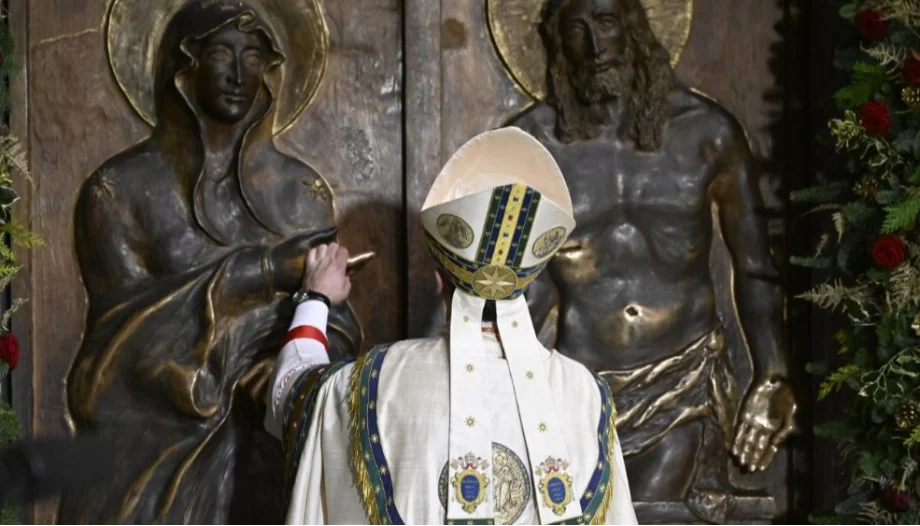
The Jubilee of Hope is coming to an end. In recent days, the Holy Doors of St. Mary Major, St. John Lateran, and St. Paul Outside the Walls have been closed, along with those of many other jubilee churches around the world. Finally, on January 6, the Solemnity of the Epiphany of the Lord, the closing of the Holy Door of St. Peter's Basilica in the Vatican will mark the definitive end of this ordinary Jubilee.
Throughout this Holy Year, we should ask ourselves: what has become of our hope? Has it truly filled our hearts?
The late Pope Francis, in proclaiming this year of grace through the bull Spes non confundit (Hope does not disappoint), on May 9, 2024, he shared with us his deepest desire: a desire for hope for everyone, because—as he himself recalled—«everyone hopes.» This is how his message began: «Francis, Bishop of Rome, Servant of the Servants of God, to all who read this letter, may hope fill your hearts.».
In that same bull, like a true roadmap, the logic of hope was outlined based on its two dimensions: grace and sign. The transition from one to the other prevents hope from becoming static, dull, resigned, or contingent. It is a hope that is always alive. This living hope is what truly fills the heart.
It's not enough to just have hope; you have to show it.
God's love is the source of all hope. Hope is, above all, grace. Pope Leo reminded us of this on the Ninth World Day of the Poor, November 16, 2025: «Christian hope does not disappoint because it is founded on God's love poured into our hearts by the Holy Spirit.».
But Christian hope must not only be lived inwardly: it must also be made visible. True hope calls for signs that embody and express it. «Attaining the hope that God's grace gives us» is necessary, but not sufficient; it must be rediscovered in the signs of the times. This is what Francis affirmed in Spes non confundit: «The signs of the times, which contain the longing of the human heart for God's saving presence, need to be transformed into signs of hope» (SNC, 7).
Our signs of hope
What are these signs of the times that today call to be transformed into signs of hope? They are these: peace; the desire of young people to have children; closeness to prisoners; care for the sick; accompaniment and encouragement of young people; responsible welcome of migrants; integration of exiles, displaced persons, and refugees; recognition of the value of the elderly; and, finally, the living memory of the poor (SNC, 7).
This is, we could say, the rosary of hope. Its signs: peace, openness to life, prisoners, patients, young people, migrants and refugees, seniors y poor These are our hopes: the same ones that the heart of Christ on earth (whoever that may be), and with him the whole Church, goes over and over, prays and offers... even to the point of giving his life? Yes, even to the point of giving his life.
Good hope, the most urgent sign
These signs are not isolated: they form a true rope team. One leads to the other. At the forefront, paving the way for hope, is peace: a peace whose demand, said the Pope, «challenges us all» (SNC, 7): «all»: all peoples and every person. Peace as the origin, as the environment for all action and every intimacy, as a vital destination.
And, following this universal requirement, another particularly urgent one emerges: openness to life. «It is urgent that, in addition to the legislative commitment of States, there be convincing support from religious communities and civil society, because the desire of young people to bring new sons and daughters into the world, as the fruit of the fertility of their love, gives a future perspective to every society and is a source of hope: because it depends on hope and produces hope,» Pope Francis exhorted us in this letter.
Openness to life speaks the language of hope. Without it, it can hardly even be uttered: proximity, accompaniment, stimulus, care, welcome, recognition… We need to recommit to life as memory and as promise, to recover the back-and-forth swing between hope and good hope.
The 21st century, the century of hope
In this sense, the 21st century is the century of hope. Its most fundamental question is one of hope: whether or not to pass on life.
The French philosopher Rémi Brague, in his book Anchors in the sky —also collected by José Granados in Hope, from the future to the fruit— argues that, just as, for other reasons, the 19th century was the century of charity and the 20th century was the century of faith, ours is the century of hope.
It is because the decisive question of our time revolves around the fruitfulness of being: to generate or not to generate. Today we choose whether or not to transmit life. This crisis does not arise simply from a change in lifestyle; it arises, above all, from a deeper transformation: being and good are no longer perceived as inseparable. In our time, the coming of a human being into the world is no longer seen as a good in itself, but becomes dependent on conditions.
Crossing the threshold of hope
The Holy Door is closed. But we are all called to cross the threshold of hope in order to remain within it.
In these final days of the Jubilee, as our gaze turns to a manger where a Child brings hope, transforming the sign of the empty cribs On a hopeful note, it could be a good ending, the best ending, one that does not disappoint.
For this to happen, may hope become incarnate; may bodies be places of hope; may hopes be those of each day; may we all cross the threshold, even with the Holy Door closed. May we be within hope, fully within it. May we all be hope and may we be able to manifest it. May hope fill our hearts... And may we want to sing about it.


 Español
  English
  Italiano
  Français
  Deutsch
  Polski
  简体中文
简体中文