




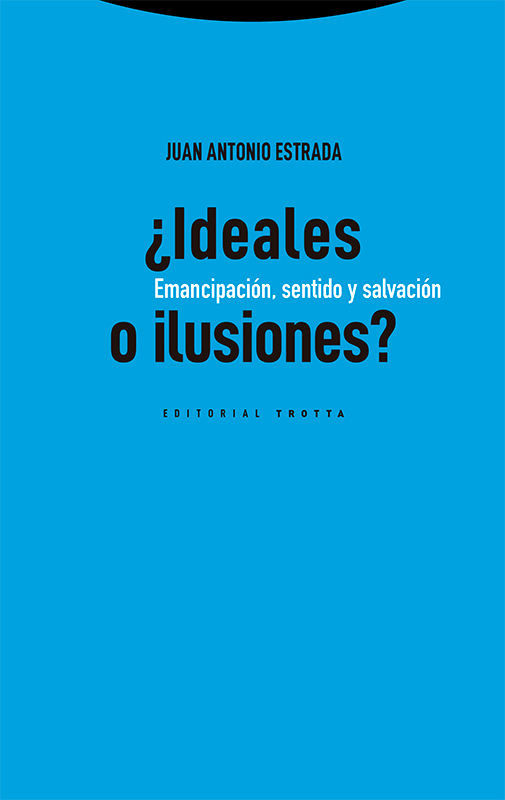
The Jesuit Juan Antonio Estrada (Madrid, 1945), professor of philosophy at the University of Granada, has published a magnificent compilation of previously published articles on the meaning of life with Trotta, which is worth reviewing, albeit briefly.
As a result of his extensive research, Estrada reminds us of that memorable text by Benedict XVI when he emphasized that the early Church entered into dialogue with Greek philosophy in search of a dialogue between faith and reason.
The result of this dialogue was the so-called realistic philosophy that underpinned Christian humanism until the May 1968 revolution, passing through the renewal introduced by Francisco de Vitoria and the School of Salamanca.
Christianity would be an ideal because it would open the way to identification with Christ by following the necessary steps of an ideal or any project of greatness: “there are three values that are fundamental to any project: meaning, emancipation, and salvation” (14).
Certainly, Jesus“ evangelization ”sharpened the need for personal conversion and individualized the concept of salvation" (60), to which we could add that this took place in a climate of total freedom.
Estrada then draws an initial conclusion: “the focus of religion is no longer worship, but behavior and relationships with others, radicalizing the previous message of the Jewish prophets” (61).
Certainly, the Gospel scene of the destruction of the temple speaks to us of the new altar in the heart of every Christian who offers up his or her daily life as a sacrifice of immense value, as great as his or her love, and always united to the one true sacrifice of the New Law, which is the Mass. St. Josemaría spoke of not reducing Christianity to going to church: “Christianity arises around a person, not a doctrine or an ideology; it offers a different way of life. The ultimate reference is not the religious system, but the personal following of Jesus” (62).
For much of history, the Ten Commandments revealed to Moses occupied an important part of the moral teaching of the Church from the Middle Ages to the present day, when the new catechism has proposed a morality of holiness for all Christians (65).
Estrada then recalls that “Human history shows humanity’s inability to triumph over evil. The success of revolutions soon turns into new forms of oppression by the victors. We must place our hope in the ongoing struggle against evil and in the action of God, who inspires those who follow Jesus” (69).
Indeed, what happened to our author is similar to what happened to Juan Azor, author of the Jesuits“ ”ratio institutionis" in the 16th century, who influenced the drafting of the catechism for parish priests or St. Pius V, when the time came to propose holiness as a model for Christian morality, faced with the urgent need for reform of the Church and the Christian people, he simply called them to salvation.
Once again, Estrada places the mystery of the Lord's resurrection at the center of the new morality and the new evangelization when he states: “What is new in the proclamation of the risen Christ is the fundamental reference to his history and his way of life. To emphasize the resurrection while marginalizing the life of Jesus would lead to the devaluation of the earthly Jesus” (70).
For Christianity, it was a unique opportunity to develop within the framework of the Roman Empire, adopting its laws, bureaucracy, and administration, because it was a well-organized society. The price to pay was the distancing of Judaism from its origins (75).
It is interesting that Estrada made the mistake of admitting a distance between the clergy and monks and the Christian people, and a difference between the various social classes in Christianity. This was surely due to the influence of the Marxist views of his youth (76).
The different theological schools that would emerge in the Church with the birth of universities, depending on the emphasis placed on the balance between faith and reason by St. Thomas, on the effort to emphasize the will in John Duns Scotus and St. Bonaventure, or on the promotion of nominalism with William of Ockham and his contempt for reason (79).
Luther brought about a painful transformation of Christianity, stripping it of the mediations of the Virgin Mary and the saints, of the sacraments to intervene in grace, and of the magisterium to shed light on understanding (81).
Finally, our author will refer to the Catholic reform that took place in Spain with the reform promoted by the Catholic Monarchs and Cisneros and continued by Francisco de Vitoria and the School of Salamanca, which we will celebrate in the year 1526 (86).
Next, he will address the Enlightenment, whose starting point we must place in Descartes (1596-1650) and his discourse on method, when philosophical immanentism began, which would last until Kant (1724-1804).
He then summarizes: “The Kantian system has influenced philosophy, ethics, and religion. But Hegel (1770-1831) is the continuator, reformer, and systematizer of global rationality. His system dominates the entire 19th century and serves as a reference point for Feuerbach, Marx, Kierkegaard, Schopenhauer, and Nietzsche” (111).
Ideals or illusions? Emancipation, meaning, and salvation






 Español
  English
  Italiano
  Français
  Deutsch
  Polski