


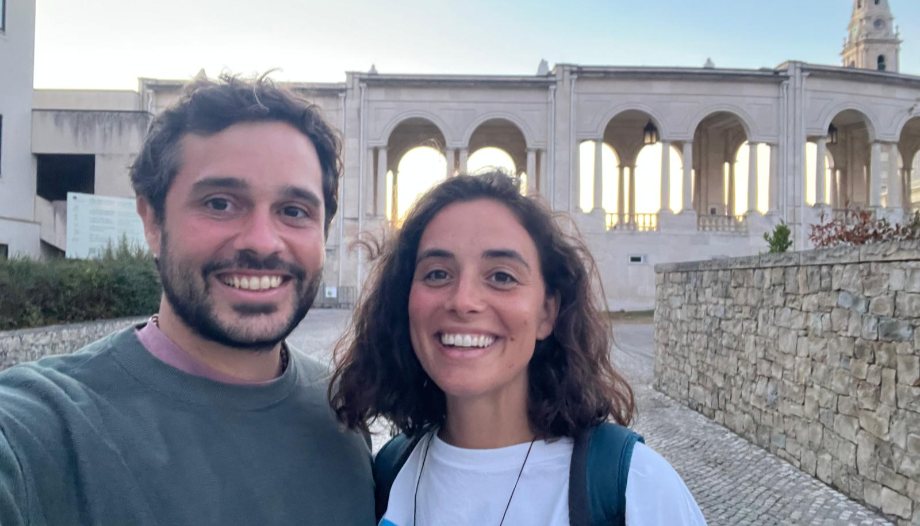
Carlota Valenzuela and Santi Roldán met in November 2024 and married in September 2025. She is from Granada and he is from Buenos Aires. They had a brief but conscious courtship, which put mutual knowledge and prayer at the core of their relationship. Their love was not the fruit of a hasty infatuation, but of a discernment lived seriously.
Carlota, known by thousands of people since she made a pilgrimage on foot from Finisterre to Jerusalem three years ago and for sharing on social networks her life of faith with more than 120,000 followers, explains today how he and her husband, an Argentinean, build with their marriage a shared vocation.
Formation during their engagement has been key: Married Love retreat, teenstar, pre-marriage course and regular talks with a priest to understand the real value of the sacrament. They insist on the need to change the story that believers often have about marriage: it is necessary to speak of its beauty, to show happy marriages and to restore hope.
When asked what marriage means to them in terms of imitating God and doing his will, they were surprised by the naturalness with which they spoke of something unusual for newlyweds: having explicitly decided to live seeking God's will. This decision does not remain an abstract idea, but is embodied in a very concrete daily practice: praying together.
Prayer routine
Their day always begins in the same way. They light a candle, place themselves in front of an image of the Virgin and pray the lauds. Carlota explains that already in that first moment of the day what each one carries inside is transparent, because “in the prayers of the lauds, besides the proposals of the Church, we ask for what we have in our hearts, and then I start to see what Santi has in his heart and Santi sees what I have in mine”. Then they read the readings of the day and comment on them, trying to see “how the readings of the day resonate in our concrete reality”. This, she says, is how she begins her day.
The day also ends in prayer, with a practice they learned at the Married Love Project retreat and which has become one of the pillars of their married life. It is a marital prayer in which each one speaks personally to Jesus out loud in front of the other. Carlota describes it as “a neutral ground” in which Santi can pour out “the things that weigh on him, the things that generate illusions, the things he regrets, the things that have hurt him that I have done throughout the day,” while the other is simply a witness. Then she does the same, always in the light of the Gospel of the day and of their concrete life as spouses.
Santi stresses that this prayer with Jesus is neither uniform nor predictable. “The relationship with Jesus is not always the same,” he explains; there are days when he speaks to him about a sin against which he is struggling more, on others he shares a concern or a fear, and on others he simply thanks him “because the day was very nice.” The decisive thing, he insists, is that “my wife listens to what I have in my heart, without interrupting and without intervening”, which allows me to show what I have inside “in a very honest and open way, without the need to negotiate anything”.
Lack of time
In the morning they dedicate between half an hour and forty minutes to prayer, and in the evening about ten minutes. Is this too much or too little time? It depends on what you compare it to. On many occasions lack of time - work, children, rushing around - make married prayer life difficult but Carlota advises those who think they have no time to “check the metrics on their cell phone and see how much time they have spent on social networks or reading the press.”.
Carlota clarifies that when there are days when they are tired, the prayer is brief, but “we never go to bed without having prayed. Even in more uncomfortable circumstances, for example if one is sick, ”the prayer can last a minute, but we never go to sleep without praying“.
Prayer and conflict management
For Carlota and Santi, praying together is not a pious addition, but something structural: “A united marriage is the basis of everything in life”, and that is why “prioritizing joint prayer is very important”.
They have seen marriages in which one of the spouses has a great faith life and the other does not, and how this generates a silent wear and tear, because “no matter how much one rows, if the two do not row in the same direction, everything is more difficult,” adds Carlota. Personal prayer is necessary, but conjugal prayer is “like the glue of marriage” and “the boiler that fuels the home.
This prayer space has very concrete effects on the management of daily conflicts. Santi explains that in marriage there is always the temptation to avoid certain topics out of laziness or fear of arguing. “You have the option of not talking about things,” he acknowledges, but clarifies that what is kept “does not magically disappear.” Prayer forces them to talk, to have those difficult conversations that one would try to avoid, and helps them “build something together.”.
Carlota, far from idealizing coexistence, recognizes with humor that, although they get along very well, “there are times when the armchairs fly”, especially in her emotional cycles, when she goes from thinking that Santi is wonderful to being bothered even by the way he breathes. In those moments, she explains, prayer helps her to “suspect myself”, because by placing herself before God she understands “who God is and who you are”, she remembers that the perfect one is Him and not her, and she recognizes herself as a “beloved, forgiven and redeemed daughter”. From there she can accept that, if there is conflict, she probably also has responsibility, even if it is in small daily gestures. Recalling a phrase of her grandfather - “two do not quarrel if one does not want to”- she insists that when there are problems “it is the movement of both” and that prayer places her in a realistic humility from which she can forgive and ask for forgiveness.
Santi completes this idea by explaining that the life of prayer helps them not to live from the claim. “If I live in the claim I stop seeing Carlota as a gift, as a gift from God, and I start seeing her as something that is owed to me.”.
On the other hand, when the other is lived as a gift, “things change a lot”. Recognizing one's own mistakes allows the other to become a help and not an enemy, and avoids falling into constant accusation, which he clearly identifies: “The devil is the accuser, and we spouses are not exempt from that”. To get out of this dynamic, he insists, one needs the humility to recognize that one has done something wrong and to accept help.
At the beginning of their marriage, they have discovered something that they consider to be an authentic life strategy: to prioritize the other person. Carlota expresses it clearly when she affirms that “your priority is the other not only as a life option, but as a vital strategy”, because work changes, children leave and circumstances vary, but marriage is “your way to heaven and your daily happiness”. Taking care of it, he concludes, is not an add-on, but the great investment of life.
Fear of the future
When asked about their fears, none of them mentions major future crises, but rather a more subtle danger. Carlota is afraid of “normalizing miracles” and thinking that what is going well is only the fruit of one's own effort. She worries that, little by little, “we are taking God out of the equation” and that unavoidable matters, such as paying a mortgage, will become the axis that determines all decisions. Santi agrees completely and expresses it from another angle: he is afraid that “we are doing well and we think we are doing well because of our strength and then we leave God aside”.
Observing other Christian marriages, Carlota confesses that she is sometimes sad to see God relegated to Sunday mornings, “if the children are not sick. She also worries about the attachment to material things, often justified by the care of children. He recalls that Jesus” parents did not provide him with “life insurance, a pension plan or a private university”. He only had “parents who cared for him and loved him”.
He explains that many times, with the excuse of giving stability or a good school, family life and marriage are sacrificed, when in reality “what they are giving their son is not what he really needs”, because “he will probably be a good professional, but he needs much more to be a true saint to get to heaven”.
The best of dating
Looking back and evaluating their courtship, both agree on the great successes. Santi does not hesitate to say that “chastity was our number one success”, because it allows us to maintain clarity in discernment. Living chastity makes it easier for the engagement to be a time to talk, to walk, to really get to know each other and to be able to make a free decision, because it is clear that “the engagement has two possible endings: to get married or to leave”.
He explains that part of discernment is to accept that there will be no absolute certainty that confirms that one chooses the right person and that one does not marry with all the answers, but with enough peace and joy to take the step.
Contraceptives
In these first months of marriage and in conversations with couple friends, Carlota and Santi see how selfishness often creeps into marriage through small plots that one does not want to give away. One of them are artificial contraceptive methods, which make it possible to “make sure” that everything goes at the pace you want.
She admits that she has always been rebellious in the face of the Church's proposals and that she has only learned to trust them by seeing them incarnated in her life. One of those points was precisely the issue of contraceptives, but after only a few months of marriage, she is convinced that it is not an arbitrary prohibition, but a protection against some dynamics that slowly erode self-giving.




 Español
  English
  Italiano
  Français
  Deutsch
  Polski