


From the early months of his pontificate, Pope Leo XIV has given his teaching a clear ecumenical orientation (unity of Christians), as reflected in his papal motto Taken from St. Augustine, ‘In Illo Uno Unum’ (In Him who is One we are One), although it refers to several aspects, as the Pontiff has been developing.
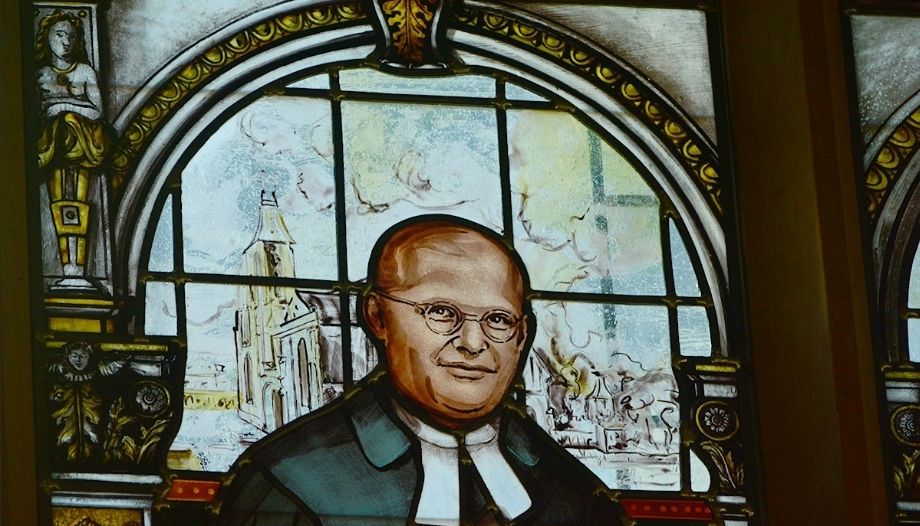
There are no official lists of Christian theologians, other than Catholics, whom Leo XIV cited as Pope of the Catholic Church. However, there have been mentions of some, such as Dietrich Bonhoeffer (1906-1945), a Lutheran theologian and German pastor, a figure in the resistance against Nazism, and a victim of the Nazis at the age of 39. Of course, there is also Ecumenical Patriarch Bartholomew I, with whom he met several times in Istanbul, and King Charles III of England, leader of the Anglican Church, among others.
Dietrich Bonhoeffer
In the Christmas greeting to the Roman Curia on December 22, at the end of the speech, The Pope quoted Lutheran theologian Dietrich Bonhoeffer. Here is the full reference: “Your Eminences, Your Excellencies, dear brothers and sisters, the Lord descends from heaven and lowers himself toward us.
As Bonhoeffer wrote, meditating on the mystery of Christmas, ‘God is not ashamed of man’s baseness, he enters into it […]. God loves what is lost, what no one considers, the insignificant, the marginalized, the weak and the downtrodden’ (cf. D. Bonhoeffer, Riconoscere Dio al centro della vita, Brescia 2004, 12). May the Lord give us his own condescension, his own compassion, his love, so that every day we may be his disciples and witnesses,” said the Successor of Peter.
The reference did not seem coincidental. Leo XIV evoked the figure of Bonhoeffer as an example of a Christian faith that does not retreat into the private sphere, but rather assumes specific responsibilities.
Voice of Christian resistance
Dietrich Bonhoeffer was born in Breslau in 1906 and trained as a Lutheran theologian in a demanding intellectual environment. From a young age, he stood out for his biblical depth and his concern for the concrete life of the Church. For him, theology was not just an academic exercise, but a reflection at the service of the Christian community and its witness in the world.
During the rise of Nazism, Bonhoeffer became one of the clearest voices of Christian resistance. He actively participated in the opposition to the regime's exploitation of faith. He maintained that following Christ meant taking risks and committing to the truth, even when this had serious personal consequences.
Consistent faith, witness
His writings, especially The Cost of Discipleship and his letters from prison, develop the idea of ‘costly grace,’ a faith that demands consistency and responsibility. Executed in 1945, Bonhoeffer is now recognized as a Christian witness by Catholics, Protestants, and Orthodox Christians, also for his writings from prison.
The message that Pope Leo XIV wished to convey by quoting the Lutheran pastor can be interpreted in several ways. One of them may be that ecumenism is also built by recognizing holiness and spiritual depth beyond confessional boundaries.
Patriarch Bartholomew I
This same vision was evident during the Pope's apostolic journey to Turkey and Lebanon. In Istanbul, Leo XIV met with the Ecumenical Patriarch of Constantinople, Bartholomew I. In his speech, the Pope recalled that Catholics and Orthodox Christians share the same apostolic roots and a common responsibility in the face of current challenges. He also emphasized that unity cannot be imposed, but rather matures through patient dialogue and charity.
Patriarch Bartholomew I, for his part, insisted on the need for a common Christian witness in the face of the ecological and social crisis. Known for his commitment to caring for the environment, he emphasized that the defense of creation is a privileged area for ecumenical collaboration. Both leaders agreed that prayer and joint action are inseparable from theological dialogue.
See here a summary of two or three ideas expressed by Pope Leo XIV during the visit, and also some by Orthodox Patriarch Bartholomew I, with whom he imparted a final blessing.
Leo XIV: “Overcoming the scandal of divisions”
“We are all invited to overcome the scandal of the divisions that unfortunately still exist and to nurture the desire for unit for which the Lord Jesus prayed and gave his life,” said the Pope. “The more we reconcile ourselves, the more we Christians will be able to give credible witness to the Gospel of Jesus Christ, which is a proclamation of hope for all.”.
Bartholomew I: “running the race” of Christian unity
Patriarch Bartholomew told the leaders that with “the fervor of the Nicene faith burning in our hearts,” they must “run the race” of Christian unity in fulfillment of Jesus“ prayer for the unity of his disciples. ”Let us love one another so that with one heart we may confess: Father, Son, and Holy Spirit, consubstantial and indivisible Trinity. Amen!".
“The commemoration of Nicaea is a testimony to the profound unity of all Christians in the faith,” he wrote in Vatican News Cardinal Kurt Koch, Prefect of the Dicastery for Promoting Christian Unity.
Charles III of England
Before this trip, Pope Leo XIV had been involved in another ecumenical gesture significant, when praying in Rome with the King of England, Charles III, the highest authority of the Anglican Church. The historic meeting, sober but laden with symbolism, emphasized historical reconciliation and the common mission of Christians in increasingly secularized societies.
The ecumenical dimension of the pontificate was also expressed in the prayer celebrated in the Basilica of St. Paul Outside the Walls together with an Anglican representative, the Archbishop of York, Stephen Cottrell, the most senior prelate of the Church of England.
In the background, Saint John Henry Newman
The opening hymn, composed by St. Ambrose of Milan, Doctor of the Church, was performed in an English translation by St. John Henry Newman, who was Anglican for half his life and Catholic for the other half. Newman, a 19th-century figure, was proclaimed a Doctor of the Church on November 1 by Pope Leo XIV. King Charles himself was present at his canonization on October 13, 2019, in St. Peter's Square.
Standing before the tomb of the Apostle Paul, the Pope recalled that the unity of the Church was a central concern of early Christianity and remains an urgent call today.





 Español
  English
  Italiano
  Français
  Deutsch
  Polski