



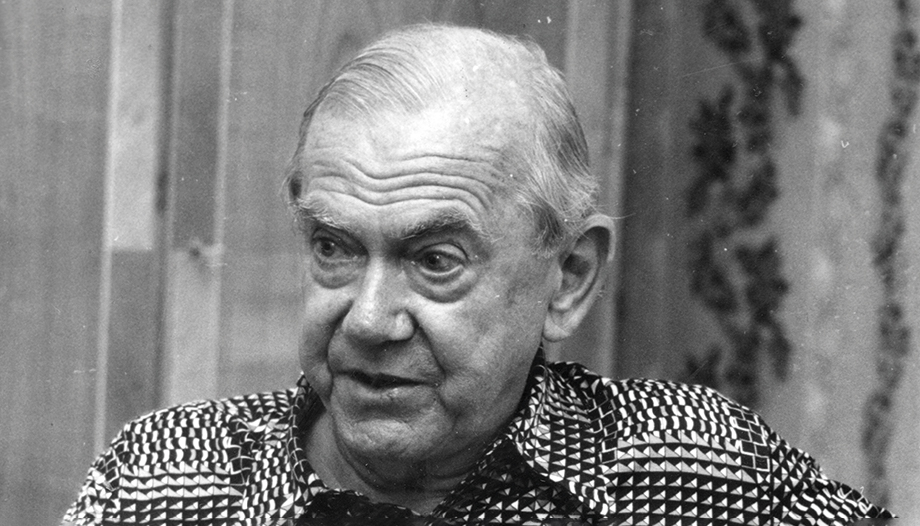
In my youth, that is, in the sixties of the last century, Graham Greene (1904-1991) was one of the stars of the European literary firmament. Not only had he written twenty-five novels, but he had also been, for example, the screenwriter of Carol Reed's great film The third man (1949), considered a masterpiece in the history of cinema.
In addition, Greene had written numerous short novels, plays and even works for children's audiences. He had first worked as a journalist in The Times, but he soon devoted himself entirely to literature while traveling the world on various missions as a spy in the service of the British MI6.
His personal life was always messy like many of the characters in his novels. A few years ago I reread what seems to me his best novel: Power and glory (1940). I had read and reviewed it in my youth, but when I reread it now I was even more impressed by the story of that renegade priest who gives his life for others in the midst of the Mexican revolt of the Cristeros.
As Charles Moeller wrote, “from a faith standpoint, it's Greene's greatest book.” (20th century literature and Christianity, I, 370).
“Catholic writer.”
Greene wrote two autobiographical books, both of which are worth reading for those with a penchant for writing: A kind of life (A Sort of Life, 1971) y Escape routes (Ways of Scape, 1980), in which literature and life are abundantly mixed. Perhaps the culminating anecdote of his life as a “Catholic writer” -which appears in both books- was that of the condemnation of Power and glory in 1950 and the conversation years later with Pope Paul VI about it: “The methods of censorship are always strangely inconsistent. In the 1950s I was summoned to Westminster Cathedral by Cardinal Griffin, and there I was told that my novel Power and glory, published a few years before, had been condemned by the Holy Office and that Cardinal Pizzardo demanded some changes which, naturally and I hope politely, I refused to make. [...] The interview ended abruptly and he gave me as a farewell a copy of a pastoral that had been read in the churches of his diocese and in which my work was implicitly condemned. Later, when Pope Paul VI told me that among the novels he had read of mine were Power and glory, I replied that the Holy Office had condemned the book. Then, much more liberal than Cardinal Pizzardo, he answered me: ‘Some parts of your book will always bother some Catholics, but don't worry about that’. Advice that was not difficult for me to follow.” (A kind of life, p. 70).
A kind of life
In this same book, after describing his 1926 conversion (pp. 141-146), he recounts that in the 1950s he gave up sacramental practice, but that he saw himself as a member of the Church's Foreign Legion fighting on its behalf, even though he did not feel entirely identified with it: “Later on we may become hardened to the formulas of confession and become skeptical about ourselves: perhaps we only try to keep half-heartedly the promises we made until continued failures and the circumstances of our private lives make it impossible to make any more promises; and many of us abandon confession and communion to enlist in the Foreign Legion of the Church and fight for a city of which we are no longer entirely citizens.” (pp. 145-146).
It is known that in his last years Greene received the sacraments again from the hands of the Galician priest Leopoldo Durán, with whom he had established a deep friendship and with whom he made numerous trips around Spain between 1976 and 1989, which would give rise to Greene's book Monsignor Quixote 1982.
Vocational perspective
When Graham Greene in A kind of life recounts his baptism in 1926, after multiple conversations with Fr. Trollope, a Redemptorist priest - who had been an actor in his youth - whom he had befriended, seems to suggest that his conversion was due to his desire to accommodate his girlfriend who was Catholic. However, at the end of the chapter he adds a thought-provoking paragraph:
“I remember clearly the nature of my emotion when I came out of the cathedral [after being baptized]: there was no joy in me, but only a dark apprehension. I had taken the step with a view to my future marriage, but now the ground was giving way before my feet and I was afraid of the direction in which the tide might carry me. What if I discovered in myself [...] the desire to become a priest? At that time it did not seem impossible. Only now, when more than forty years have passed, can I smile at the unreality of my fears and feel at the same time a sad nostalgia for them, for I lost more than I gained when fear became irrevocably part of the past.” (p. 146). The depth of his confession and the magnificent way of describing it are impressive: in Greene literature and life are intimately intertwined. Perhaps that is why it is worthwhile to continue reading him.






 Español
  English
  Italiano