


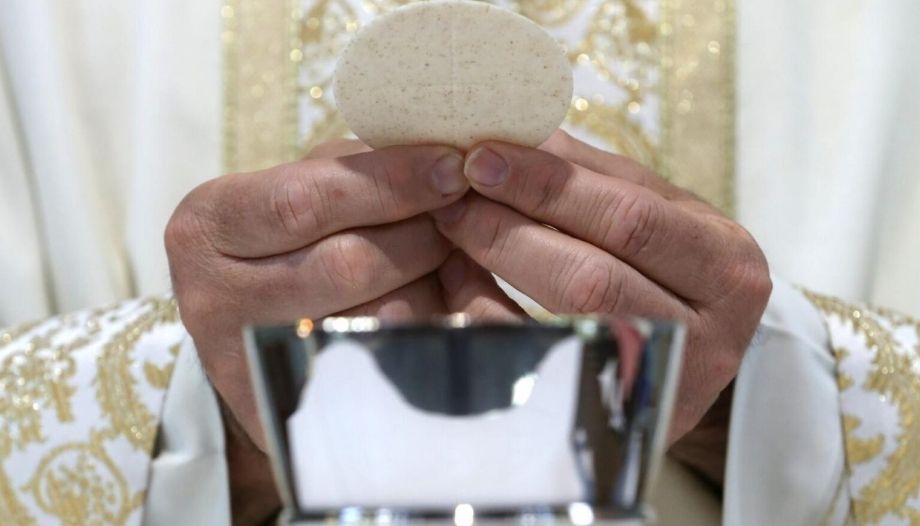
- DD Emmons, OSV News
The convert has been repeatedly told that the Mass, and specifically receiving the Eucharist, is the center of Catholic life, the supreme act of worship, and that attending Mass is a fundamental obligation. How then can a Catholic deliberately miss any of it? Here is a brief reflection on leaving Mass before it is over, or arriving late on a regular basis.
When you see someone leaving Holy Communion immediately, you wonder if he or she is sick. Is there an emergency? But no, after a while, you realize that the situation is not uncommon. Like being habitually late for Mass, it may be rude, impolite and irreverent, but it is not uncommon.
A parishioner was overheard saying that her family attended the 11:15 Mass. There is no 11:15 Mass. She laughingly explained that her family was always 15 minutes late, every Sunday. Are these people also always 15 minutes late for a doctor's or dentist's appointment, or for the school bus stop?
Organizing our lives
In the course of events, it seems strange that we cannot organize our lives in such a way that we can attend Mass in its entirety. It is as if we were spectators at a play or a baseball game, and we decide to arrive at the end of the second inning or leave arbitrarily before the event is over.
In the theater or the game, neither the actors nor the players leave before the curtain comes down or the last out is made. Likewise, they are present when the curtain goes up or the first pitch is thrown. During Mass, we are the players; we are the participants.
And before a president, a queen or a pope?
If we were invited to the presence of a president, a queen or the Pope, wouldn't we arrive before the dignitary and stay until the ceremony was over? It is protocol, respect and good manners. Does God, who created us and gave his life for us, not deserve the same respect? What if Jesus asked us to attend the Last Supper? Would we arrive late or leave before it was over?
When Mass begins and ends
The Mass begins with the entrance procession and the hymn. It ends with the dismissal. Everything in between is the Mass.
The story is told that one morning during Mass, a priest saw a lady receive Holy Communion and then go to the parking lot. The priest sent two servers with candles to walk beside her, for she was still a tabernacle of Christ. He stopped leaving early.
There was a time in the history of the Church when people justified that their obligation to attend Mass was satisfied if they attended the offertory, consecration and Holy Communion.
Liturgy of the Word and Eucharistic Liturgy
This idea was eliminated with the Second Vatican Council. The ‘Sacrosanctum Concilium’ (Constitution on the Sacred Liturgy) says: “The two parts which, in a certain sense, compose the Mass, namely, the liturgy of the word and the Eucharistic liturgy, are so closely united with each other that they form a single act of worship.
Therefore, this sacred Council earnestly exhorts pastors of souls, in instructing the faithful, to teach them insistently to participate in the whole Mass, especially on Sundays and holy days of obligation” (no. 56).
Attend Mass on Sundays and Holy Days of Obligation.
The Code of Canon Law also states: “On Sundays and other holy days of obligation, the faithful are bound to attend Mass” (no. 1247). And the Catechism of the Catholic Church, no. 2180, repeats the same words of canon law about our obligation to attend Mass. The first precept of the Catholic Church also tells us that we are obliged to attend Mass on Sundays and holy days of obligation.
There is no ambiguity here. None of these documents even remotely hints or infers that we can arrive late or leave early, or that it is okay to miss part of the Mass. In the words of Yogi Berra, “It ain't over till it's over.”.
Other reasons: preparation and thanksgiving
Leaving aside the aforementioned Church documents and laws, there are other reasons to arrive punctually and remain until the end of Mass. Those moments before Mass, when we enter this sacred place, kneel before the throne of grace and reverence our merciful God, are moments to express our love. This is a time of personal preparation for meeting God in the Eucharist.
Risk of trivializing
Likewise, the time after partaking of Holy Communion is a special time of reflection. We have just received the body and blood of Christ, and to simply walk away is a mockery of this glorious treasure.
By arriving late or leaving early, we not only trivialize the real presence of Jesus, we not only trivialize the Eucharist, but we also lose the full richness of the Mass. It is also a sign of bad manners toward the celebrant, the servers, the ministers, all those who help orchestrate the Mass.
What St. John Paul II wrote
St. John Paul II, in a May 31, 1998 apostolic letter entitled «On the Sanctification of the Lord's Day,» wrote the following. “As the first witness of the Resurrection, Christians who gather each Sunday to experience and proclaim the presence of the Risen Lord are called to evangelize and bear witness in their daily lives.”.
“For this reason, the Prayer after Communion and the Concluding Rite-the Final Blessing and Farewell-need to be better valued and appreciated, so that all who have participated in the Eucharist may come to a deeper sense of the responsibility entrusted to them.”.
The disciples of Emmaus
“Once the assembly disperses, Christ's disciples return to their daily surroundings with a commitment to make their whole life a gift, a spiritual sacrifice pleasing to God (cf. Rom 12:1).
They feel indebted to their brothers and sisters for what they have received in the celebration, similar to the disciples on the road to Emmaus who, once they recognized the Risen Christ ‘in the breaking of the bread’ (cf. Lk 24:30-32), felt the need to return immediately to share with their brothers and sisters the joy of their encounter with the Lord (cf. Lk 24:33-35).”.
We know that we will encounter the Risen Christ in the holy sacrifice of the Mass. How could we miss any part of it?





 Español
  English
  Italiano
  Français
  Deutsch
  Polski