


Lent, in confronting us with the redemptive Passion of the Lord, also confronts us with human suffering and with the mysterious value of salvation that it acquires in the Holy Cross.
No one is unaware that precisely this mystery of pain is one of the great questions that torment the faithless man of our time and of all history.
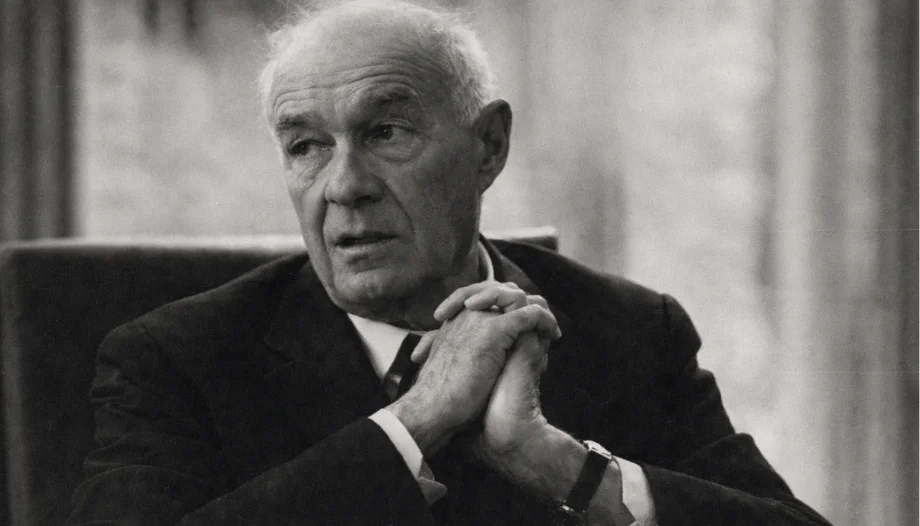
“Our blind gaze before the light” is the title of one of the last works translated into Spanish by Gustave Thibon, the self-taught thinker who chose the solitary life in his peasant retreat of Saint Marcel D'Ardeche. “It is not the light that is missing from our gaze; it is our gaze that is missing from the light,” he said in that book. With his creative silence, he seeks to pierce the darkness that we ourselves create.
From there he tries to transmit the bursts of light that he discovers in his solitude, only interrupted by this or that trip when his presence is required for a lesson or colloquium.
Today he has agreed to comment for the readers of Word that mystery that only the Holy Cross can unveil. We are grateful for his slow, serene phrases, full of Christian experience.
In the so-called permissive or hedonistic society of today's Europe, it could be said that pain has been treated as an evil, as an epidemic that should be eliminated and uprooted. My question is the following: Is it possible for a state, through social reform or by technical means, to totally eliminate pain, and secondly, if this is not possible, how could this pain be exploited, what is the meaning of pain in everyday life?
-Are you talking about physical pain or moral pain?
Physical pain and moral pain
You yourself could make us see what the difference is, and give an answer for both cases.
-As far as physical pain is concerned, I think it is inherent in human nature. There are some bodily needs that can sometimes go as far as physical pain; for example, hunger and thirst and the like. There are also diseases, inclemencies, which can sometimes be terribly annoying and even, sometime, tragic, and which together are part of human nature. I would even say that in the physical order one cannot speak of joy. One can speak of pleasure as opposed to pain.
Well, in reality, it is thanks to discomfort, pain, deprivation, that one feels physical joy more deeply; and by suppressing pain or discomfort or deprivation - as these two things are indissolubly linked in human nature - one comes to suppress pleasure. For example, I remember that at one time I was hungry - it no longer happens to me now and I feel it a little - well, food took on an exceptional quality, eating was an ineffable voluptuousness; I also remember something that has completely disappeared in our “air-conditioned” era; when one returned from working in the fields and there was a north wind, arriving near the fireplace was a kind of revelation of pleasure. If the pole of pain is suppressed, the opposite pole is also suppressed, so that one comes to live an extremely neutral life, without pleasure or pain, which does not seem desirable to me.
What about moral pain?
-Moral pain we wish it to no one, and yet it is necessary to all men. It is not only Christianity that has said this, but from the most remote times it has been thought that only pain makes men gain maturity. It is necessary to go through the ordeal of pain in order to sculpt an inner life. Already the Greeks used to say the formula «through pain comes knowledge» and indeed, man reveals himself through pain.
If pain is suppressed, it happens as in the physical order, the deepest joys of the soul are suppressed, which has been confirmed by Christianity through the Cross. I do not believe that pain should be turned into an ideal because, although I believe that pain matures man, I abhor «painism» which consists in saying that pain is the only value and in artificially provoking and maintaining it. I affirm that good pain is natural pain, that which comes to us from events. - cough. I believe that this one should not be avoided. And contemporary painism would like to suppress moral pain, and it manages to make individuals amorphous, neutral, without any significance.
When I was recently in America, an American woman told me that when her father died, she took the tranquilizers that suited the case and she remembers her father's death like a dream. In my opinion this is really distressing. I think that childbirth without pain is regrettable. Jesus Christ himself said that a woman suffers the pain of childbirth and after the fear, she is happy to have brought a man into the world. And when you do not suffer pain, you do not get the effect of contrast, you are not happy either for having brought a man into the world. I believe that pain is necessary. It is linked to joy as a pole is linked to the opposite pole, as, for example, spring is linked to winter, or to summer if you prefer.
Contradictions
What are the advantages that a Christian can draw from contradictions, from things that come without one looking for them, from things that are painful from a physical or moral point of view? Can anything be found in them that is useful for a man's inner life?
-There is a great teaching. I believe that what is proper to the interior life of a Christian, as far as it is profound, is to accept God's will, to accept events.
Pascal said that if God gave us teachers chosen by Him, then how would we obey them, well," said Pascal, "events are infallible teachers. I believe that in any event, even in pain, a submission to God's will is absolutely necessary for the Christian. You will tell me that it is exactly the same in the case of pleasure or joy, but it is much easier to adore the will of God when God himself is with our own will than when he opposes it. Then, in the acceptance of pain there is a spiritual value.
Pain makes us feel our limits, makes us notice our dependence, creates humility. It also gives us a warning, while happiness, as the poet said, warns us of nothing.
As long as one is happy, one is not warned. Through the trial one reveals oneself, becomes aware of one's limitations and weaknesses, and finds the virtue of humility, essential for the Christian.
If, on the contrary, one rebels against events, against unforeseen or unwanted misfortunes, what fruits can be drawn from this rebellion?
-What one can get from this rebellion is an aggravation of the pain, because when one rebels against pain, then, besides suffering it anyway, because it cannot be suppressed with anger, rebellion enters, which is nothing more than a poison. In any case, the fact must be suffered. Then the famous sentence is fulfilled: “The events guide the one who follows them and drag the one who refuses them”.
Could it be said that in today's society, for example in Europe, there is less and less physical pain and more and more moral pain?
-Unquestionably. Refinements of pain have been created, to the extent that we have wanted to suppress pain, because to the extent that pain is considered as an injustice, and is not admitted, as it remains anyway, it is aggravated by this rebellion, by this lack of consent.
So much comfort has been created, so many facilities, so many possibilities, that everything that is rejected seems to us an injustice and moral pain increases in the same proportion, in such a way that, wanting to flee from pain, we only manage to multiply it, and this is not a paradox, but a reality that we see every day.
So, some signs, such as the statistically proven increase in alcoholism and drug abuse, do they not mean that this moral pain is being put to sleep?
-There is no doubt that one wants to suppress moral pain, but not only that, because many beings are not capable of suffering moral pain. In a certain way, we want to forget, we want to escape from boredom. Because in a society that has suppressed the pain of pain, we want to forget, we want to escape from boredom.
as it has also suppressed joy - since the two are correlative - one falls into monotony, into boredom. Boredom is the cancer of developed civilizations, and this is what all sociologists say. Boredom means killing time, whereas in reality time should be used. And when time is not used, then it is killed. And to try to kill it, the fact of resorting to alcohol, to drugs, to eroticism, are perfectly logical phenomena. In this field it is a question of obtaining oblivion. That is to say, it is the escape from oneself in order not to live as a man, to leave life aside and to live a life of phantasm, of dreams. All these procedures that you mention to me are procedures to transform reality into dreams, and dreams do not do much good. One could speak of a kind of oneiric civilization.
Senior Citizens
The population pyramid, for example, is becoming larger and larger on the side of the elderly, because of the lack of births. Doesn't this elderly population present a somewhat painful situation, since, as the family is being destroyed, they are more and more isolated and unhappy?
-The problem of old age is relatively recent, because although there used to be old people, there were fewer than now. For example, the average age two hundred years ago was thirty to forty years.
There were also people who lived into their eighties or nineties, but far fewer than now. Life has been prolonged in an inordinate way. In the seventeenth century, it has been statistically calculated, a man had to be an orphan of father or mother at the age of twenty and an orphan of father and mother at the age of thirty. Thus, in a certain way, a man of thirty was an old man.
Now, the progress of medicine and hygiene has caused the number of old people to increase dramatically. This distortion leads not only to the conflict of social classes, but to the conflict of generations, to a kind of segregation - now we speak of “classes” of age and of separation between classes of age - which makes the generations more and more isolated, and this is serious for the old and for the children. I have a friend, an American psychologist, who has written an admirably documented book on the feeling of “incompleteness” - as they say - of children who have not known their grandparents.
I must confess that this affects me a lot, because I have benefited a lot from my grandparents - who died when I was in my thirties - and who gave me something irreplaceable. The same feeling of “incompleteness” that is observed in children is also found in the elderly. This segregation is a scary thing. What I found appalling, is something I have seen in America, in some upscale Florida towns, where old people who have some fortune are crowded together.
They don't really look very old; you could say they are old children. That one is frightening. It resembles a post office prison. This is a very serious problem, precisely at a time when we are fighting against all barriers between peoples, races or nations. When we want an inhabitant of Patagonia to be our neighbor, at the same time we introduce segregation between beings through whose veins runs the same blood, between parents and children. I know an American who, talking to me, strongly criticized racism and at the same time could not stand his mother, that is to say, he introduced segregation within his own family.
It is the same as that love of the distant neighbor that seems to dispense with the love of the nearest. Especially when the love of the distant being does not commit to anything. Even if I love the one from Patagonia, he hardly bothers me, and that is a fictitious love. This raises the problem of aging, which is very difficult. I think that old people would be interested in staying in families and remaining active. But this is another problem. Before, they continued in activity as long as they could, and their activity was gradually decreasing. On the contrary, in this centralized and state-run society in which we live, the pension age is like an axe, which at one stroke takes away a man's activity and immediately classifies him among the useless and the parasites. This is horrible, because a man is accustomed to have an activity. Thus, a very large mortality is created in the two or three years following the pension, as the insurance companies could certify. For those who survive, this inactivity creates a boredom, a tiredness, a disinterest in everything. That is why it would be very important to prepare for the pension when one thinks about it, which is not the case for me. I plan to work until the end of my life.
To prepare the future so that the age of retirement will be an age of free activity, where one will be able to do everything one wants, such as reading books that one has not read, contemplating what one has not contemplated, meditating, praying; devoting oneself to charitable, material or spiritual works when one is capable of doing so. In short, this implies a recycling of the old.
Because one grows old. You see, a man is old, at any age, when deep down he no longer has any future to fertilize. I believe that one remains as long as one has something to do. Freedom is a promise, not a fulfillment: I believe that one remains young as long as he keeps in himself a promise. Even if one is on one's last day, one has things to do. I like very much the phrase of Septimius Severus when, being in present-day New York, on the day of his death, the centurion on guard entered his tent.
The emperor, seeing him enter, took the papers he was carrying - State papers - and sitting up, said, “Laboremus” - let us work - and at that instant he died. It seems to me that this is a beautiful end to a life.
Mr. Thibon, the trend is now towards a concrete way of ending life, the so-called “death with dignity”. Euthanasia goes without saying. You know that its legalization is already being discussed in some European countries. If not yet inscribed in the customs, it has at least been introduced in draft laws. Is this philosophy that leads to euthanasia not the same as the desire to overcome pain in its ultimate expression?
-It is exactly the same. It is curious to observe to what extent the extremes touch each other. On the one hand, euthanasia is preached. I have seen a very documented book, written by a doctor, which speaks of “termination of old age” as one speaks of termination of pregnancy. This seems very logical to me, because if abortion is considered normal, that is, to suppress the possibility of an entire life, it seems much more normal to me to cut short a life that has already been largely realized. In reality, the person in question suffers less.
What I find very curious is that in the same era in which euthanasia is proclaimed, that is, the artificial shortening of life, artificial prolongation of life is also preached, keeping dying people in a state of survival by the most complicated, most curious means.
Whereas good Catholic theology, as I remember reading in a seminary manual of about a hundred years ago - a time when there was common sense - said that no one is obliged to preserve his or her life by means that are too complicated or too costly. It is about sustaining life beyond what is natural. There are resuscitation rooms in hospitals where people are kept in comas for months at a time.
My daughter-in-law is in one of those wards where they kept - against all logic - children who had been born wrong, deformed, monstrous, and now next door is the abortion ward, where they will suppress well-built children. I believe that the ideal would be to follow the laws of nature, which in the end are the laws of God. To follow the cycle of life.
To have the pains that nature sends us and, at the same time, not to practice euthanasia or artificial prolongation of life. As far as the attenuation of certain pains is concerned, everyone knows that patients who suffer too much are given morphine. This may shorten life by two or three days, but it is not really euthanasia. One is not obliged to suffer to infinity. But euthanasia as such is monstrous. It is the same rebellion against Providence as the artificial prolongation of life.
A wisdom
On the other hand, there are theologians who say that suffering on the deathbed can shorten the pains of purgatory. Do you agree?
-Obviously, I am not a theologian nor do I know the secrets of God, but I believe that the fact of accepting all the trials that come to us in this life certainly has a value of purgation, of consent, of prayer, which should normally shorten the pains of purgatory. Because when pain is well received and does not make a person sour, it places the individual at his limits, it teaches him his fragility and his nothingness, which is already a lot.
In general, when a man is ill, if he is not essentially revolted, he realizes that when he was healthy, he had neglected many essential things, that he had preferred the accessory to the essential. This is very frequent. Celine, who is a great man, although I would not recommend him in all his aspects, said “I have become a doctor, because when men are ill they are a little less scoundrels than when they are healthy”. They return to their limits, to their humility.
It is a contradictory desire. We would like our children to possess all the wisdom that pain brings with it, but we do not want them to suffer. That is why when you see some parents who have known misery or who have been poor in childhood and then have a well-to-do situation, then they make of their children spoiled children, saying: “I would not want my child to suffer what I have suffered or to lack what I have lacked”. In reality what they lack is to have lacked something; because everything that is appreciated because before it was not had and then it has been conquered, as they obtain it immediately, then they will not appreciate it. We can say then what Péguy said: “What we lack is the lack”.
In certain political movements, for example, the Marxist revolutionary movements, there is a lot of talk about the liberation of man and it is even believed that man can free himself from pain through revolutionary struggle. What is the relationship between this ideology and the Christian doctrine of the cross of which you spoke?
-Marxism is opposed to the Cross for the simple reason that it believes in the terrestrial paradise, that is to say, the epoch of the disappearance of the State, the epoch of a tomorrow that sings, the epoch of the great night, where society will live in a perfect equilibrium, where, according to Marx's words, man will have found an agreement with himself, with nature and with his fellow men, according to a philosophy inherited from Hegel, where all the contradictions of existence will be abolished. I will tell you at once that this seems to me childish, and that not the slightest principle of the abolition of these contradictions is discernible. Things remain exactly the same. It is worse in the economic field and even worse in the political field. And when Marxism pretends that it could solve the psychological problems, the moral problems, they are nothing but jokes, as if this could have the slightest relation to political reforms, whatever they may be. On the other hand, they themselves are forced to confess it.
I recently read a German magazine that quoted an article published in Russia. There it said “Is love conservative?” Because in Marxist mythology, the conflicts of love, the crimes of passion, the fact that Romeo commits suicide if Juliet rejects him, all that belongs to bourgeois society; when man will be “de-alienated,” all those conflicts will disappear.
Well, the magazine was obliged to recognize that, even in Russia, if a boy is madly lost for a girl and she rejects him, the boy feels unhappy - exactly like the bourgeois - it is curious - and it recognized that there are in the USSR suicides of this kind, adulteries, crimes of passion... That is why the question of whether love would be conservative. But love is neither conservative nor revolutionary. Love is what it is, what do you want? By wanting to suppress the Cross, we only succeed in nailing it to men, taking away from them the merits that the Cross carries with it. There is a phrase of the English politician, Lord Hampton, who says that society becomes a hell when you want to make it a paradise.
If someone gets married and expects perfection in his wife, if he asks her to embody all women, and even with contradictory virtues, how reality will contradict him, the marriage will tend to turn into hell! That is why men who seek perfection in a woman go from one woman to another and find less and less of it.
The Cross is inherent in human nature. The cross, the contradictions, are erased in the higher world. Simone Weil said very rightly that the enormous error of Marxism, its crime, is the wrongly made union between the contradictories. I believe that the contradictions here below can be resolved in time, but horizontally, at the same level of time. Whereas the contradictions of existence are resolved, not at the level of existence but at the level of being. They are resolved in God. There is not the slightest doubt. That is why St. Thomas noted very well that the coexistence of two opposite virtues, such as, for example, understanding and fortitude, could only be supernatural.
Discovering the meaning
Today people rebel against pain and suffering because they do not find meaning in it, and it may also be because they have rejected the only meaning it could have, that is, the redemptive meaning.
-Unquestionably. It has the sense of consent to what God wants and it also has the sense of redemption. Simone Weil, with her usual genius, said that there are three types of suffering: punitive suffering, which expiates our sins, punishes us for our faults - we all have so many of them.
Secondly, purifying suffering, which is no longer only punishment, but purifies us, makes us better. And thirdly, redemptive suffering. When one is already purified, then one pays for others. This is the very theme of the Communion of Saints.
Evidently, when the meaning of suffering has been found, then the feeling itself is lightened, it takes on a meaning. But unfortunately, nowadays, nothing has meaning anymore. Nothing has meaning, life has no end. Then, an end appears, which is comfort. Obstacles must be avoided. When there is no goal in the journey, it is better not to travel. Or at least, if you have to travel, what you are looking for is the maximum comfort since there is no end. This is the misfortune of all psychology and modern sciences which, on the other hand, have made extraordinary discoveries. They have explored all the nooks and crannies of the human lock, but they have lost the keys.
In other times, as in the Middle Ages, the lock was much less known - psychoanalysis and all that had not been done - but they had the key. The key was God. The key was the meaning of human destiny. It was the eternity that awaited us. Now you know the lock perfectly well, with all its springs, but, if it is useless, what do you want to do with a lock? As Peguy said: “The door is Jesus and Jesus is the key”.






 Español
  English
  Italiano
  Français
  Deutsch
  Polski