




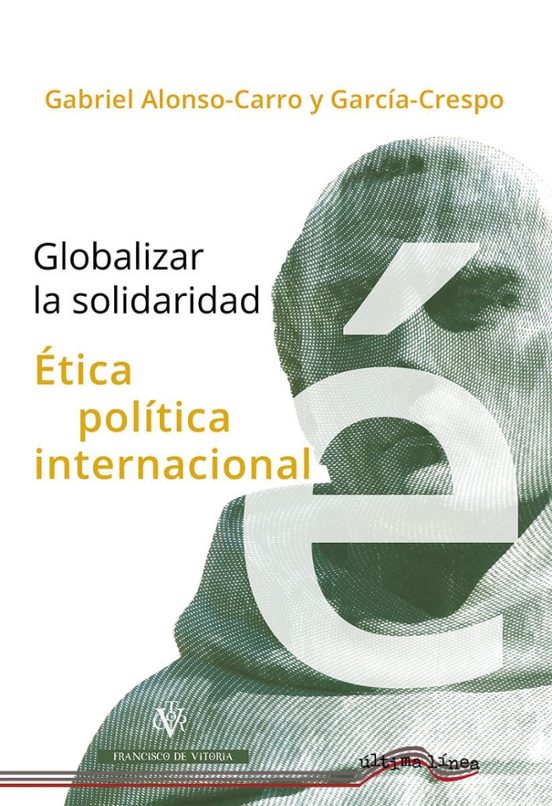
«Globalizing Solidarity. International political ethics» is the result of the author's personal experience and reflection after ten years as Head of Studies at the Diplomatic School of the Ministry of Foreign Affairs (Spain). Due to his philosophical and theological formation (he was, in addition, professor at the Ecclesiastical Univ. S. Dámaso of Philosophy and at the CEU S. Pablo of Social Doctrine of the Church), plus his studies and professional practice in International Relations, it is an interdisciplinary volume of humanistic thought very much inspired by the Catholic social vision. Although it is not really a theological study, but a theoretical reflection and history of International Politics.
The result is a suggestive and stimulating volume to approach the analysis and study of the international panorama - and more so today - from keys such as ethics, solidarity, personal dignity and the unity of the human race, so dear to the Western and Christian tradition. To this is added a more hopeful and moderately optimistic vision than usual. In this sense, it always places the person and his or her intrinsic transcendent dimension at the center as the foundation of the possible joint approach to the challenges posed to the global human community, in continuity with the Hispanic tradition of the School of Salamanca and later milestones.
Promoting peace
In this order, two ideas underlined by St. John Paul II (the globalization of solidarity) and by Pope Francis (the culture of encounter) are developed in some detail. The work pivots on these two axes. Let us say that inspired by them, I develop its foundations from the human and social sciences. A few weeks ago, Susana Tamaño, the successful Italian writer, urged intellectuals to support Leo XIV's intention to promote a “disarmed and disarming” peace, and this monograph is a good example.
If we stick to etymology, by solidarity we should understand that which is solid, that which is compact. And that is the direction in which globalization (mundialization in French) should point in order to build a more cohesive global human community in the face of the great challenges that lie ahead: AI, climate change, mass migrations, serious war tensions, etc. One cannot fail to mention the interesting opening chapter, in which the constant historical desire for the unity of the human race from classical antiquity to the present day (global governance, planetary democracy, etc.) is framed, together with the apt mention of the Hispanic tradition - which was a realization of the universal monarchy project dreamed of by Dante - and inspired by a more balanced anthropological vision than the Lutheran and Protestant one subsequently adopted by the Anglo-Saxon world.
Moral reason in the face of global challenges
The path proposed in this work is the exercise of moral reason as opposed to mere technical reason (a diagnosis already pointed out by the Frankfurt School) and, as opposed to a pessimistic conception resulting from the understanding of the world order as the realm of chaos, power, violence or amorality. An «idealism without illusions» (in the felicitous expression of G. Weygel, biographer of St. John Paul II) is proposed which offers a better reason for international politics than pure realism (Realpolitik) or the voluntarist utopian idealism.
The book does not remain merely illusory daydreams, but successfully argues and demonstrates with historical facts that this approach to understanding complex global politics is more correct, more accurate, and that, moreover, it allows us to face the future of humanity and the planet with moderate and cautious optimism. This is not a matter of wishful thinking, but of noting that the human community possesses ethical resources, already proven and brought into play in the recent past, that can enable it to act jointly in the face of certain disturbing challenges. In this context, the positive evolution of human development, now conceived as integral, the greater sensitivity to the need for peace and the necessary limitations of wars (ius ad/in bellum), the relevance of international solidarity or the pacifying role of different cultures, religions and worldviews -especially the Western one-. In short, there are compelling reasons to see some light in an international panorama that often appears too gloomy and convulsive.
Globalizing solidarity. International political ethics
Professor of Spanish Literature at the Complutense University.






 Español
  English
  Italiano
  Français
  Deutsch
  Polski