


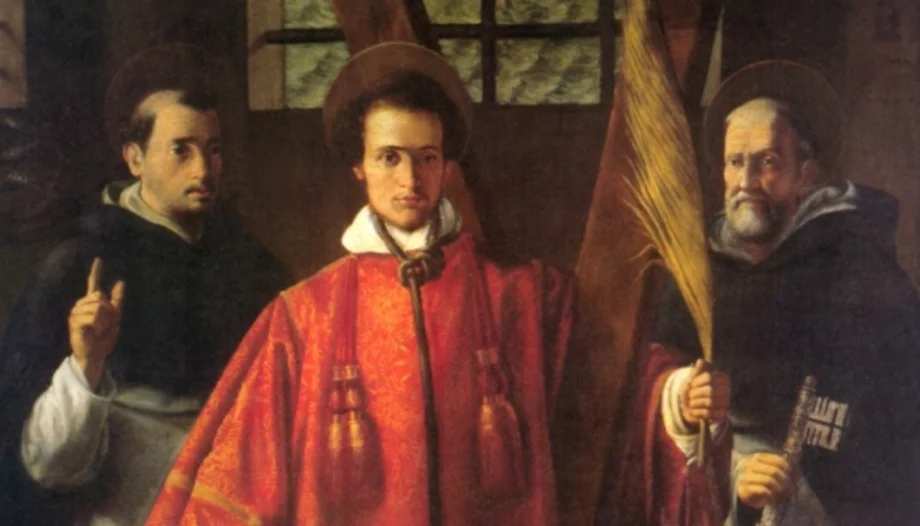
The figure of St. Vincent, deacon and martyr of Huesca, continues to fascinate believers and scholars alike. In fact, his testimony, set within the framework of the Diocletian's persecution at the beginning of the fourth century, retains a surprising timeliness. It is not just an “ancient character”, nor “a heroic chapter of the past”; on the contrary, it is a living call to fidelity, to courageous love and to the truth that liberates.
It is curious that Christian history presents him as a servant. nearby to his bishop, a herald of the faith full of a singular courage, whose genesis is none other than the same Spirit, proof of which is that Vincent is a man capable of giving his life without rancor.
We will take a brief look at the meaning of this saint. oscense from his identity as a deacon, his martyrdom, the liturgical tradition that has venerated him and, finally, we will allow ourselves to be enlightened by the thought of Pope Benedict XVI, whose teachings on truth, freedom and love allow us to rediscover their value for our time, on this occasion, especially for young people.
Brief historical context
Vincent lived during the great persecution waged by Emperor Diocletian between 303 and 304. It was a time when being a Christian implied a real risk: temples were destroyed, meetings were forbidden, and people were forced to renounce their faith in order to preserve their lives. It was in this context that Valerius, bishop of Saragossa, and his deacon, Vincent, a native of Huesca, were arrested.
The old Passio Sancti Vincentii relates that, because Valerius had speech difficulties, it was Vincent who usually took charge of proclaiming the Word on behalf of the bishop. This mission explains that, before the governor Dacianus, it was the young deacon who took the floor to defend the faith of the community. While Valerius was sent into exile, Vincent was subjected to various torments in Valentia (today Valencia), where he finally gave his life.
In addition, the patristic texts and hymns of Prudentius -such as the Peristephanon V- underline the inner serenity of the martyr, his spiritual strength and his joy in the midst of pain, a sign of the presence of the Holy Spirit. His testimony and fame spread rapidly, making him one of the most beloved figures of the Hispanic Church.
Vincent: the martyr servant of charity and herald of the Word
To speak of St. Vincent as a deacon is to enter into the essence of his vocation. In the early Church, the deaconate united two dimensions inseparable: in the first place, concrete service to the community, especially to the poor; and secondly, the proclamation of the Word, always in communion with the bishop. St. Augustine, in referring to Vincent, describes him as someone who served Christ “by word and deed” (Serm. 276). This double mission defines his whole life and prepares the ground for understanding his martyrdom.
Vincent was neither an ideologue nor an agitator; he was a servant. His courage came from a deep spirituality and from a life dedicated to others, a selfless and generous dedication, without thinking so much of himself as of the good he could do with his actions, his words and, why not say it, with his own martyrdom, which was not the fruit of improvisation, but the logical consequence of having lived daily the diaconia: service to God, service to the Gospel, service to his neighbor.
Now, for the ancient Church, the martyr is the one who participates in the Passion of Christ. Tertullian said that “the blood of the martyrs is the seed of Christians”, because in them the face of Jesus shines in a very special way. In the Passio, As Vincent suffered, it was affirmed that he was sustained by “another”, in a clear allusion to the Holy Spirit. The martyr is not a solitary hero; he is someone carried by grace.
Vincent does not die for an abstract ideal or an abstract stubbornness, but for the life-giving Truth, Christ. When the governor offered to save him if he renounced his faith, he responded - according to tradition - with serene firmness: he could not deny that which gave meaning to his existence. St. Augustine taught that “it is not the torment, but the cause, that makes the martyr”. In Vincent, the cause was Christ himself.
The sources emphasize that Vincent showed an inner peace that impressed even his own persecutors. This peace is a sign of the Holy Spirit, who transforms fear into courage. Martyrdom, thus understood, is an act of love rather than of resistance: a free and trusting surrender.
The voice of the liturgy: Vincent, light of the Church
Since the first centuries, the liturgy has preserved the memory of Vincent. In ancient sacramentaries (Leonianum y Gregorianum) appears in his celebration. The collect prayer of his feast expresses with simplicity the core of his witness: “to imitate his strength to love what he loved and to practice what he taught”. The Christian poet Prudencio calls it lumen Hispaniae, the “light of Hispania”. He does not do it for nationalistic reasons, but because he saw in him a light that springs from Christ.
His martyrdom became a living proclamation of the Gospel. This liturgical assessment shows us that Vincent was not only a defender of the faith, but also a spiritual model, a point of reference for the communities and a generator of Christian life.
A contemporary reading of St. Vincent's testimony
Recent decades have once again highlighted Christian martyrdom as a witness to truth, love and freedom. In this sense, the thought of Benedict XVI helps to illuminate the figure of St. Vincent and to situate him in dialogue with today's challenges.
In the first place, from the point of view of the Truth that liberates, Benedict XVI insisted that the truth does not impose itself, but “has its own force. In a world where there is a fear of affirming certainties, the martyr reminds us that truth is a good to be loved and guarded. Vincent was not saved by lying, because he knew that lying enslaves. His freedom was born of the truth of Christ.
Secondly, if we consider love as the center of Christianity, in the second place, in Deus Caritas Est, the Pope teaches that love is the essence of Christian life. Martyrdom, far from being a gesture of defiance, is the greatest expression of this love. Vincent did not die out of hatred for the persecutor, but out of love for Christ and his Church. His meekness confirms that Christian martyrdom is not violence, but communion.
Thirdly, we must assume that the light of Vincent and his martyrdom is capable of illuminating even the errors proposed by modern relativism, showing on it the Truth of the Gospel, in fact, on several occasions Pope Benedict XVI denounced the “dictatorship of relativism”, which confuses the "truth of the Gospel" and the "dictatorship of relativism". freedom without truth. Vicente is an antidote to this culture: a humble but firm Christian, who does not renounce to confessing what he believes in. His example is especially valuable for today's deacons and agents of evangelization.
And, fourthly, on the criteria of religious freedom and the strength of conscience, in speeches at the Bundestag and at the Collège des Bernardins, Benedict XVI defended the public presence of the faith. In the case of Vincent, saying yes to God and no to the demands of power, He anticipates a vision: conscience is sacred territory that no government can invade. His martyrdom is a defense of religious freedom in its purest form.
St. Vincent and the youth of our time
Among all the messages that St. Vincent offers to the Church today, one stands out especially: his closeness and strength for young people. Why? Because he is an authentic witness of coherence; in fact, young people today value authenticity. St. Vincent did not live a half-hearted faith; on the contrary, his life was a resounding “yes” without double standards. In a world where empty speeches abound, young people can find in him an example of radical coherence.
Now, the life of Deacon Vincent shows that faith is an adventure, since Vincent's life was marked by service, inner struggle, preaching, friendship with his bishop and, finally, witness. It was an exciting existence. Today many young people are looking for causes to live for; Vincent reminds them that Christ is the greatest adventure, and consequently the radical cause of one's existence.
Vincent also teaches us that courage is born of faith; it cannot be an isolated experience in the field of faith. Young people experience social pressures, doubts, comparisons, fears, and Vincent teaches that strength is not in self-sufficiency, but in the Holy Spirit. His life proclaims that faith does not weaken, but sets free and strengthens.
And finally, the message to be impressed is that his life and martyrdom are a model of service and a credible sign that there really is something that matters and surpasses us. Vincent's diaconate shows that Christian greatness is in serving.
Many young people feel the desire to help; St. Vincent channels that generosity into a service that is born of the Gospel, a service that produces joy and at the same time is a credible, visible and noticeable sign. Prudentius, in describing him in the Peristephanon, underlines their joy in the midst of suffering. Young people are looking for authentic joy, not illusory joy. In Vincent we can see that true joy is born of a heart given to Christ.
St. Vincent, deacon and martyr, is a transcendent figure. His witness illuminates the life of the Church, inspires deacons, strengthens persecuted Christians, awakens faith in those who doubt and offers young people an example of authenticity and courage.
Vincent appears as a witness to the truth that liberates, a servant moved by love, and a profoundly free man. His life shows that following Christ is not a burden, but a fulfillment. And his fidelity invites everyone - especially young people - to live the faith in a joyful, coherent and courageous way and continues to be, as Prudentius said, lumen HispaniaeThe light that does not go out, a guiding light and an example that strengthens the Church in every age.





 Español
  English
  Italiano