


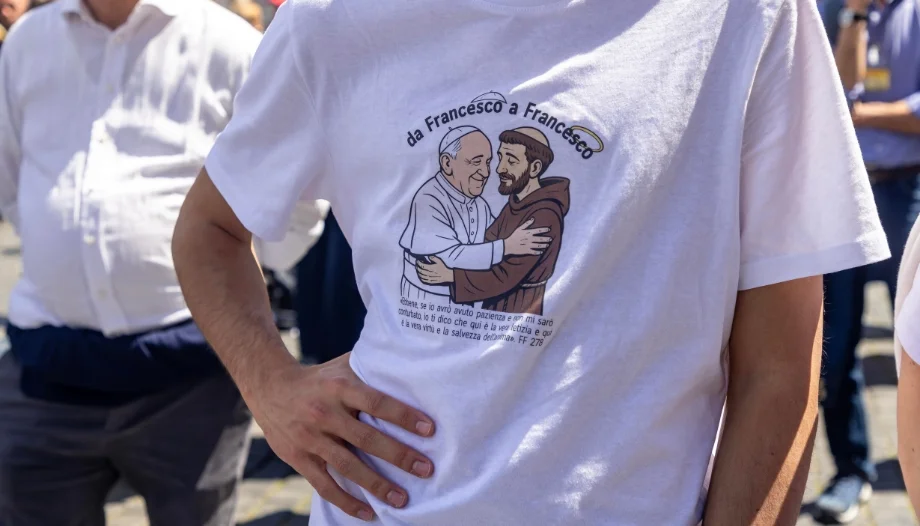
A few days ago we received the pleasant news that the Holy Father Leo XIV had convoked a Jubilee Year dedicated to St. Francis for the year 2026, which will last from January 10, 2026, to January 10, 2027. Let us hope that at the end of this time he will grant us the gift of an encyclical or apostolic document on the teachings of the saint of Assisi, so dear to all Christian people.
Franciscan poverty
With this year dedicated to St. Francis, the Holy Father simply wishes to commemorate the eighth centenary of the death of the “...".“Poverello”The name "Carlo Acutis", as they call in Italy to one of their most venerated and beloved saints and visited in Assisi where his remains are kept and now also those of Carlo Acutis.
Precisely, the decree published on January 16 by the Apostolic Penitentiary recalls the hopes of the Holy Father, expressed in very concise but precise words, that “every Christian faithful, following the example of the Saint of Assisi, may become a model of holiness of life and a constant witness of peace”.
Finally, the decree recalls that to gain the plenary indulgence it is sufficient to visit any place related to St. Francis or the Franciscan family. Finally, the decree recalls the general conditions to be observed to gain the indulgence “with the usual conditions (sacramental confession, Eucharistic communion and prayer according to the intentions of the Holy Father), applicable also in the form of suffrage for the souls in Purgatory”.
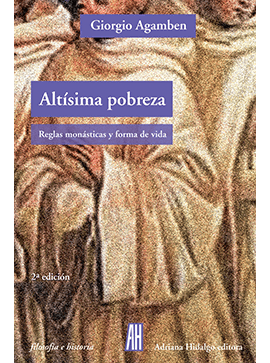
Precisely in the work of Giogio Agamben, to which we will refer next, the relationship between the primitive Franciscan rule and law will be dealt with exhaustively, and in these pages we will discover the high concept of poverty for St. Francis and for the great authors of Christian spirituality. Precisely in the 21st century, with the great inequalities between North and South and within Western countries themselves, it is very important that we apply the teachings of poverty to the life of Christians of every class and condition in this Jubilee year dedicated to St. Francis of Assisi.
Identification with Christ
Our author, Giogio Agamben, will deal with the concept of “Highest Poverty” in many different ways, since total detachment from earthly goods is one of the most essential characteristics of St. Francis. This “Highest Poverty” has much to do with the life of Jesus narrated in all naturalness in the Gospels and in the New Testament.
The detachment and, at the same time, the freedom in the use of the material goods so necessary to be able to live and develop the intense activity of the hidden and public life of Jesus, will mark the poverty of the first Christians.
Lady Poverty, “Lady of the heart”, St. Francis called her, and with these words, taken in all their dignity and category, he is dealing with such a delicate question, because, as Giorgio Agamben will explain, many learned theologians and canonists became bitterly involved after the death of St. Francis to argue about the rule and the law, about the use and ownership of material goods (119).
Those great diatribes, seen now with the perspective of time, can seem to us Byzantine discussions or school debates without the greatest interest. But the reading of those impassioned quoadlibetales speaks to us of the radical holiness of the Christian life (162).
Certainly, this is a question that affects the heart: “Ubi thesaurus cor” (Mt 6:21) “Where your treasure is, there will your heart be”. In this sense, the solution was given by St. Francis himself when he affirmed that to love and imitate Jesus Christ was the basic rule of the Christian, the rule of life of anyone who wishes to love and imitate Jesus Christ is to identify himself fully with Him (152).
Joy and peace as the essence of the Franciscan charism
Immediately, we must remember that, as the venerable Cardinal Carlos Amigo Vallejo, Archbishop of Seville, a Franciscan since his time at the University of Valladolid, often affirmed, the essence of the Franciscans was not poverty but joy. Indeed, the most important thing we will learn from this Jubilee Year of St. Francis was his profound joy, his good humor and his optimism, fruits of an immense love for God and souls.
I will always remember the anecdote that Friar Carlos Amigo Vallejo told me in one of our long conversations. He referred how in one of the first meetings of the Franciscans on the outskirts of Peruggia, on the lawn, there were about three hundred people coming from all the places where they were established. They were in silence and prayer when St. Francis stood up and exclaimed: “We have made great promises to God”. After a while he stood up again: “Even greater are the promises that God has made to us”. Finally he spoke again for the third and last time, before blessing them and bidding them all farewell: “Let us be faithful to our promises and He will be faithful to His promises!.
It is always said that joy is the result, the consequence of having peace in the heart, the fruit of living the prayer, the Our Father, that Jesus taught us: “Thy will be done on earth as it is in heaven”. If we try to think about what Jesus and others may need from us and we are ready to give it to them, we will discover that the first thing others need is a smile (173).
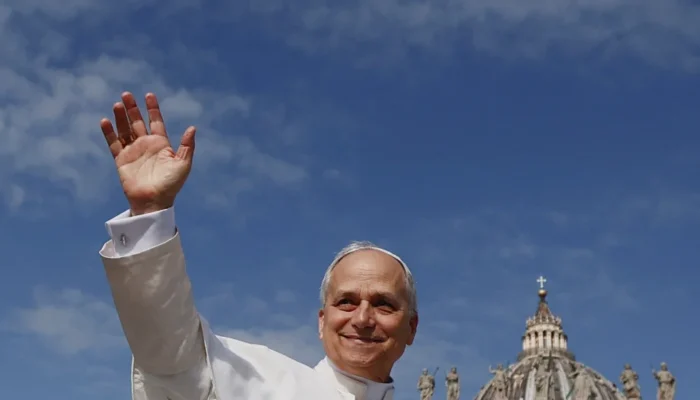
Precisely, the first thing the Holy Father Leo XIV did when he was elected from the balcony of St. Peter's Square was to remind us: ”Peace be with you” and to ask us to be builders of unity and peace.
It is significant that this is the goal of this new Jubilee Year, which follows the Jubilee Year of Hope. Let us recall the words of Leo XIV when he proclaimed the Year of St. Francis: “May every Christian faithful, following the example of the Saint of Assisi, become a model of holiness of life and a constant witness of peace”.
Joy is the consequence of knowing that we are beloved children of God, as St. Josemaría so often emphasized, ever since he discovered trust in God the Father in one of the moments of his greatest mystical life, on a streetcar near Atocha Street in Madrid.
Highest poverty. Monastic rules and way of life.





 Español
  English
  Italiano