



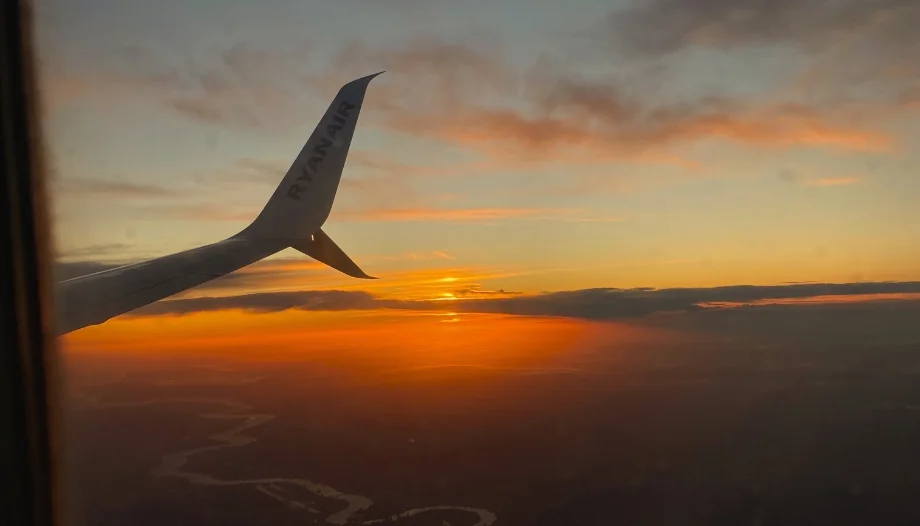
Last Sunday I experienced terrible turbulence on a plane returning to Madrid. Many passengers were screaming and many others, like me, were praying in silence. When we landed without any mishap, there was nervous laughter and comments of relief. One of the passengers said to her companion: “I have even prayed an Our Father, and I haven't done it in ages”.”. It was then that I remembered Leiva's famous song in which he recites the phrase: “everybody believes in God when the airplane moves”.”. Never before has a verse made me feel so identified.
The scene is revealing. In a matter of minutes, people who perhaps had spent years without saying a prayer, without thinking about God or even openly denying Him, turned to Him with an almost instinctive naturalness. As if, deep down, there were a hidden certainty that only comes to the surface when the illusion of control disappears. As long as everything is going well, as long as we believe we have life under control, God seems dispensable. But when the ground -or the air- moves, something within the human being seeks shelter in the eternal.
One can spend the whole day enjoying what God gives us - life, health, love, beauty, even routine - and live completely oblivious to the One who created and sustains it all. We consume the gifts as if they were acquired rights, without stopping to think about their origin. And yet, it is when turbulence comes that we decide to turn to something greater than ourselves. Not to money, not to success, not to self-sufficiency, but to God.
Israel also remembered God
This behavior is not new. It was already seen in the people of Israel. When they arrived in the Promised Land, after being freed from slavery, they became comfortable, forgot about God and began to worship gods that were not God. But when famine, war or exile came, then they cried out to the true God. In need they recognized what in abundance they had ignored. History repeats itself, century after century, person after person.
It is curious - and at the same time very human - how in the worst moments we turn to the only one who, deep down, we know can help us. Perhaps because the proximity of death makes us honest. It reminds us that we are not invincible, that we do not control everything and that our life hangs by a much more fragile thread than we like to admit. In those moments, the masks fall and the essential question appears: what is beyond me?
Learning to die, learning to live
Death, or its threat, has that power. It compels us to look to Heaven, even those who spend their lives oblivious to it. As St. Augustine said, “You have made us, O Lord, for Yourself, and our heart is restless until it rests in You.”. Maybe that's why, when the plane shakes us, the heart remembers what the mind had wanted to forget.
Perhaps the turbulence is not there just to scare us, but to remind us that we are not alone, that there is Someone greater than us, even when we only remember Him in the midst of fear.
Perhaps that is why Montaigne's phrase makes so much sense: “learning to die is learning to live”.”. Turbulence brings us face to face with the essential. At that moment, false certainties disappear and only the naked truth remains: we do not control everything. To learn to die is not to wish for the end, but to accept our fragility and, from there, to live with greater awareness.
Those who have faced the possibility of dying learn to be more grateful, to live with less pride and not to forget God so easily when everything goes well again. Because if we only remember Him when the plane is moving, perhaps we have not yet learned how to live.






 Español
  English
  Italiano