


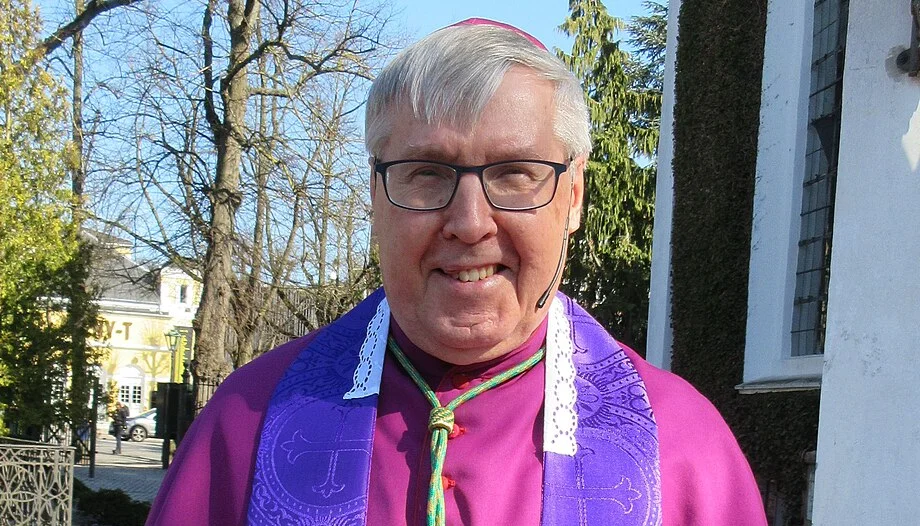
The magazine Katolskt magasin interview with the Bishop of Copenhagen, Czesław Kozon, who talks about the challenges and hopes he sees for his diocese and for the Church in Denmark.
There was a time when the Catholic Church was the cornerstone of Danish society. The evangelization of the country began as early as 826, when Emperor Ludwig the Pious sent the Frankish missionary St. Oscar, the “Apostle of the North”, to proclaim the Gospel in Denmark and Sweden during the Viking Age.
Paganism long maintained a strong influence, but Oscar's missionary work bore fruit a little over a century later, when the Danish King Harald Blåtand had himself baptized. Only with the Reformation in 1536 was the Catholic faith banned in Denmark, a ban that remained in place until 1849.
Today Catholics represent less than 1 percent of the population. However, since the middle of the 20th century the Church has grown thanks to immigration from countries with a Catholic tradition. Even so, Denmark remains, as in St. Oscar's time, a difficult mission field. The difference is that today it is secularization that challenges evangelization, even though the Evangelical Lutheran Church is formally the national Church.
«Many politicians claim that Denmark is a Christian country,» says Bishop Czesław Kozon, «but in people's daily lives one can hardly find any traces of Christianity.».
He points out that, of course, one cannot compare the situation today with the Middle Ages, but that the country's Christian roots should not be forgotten. «It should not be considered anti-Danish to be Catholic, but many people think that a true Dane must be Lutheran. That is why we must show that you can also be a good and authentic Dane by being a Catholic. It is often argued against the Danish character of the Catholic Church that it is to a large extent an immigrant Church, as is also the case in the rest of the Nordic countries.».
A triple challenge for the Church
Bishop Kozon has headed the Diocese of Copenhagen since 1995 and is only the third Danish-born bishop since the Reformation. He was born in 1951 in Brovst, in northern Jutland, and his own story reflects the current character of the Church: he is the son of Polish immigrants who came to Denmark to work. After studying philosophy and theology in Rome, he was ordained a priest in 1979 and served in several parishes and as vicar general before Pope St. John Paul II appointed him bishop.
As pastor of the only Catholic diocese in Denmark - which also includes Greenland and the Faroe Islands - he describes three main challenges: being a Christian minority in a strongly secularized society; being a Catholic minority in a dominant Lutheran context; and creating an integrated Catholic community in a Church that today is mostly made up of newcomers. He acknowledges that some Danish Catholics may feel that they are a minority even within their own Church, but he sees diversity as a richness rather than a problem.
«I see it as an enrichment. We are a universal Church and it is in our nature to welcome Catholics wherever they come from,» he explains. At the same time, he stresses that while many Catholic immigrants may not feel like a minority within the Church, they are a minority in Danish society and may feel excluded if they do not actively seek to integrate into the church community.
Catholic positions are ignored
According to Bishop Kozon, about 60 percent of the population is registered as members of the Lutheran Church. The Catholic Church is the second largest Christian group in the country, but has only about 55,000 members.
«There are probably ten to twenty thousand more, but we are still far behind the Lutheran Church in numbers,» he says.
Being a Christian in today's Denmark is, in general, a great challenge, especially on issues related to marriage and family, abortion and euthanasia. The modern view on these issues is widely accepted in society and among politicians, so Christian arguments are rarely welcome in public debate.
The Catholic Church takes a stand on these issues, but because of the small number of Catholics its voice is not taken seriously, the bishop explains. «Many know what the Church stands for, often with a negative tone, but our statements are often met with silence. We are ignored,» he concludes.
A change of attitude
The latest annual Vatican statistics show that the world's Catholic population has grown from 1.39 billion to 1.41 billion. Europe is the least dynamic region, with an increase of only 0.2 percent, although several countries have recorded a notable increase in the number of baptisms. France, “the Church's eldest daughter,” reached record numbers of baptisms in early 2025, despite the deep secularization that has long characterized the country.
Asked whether Denmark is experiencing something similar, Bishop Kozon replies that they have seen an increase in participation in adult courses on the Catholic faith, although the numbers are still modest. «It's about a hundred people a year,» he qualifies.
Nevertheless, he perceives a positive change: today people are more daring to talk about their faith. «A few decades ago it wasn't like that. Back then it was something very private, even impolite, to ask someone if they were a believer. That has changed,» the prelate explains.
Looking to the future
As for vocations, the bishop explains that there are currently seventy-three priests in Denmark, while the number of religious sisters has dropped to less than one hundred. For this reason he maintains that «from a vocational point of view we are not particularly strong. At the moment we do not have any Danish born seminarians in priestly formation».
At the same time, new vocations are emerging thanks to the Redemptoris Mater seminary in Copenhagen, which is part of the diocesan missionary seminaries linked to the Neocatechumenal Way. So far it has trained fourteen priests and another thirteen young men are preparing for ordination. «They ensure the availability of priests to be able to serve our parishes,» he explains.
Despite this, the diocese is looking for ways to awaken local interest in the priesthood and consecrated life. «In Sweden and Norway there are more native vocations. I try to encourage young people at confirmations to think about the priesthood or religious life, but we lack the resources to have a specific vocation minister who can work directly with young people,» the bishop laments.
He notes that the shortage of vocations is not exclusive to the Nordic countries, but a Western phenomenon, especially in the case of women. «Classical religious life, especially in active apostolic orders, no longer attracts young women. It is sad that this way of life is practically disappearing.».
Despite all the difficulties, Bishop Kozon remains fundamentally optimistic about the future. «When I see people rejoicing in their faith, even showing enthusiasm - especially young people - or when more people come to confession, I see that the faith is alive. There are people who really want to deepen their faith and pass it on to others.».
The prelate concludes by affirming that «it is decisive that what remains of the Church be credible and that we radiate joy and hope. That is my hope: that we can do it.
This article originally appeared in the magazine Katolsk Magazin from Sweden. Reproduced here with permission of the publisher.






 Español
  English
  Italiano
  Français
  Deutsch
  Polski
  简体中文
简体中文