


In the 11th-12th century, St. Anselm of Canterbury asked in a famous book, “Cur Deus homo?” why God had become man. Certainly in God's redemptive plans after original sin, there was a key element: to redeem the world and illuminate it from within again, it seemed necessary to do it from within, it was not enough to do it from without.
Seen a posteriori, the mystery of the incarnation of the second person of the Blessed Trinity and the hypostatic union; two natures, divine and human, in the one person of Jesus Christ, seemed very convenient to carry out the work of Redemption and Salvation.
“Gaudium et spes” and the Church as the soul of the world.
Precisely on this recent anniversary of the Pastoral Constitution “Gaudium et Spes” (1965) that we have just celebrated, that element of the illumination of the world from within, from the light of so many hearts that are one, one could understand the conciliar expression with deep patristic resonances: “the Church is the soul of the world”.
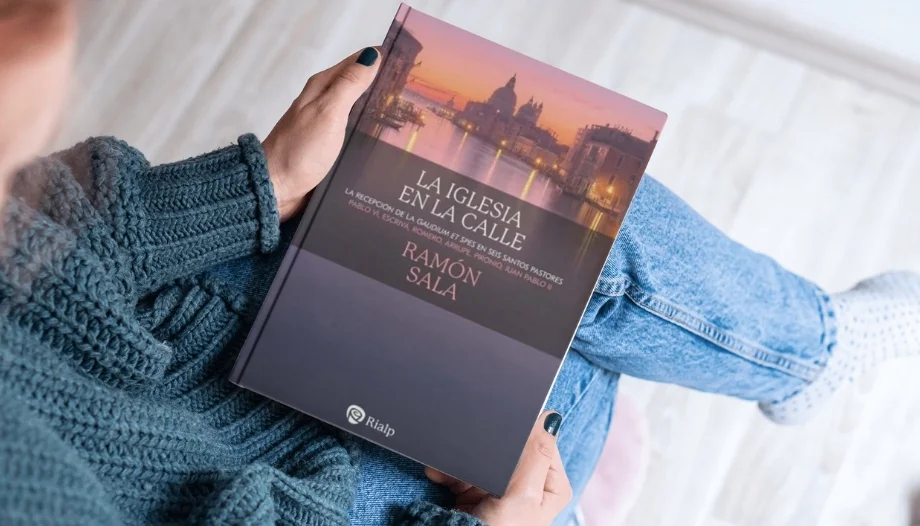
Ramón Sala OSA (Bilbao 1963), professor of theology at the Augustinian Theological Study of Valladolid, has done a magnificent job of understanding the texts of the Constitution “Gaudium et spes”, taking as a starting point the life and work of great saints who were involved in its drafting and its interpretation according to the light of God that they had received.
The Popes of the Council and its living application
Of course, the selection of persons and themes elaborated by Professor Sala could not be more appropriate: first of all, two Roman Pontiffs: St. Paul VI and St. John Paul II, two saints who knew how to echo the Holy Spirit, first as active protagonists of the and then in its development or application.
St. Paul VI was able to intervene in Vatican Council II, first as Council Father and then as Roman Pontiff to carry it out and close it. Ramón Sala recommends us to read slowly his Encyclical “Ecclesiam suam” (Rome 6, VIII, 1964), to discover many concomitances and synergies with the mentioned Constitution (26).
Then there was St. John Paul II who, first as Council Father and then as Roman Pontiff, carried out the true application of the Second Vatican Council with his travels throughout the world that brought all the particular Churches together with the universal Church in all languages, lives and cultures, and, above all, with the body of Encyclicals and apostolic exhortations. Finally, with the treasure of the 1983 Code of Canon Law, and the 1992 Catechism of the Catholic Church and the true liturgy celebrated by the Church in all the languages of the world or in Latin to show the unity and diversity of the Latin rite (215).
Sanctification of the world from the laity
Next, our author will highlight the figure of St. Josemaría Escrivá, Founder of Opus Dei, who would have anticipated the doctrine of the conciliar Church on the laity and especially would have articulated the sanctification of ordinary work as a theological place to dream of the sanctification of the world from within (30).
It is interesting to note the figure of Cardinal Pironio who would bring from America the Catholic Action and the work of so many years in the application of the Council in the peoples and nations of America and Europe in that capillary work of the laity, as St. John Paul II would underline in the Exhortation “Christifidelis laici: “The Church is a mystery of missionary communion” (187).
Justice, human dignity and option for the poor
The contribution of the holy martyr Saint Oscar Romero, who applied the conciliar doctrine to the particular Church of El Salvador and gave his blood for the Church, is very interesting because he was martyred when he asked for respect for the dignity of the Christian people and specifically for the poorest and most despised of the American continent.
The conciliar doctrine of “Gaudium et spes” recognizes that all men and women, of every class and condition, have the right to a dignified life and work because they are children of God: “Without Christ there is no true liberation” (118).
Professor Sala reminds us that the Universal Declaration of Human Rights of 1948 was deepened and founded in the Constitution “Gaudium et spes”, when the Council magisterium recognized that this declaration was based on the dignity of the human person and that the dignity of the human person was based on the fact that every human being was created as “the image and likeness of God”.
The fundamental option for the poor, characteristic of the Church since the beginning of Christianity, is present in “Gaudium et spes” and at the same time was courageously applied throughout the world. Therein lies the example of Oscar Romero who was martyred for the truth and of many other Christians who were martyred without dying defending this universal cause (109).
Mission and witness in the contemporary world
The contribution of the Superior General of the Jesuits, Pedro Arrupe, who intervened in the last sessions of the Council and was very active in its application throughout the world through the mission entrusted by God and by the Church to the Society of Jesus in the apostolic mission of the Society (146).
In particular, our author recalls the mission entrusted by Pope Paul VI to the Jesuits of dialogue with non-believers and with the contemporary atheism that plagued and continues to plague humanity in so many parts of the world. Arrupe “contributed in a direct way to begin to overcome the social barrier that still exists today between believers and non-believers” (151).
This mission was concretized positively as a fundamental option for justice, the defense of human rights, the voice of the voiceless and the daily effort to promote justice and the development of peoples in all countries: “Arrupe's insistence on linking contemporary unbelief to social injustice is striking (149).
The Church in the street





 Español
  English
  Italiano
  Français
  Deutsch
  Polski
  简体中文
简体中文