



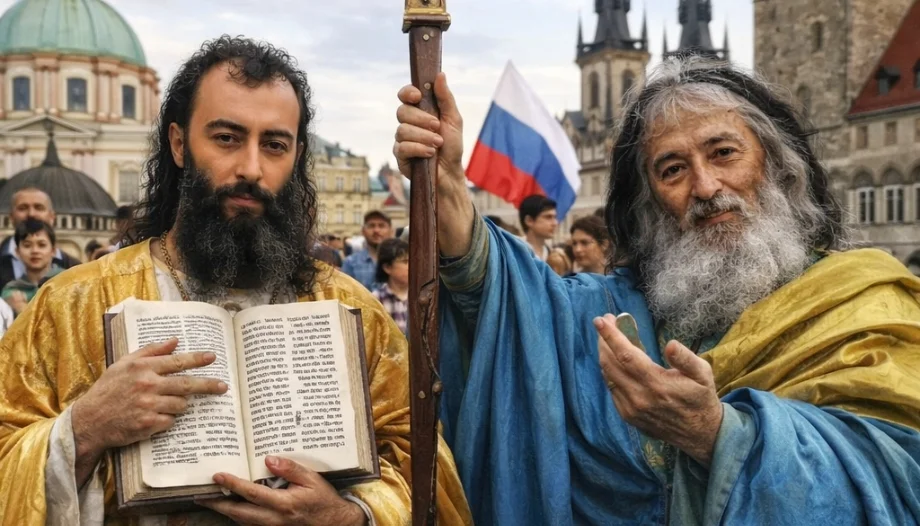
February 14 is known for being St. Valentine's Day and Valentine's Day, but it is also the memory of Saints Cyril and Methodius, who contributed so much not only to the spread of the Christian faith in Eastern Europe, but also of culture, law and writing, even inventing an alphabet.
That is why John Paul II proclaimed them co-patrons of Europe, along with St. Benedict. In fact, their contribution was as important for Eastern Europe as Benedict's was for Western Europe.
From Thessaloniki to Slavic Europe
Cyril and Methodius were brothers and were born in the late 8th and early 9th century in Thessaloniki (formerly known as Tessaloniki, a beautiful city I have visited several times), then an important city of the Byzantine Empire with Greek and Slavic populations.
Methodius (ca. 815-885), the elder of the two brothers, had initially chosen an administrative career in the service of the Empire, but later devoted himself to the monastic life. Cyril (ca. 827-869), on the other hand, the brain of the family, was born Constantine and studied in Constantinople, where he received a very high level of training in philosophy, theology and philology, later becoming librarian of the patriarchate and professor, which earned him the nickname of «Constantine the philosopher».
They were brothers in the flesh, but also spiritual, very united and complementary: on the one hand, Methodius, with his pastoral pragmatism and his administrative and organizational skills; on the other, Cyril, with his depth of thought, his eloquence and his capacity for cultural mediation. This incredible synergy proved decisive for their mission.
The mission in Moravia
Moravia is a region of the present-day Czech Republic that was populated, beginning in the 5th century, by the large ethnolinguistic group of Slavs, i.e. the ancestors of the peoples living in many Eastern European countries and divided thus: Western Slavs (Czechs, Slovaks, Poles); Eastern Slavs (Russians, Ukrainians, Belarusians); Southern Slavs (hence Yugoslavia, literally «South Slav»: Serbs, Croats, Slovenes, Slovenians, Bulgarians, Macedonians).
Like other Slavs, the Moravians were characterized by their tribal social structure and highly developed oral culture, but they did not yet have their own alphabet.
Between the 9th and 10th centuries, there was a process of Christianization of the region, both in Byzantine and Latin form, mainly by «Frankish» (Latin, precisely) missionaries.
In this context, Rastislav, prince or duke of Moravia between 846 and 870, wishing to free the country from the Carolingian Empire and its long religious manus, the «Frankish» bishops, asked the Byzantine emperor Michael III for missionaries able to speak the language of the Slavs and to form a local clergy.
The Byzantine emperor and Patriarch Photius entrusted this mission to Cyril and Methodius because of the proven linguistic, theological and pastoral skills of the two brothers.
The Paleo-Slavic language and the birth of Church Slavonic
The mission of Cyril and Methodius was arduous from the beginning: just as today's modern missionaries of communication must «translate» the contents of the Christian faith into a new language, that of the media and social networks, the two brothers were faced not only with the task of preaching the Gospel message, but also with the task of creating a language to transmit it.
Although what is known today as Paleo-Slavic (or Ecclesiastical Slavic) is not an artificial language, but a cultured and literary form of a South Slavic dialect (as Italian is from Florentine), it is certain that it was chosen by the two missionaries because it was understandable to a large number of Slavic populations and, therefore, suitable for their purpose.
Thus, it was standardized through the translation of the Gospels, Psalms, liturgical and canonical texts, and for the first time a Slavic language was written and used for worship, teaching and administration.
But how was it written? With its own alphabet! Yes, because Cyril realized that a specific one was needed for the particular sounds of the Slavic languages, especially those that did not correspond to Latin or Greek letters. So he invented a new one (in Constantinople, around 863), but not the one known today as Cyrillic (which will be an evolution of it), but the Glagolitic (from the Slavic term glagol: «word», «speech», exact translation of the Greek logos).
Cyril's idea was not only to give the Slavs an alphabet to express simple concepts, but to enunciate and transmit the Word.
Glagolitic letters had a complex and symbolic form, a combination of Greek and Oriental influences with original elements, but they provided a group of peoples with a specific identity and linguistic and cultural dignity.
Oppositions and accusations: nothing new under the sun
The «novelties» introduced by the two brothers did not please many (think of the Second Vatican Council, the Council of Trent, the debates on the «Chinese rites», the "Chinese rites", and the "Chinese rites"). Guadalupe and in the commotion they caused).
The Frankish clergy, in fact, rebelled and accused them of attacking the ecclesiastical order based on the exclusive use of Latin. Tensions became so acute that the two brothers were forced to travel to Rome to present to Pope Adrian II their work and the fruits it had produced: according to them, the very evangelization of Eastern Europe was at stake.
In Rome they were well received: Hadrian II not only approved their mission, but sanctioned the legitimacy of the use of the Paleo-Slavic language in the liturgy and even consecrated Methodius as bishop.
Thus, the Church of Rome embraced a principle that became fundamental: ecclesial unity does not coincide with cultural uniformity, but quite the contrary, e pluribus unum: plurality of languages, rites, traditions and different sensibilities.
Only Methodius returned to Moravia. Cyril, seriously ill, remained in Rome and took his vows. He died there in 869 and was buried in the basilica of St. Clement (his tomb is still today a destination of pilgrimages of Slavic Christians and not only).
It was not only the death of his beloved brother that marked Methodius, who later became Archbishop of Sirmium (today Sremska Mitrovica, Serbia). In fact, he did not lack more opposition and persecutions, to the point of being imprisoned for more than two years. But neither did he lack faith and constancy: he continued until his death (in 885 in Velehrad, Moravia) translating sacred texts, training the local clergy and laying the foundations of an autonomous Slavic Church.
From Paleo-Slavic to Church Slavonic and the Cyrillic alphabet
The life and work of Cyril and Methodius are an example of how dramatic the process of inculturation, The company's business model, which inevitably provokes disagreements, forces self-questioning, and affects balance and political and economic interests.
However, the mission of the two brothers contributed in an essential way to the formation of Slavic identities, also favoring the development of national literatures, cultural traditions and an autonomous historical consciousness.
After Methodius' death, his disciples continued his work in much of Eastern Europe and the Paleo-Slavic language gave rise to Ecclesiastical Slavonic, a liturgical and literary language comparable to Latin in the West and used to this day by many Eastern Churches.
The Glagolitic alphabet was gradually replaced by the alphabet developed by the disciples of Methodius, which was called Cyrillic (more similar to Greek).
The legacy of the two brothers thus goes far beyond the religious sphere. As John Paul II recalled in the Apostolic Letter Slavorum Apostoli (1985), in which he proclaimed them co-patrons of Europe together with St. Benedict, their work «demonstrates that evangelization does not destroy cultures, but assumes and transfigures them» and that «the unity of the Church does not require uniformity, but is realized in the communion of the different traditions,» underlining also the right of peoples to express their faith in their own language and the European value of the encounter between East and West.






 Español
  English
  Italiano
  Français
  Deutsch
  Polski
  简体中文
简体中文