



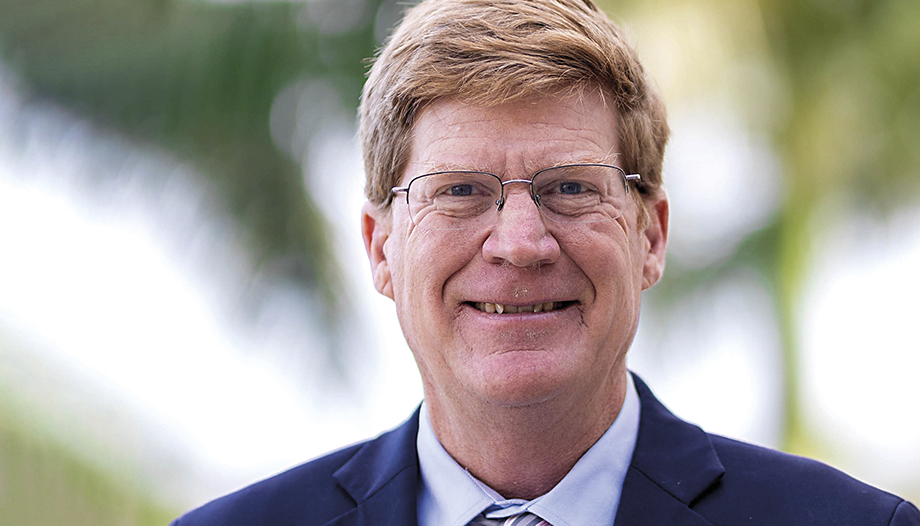
 The challenge of Artificial Intelligence"Investing in family is more worthwhile than anything else.""Young people and families need affection and special accompaniment."
Dr. Guernsey's extensive writing focuses on improving Catholic education, with influential publications ranging from pedagogy to school management. He is known for developing Catholic curriculum standards and for his analyses of how schools should affirm their identity beyond secular models.
In addition to his focus on curriculum structure and leadership, Dr. Guernsey has written extensively on the spiritual and moral dimensions of formation, including essential texts on fostering Eucharistic devotion among young people and the teaching vocation.
In this interview with Omnes, we speak with Professor Guernsey about how to help educators foster moral coherence and a transcendent vision in their students.
What do you consider to be the three essential and non-negotiable elements that should differentiate a Catholic curriculum standard from a secular one?
- The most sweeping element is that a Catholic curriculum must provide comprehensive Catholic insight into all academic disciplines. While fully embracing the natural world and natural law, Christianity is also a revealed religion: God has revealed Himself and His plan to us. The fullness of this revelation is in Jesus Christ, true God and true Man. Jesus fully reveals man to himself. So, in Catholic education and the curriculum it inspires, we have sweeping additional insight not just into religion but in into humanity and into the value and meaning of creation.
Secondly, a Catholic curriculum is differentiated by the integration of faith, life, and culture. We do not just talk about Christian insight, we lead students through our example of an integrated Christian life, where mind, body and spirit are harmonized. Where actions and beliefs are consistent. Finally, a Catholic curriculum is broad in scope and deep in transcendence. We study a broad array of subjects and learn for learning’s sake and not just to gain power or make money. We focus on the fullness of an integrated life and not on test scores. A fully engaged and integrated intellect and a virtuous person is our goal and our definition of success.
How can leadership programs effectively integrate spiritual, intellectual, and moral formation without reducing one to the other?
-We simply “are” integrated beings. It is how we exist in the world. So, we come “pre-integrated.” What we must battle against are the disintegrating forces of nihilistic modernity. They have full control of the secular educational establishment, and the results have been catastrophic. We must reveal the lies of relativism, materialism, and atheism at the heart of the current culture.
When we have our understanding of the natural integration of humanity restored, a solid education will result. There is a natural hierarchy to these elements in the human person with spiritual (faith) being first, moral (goodness) second and intellect third, but schools themselves are particularly focused on the development of the intellect: so that receives our special, but not sole, focus. All academic efforts are always in harmony with and in service to the salvation of the student and in equipping him for service to the common good.
In your experience, what are the most common challenges Catholic leaders face today, and how should their training address these realities?
-In some cases, they may not fully appreciate the chokehold that the common culture has on children and their families. The first step is to identify the sources of the skepticism and lack of commitment afflicting modernity and then to provide a rich community that embodies and leads to a deeper embrace of reality.
This is a civilization-building project and requires, first and foremost, a skilled Catholic leader capable of understanding the challenge, articulating it and guiding others to respond to it.
How can Catholic educational leaders foster a school culture that is both academically excellent and explicitly rooted in the Catholic mission?
-By keeping these two elements together! It is God who designed us and calls us to excellence. It is the integrated man, fully alive, which is the very definition of excellence.
What strategies do you recommend for helping leaders maintain fidelity to Church teaching while also navigating complex social and cultural pressures?
-By flatly stating “to heck with complex social and cultural pressures!” They have been weighed and found wanting. They have no hope and no future and are quickly passing away. We were made for more than the thin gruel our AI, social-media-saturated, and fake common culture is dishing up to our students and families. We have the Bread of Life and the fullness of reality. We are focused on natural intelligence (not AI) and on truth, beauty, and goodness. Make this clear, and enough desperate and good folks will fill our Catholic schools.
You have reflected on teaching young people about the Eucharist. What advice would you give to strengthen young people's faith in this area?
-Tell them. Tell them clearly. Body, Blood, Soul, and Divinity. It is shocking; it is true; and it changes everything. Once they get this reality, the necessity and beauty of the Mass and confession and silent recollection before the tabernacle all make perfect and persuasive sense.
If possible, put the tabernacle at the center of your school and have students make a brief daily visit. Schedule Adoration and Eucharistic processions into the school year.
What role does mentorship play in forming strong Catholic leaders, and how can institutions structure such mentorship effectively?
-Being a Catholic school principal means assuming an office in the Church. Just like other church leaders, they need Chrisitan fellowship and spiritual guidance. Bishops and superintendents should supply for this, or the burdens and pressures can lead to burn out or going with the flow of secular educational trends and viewpoints.
In your view, what innovations or new approaches are most needed in Catholic leadership preparation programs in the coming decade?
-This question itself, while well-intended, falls into the educational tendency to drift into the logical fallacy of “The appeal to novelty.” This combined with FOMO (fear of missing out) can lead folks to follow fads in forming children. Catholic formation programs should not just follow the current fads. We follow the Lord and His wisdom and vision- with centuries of success.
What I can confidently stay is that Catholic leadership preparation programs need to be bold and confident and not just “better” versions of public-school leadership programs. We have a more complete and comprehensive vision and are working for a richer end in our schools and with our students. Few are convinced the current secular model is achieving impressive results. Catholic institutions should boldly follow their own mission and not cling to a failed model.
In the context of its focus on collaboration with families, what is the irreplaceable role that the father has in the moral formation of the child that the school cannot assume?
-The family is the primary teacher of the child (i.e., first in order and most important). The Church is the primordial teacher (foundational by nature and keeper of revealed divine truth). The father, as head of the family, must faithfully translate, teach, and model, the fullness of truth and the nature of things to his children, as he follows the Church as his guide. Studies show that the father’s attitude toward and practice of the faith is the single most influential dynamic in children continuing to practice the faith into adulthood.






 Español
  English
  Italiano
  Français
  Deutsch
  Polski
  简体中文
简体中文