




 The creation of man. The Garden of Earthly Delights, by Bosch.The invisible creation, Asiel Timor Dei, Archangel musketeer
ARTISTIC COMMENTARY
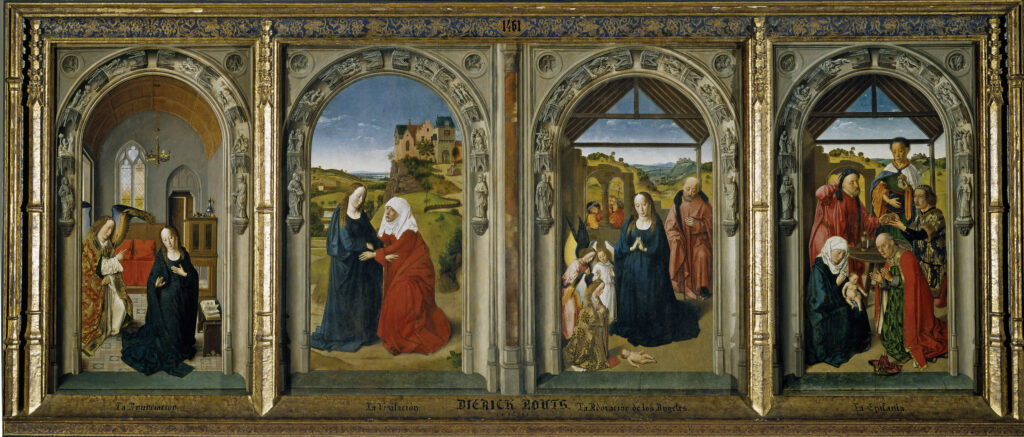
This work presents the main episodes that precede Christmas, from the Annunciation to the Epiphany or Adoration of the Magi. The first scene, on the left, represents the moment of the Annunciation: the angel Gabriel bursts in while Mary prays, kneeling on the floor. The event takes place in a domestic interior, in accordance with the convention of 15th century Flemish painting. A multitude of details can be seen in the room, from the floor tiles to the open prayer book to the half-open door. The angel's robes are rich and meticulously painted; the feathers of his wings show a gradation of color from cool to warm tones. Gabriel raises his right hand in a gesture indicating that he is communicating his message to Mary. The modeling of the faces, the brilliant display of goldwork on the sideboard, and the chandelier hanging from the ceiling highlight the artist's mastery of oil technique, although the depiction of physical space lacks fully convincing depth. The room is framed by a semicircular arch whose archivolts house small biblical scenes. Bouts borrowed certain compositional resources from Van der Weyden, such as the painted architecture that simulates a portico with a sculpted archivolt, which the latter had produced a few years earlier for the Miraflores Triptych (Gemäldegalerie Museum, Berlin).
Side scenes
The central panel includes two other scenes: the Visitation and the Nativity or Adoration of the Angels, set in a different scene. The Visitation takes place before a characteristic landscape, with the distant horizon diluted in bluish tones (atmospheric perspective) and winding paths that lead the eye towards the background. The representation of St. Elizabeth is very precise: her hands and face clearly show that she was an elderly woman when she conceived St. John the Baptist. She wears a traditional headdress, again in the wake of Jan van Eyck and Rogier van der Weyden.
The Nativity and the Adoration of the Magi are located in the same space. The Christ Child is shown lying in the center foreground, as was customary in 15th century Nativity scenes in the Netherlands. It is especially interesting to compare the figures of Mary and Joseph: they wear the same garments in both scenes, but in the final episode they are shown with their heads covered and adopt a more restrained attitude. This fact, along with other minor details, suggests the intervention of at least one other hand, which partly justifies that the work is considered a product of Bouts' workshop (Museo del Prado).
The original structure of the triptych
Although this work by Dirk Bouts looks like a polyptych composed of four panels, one for each scene, it is actually a triptych consisting of three panels. Today, these three panels are presented together in a single modern frame, which has altered its original functionality and hides the reverse side; it was originally a triptych with folding wings. A triptych is a folding object that usually shows three or four scenes when open; when closed, it may present a different motif, such as other related scenes (as in the Garden of Earthly Delights by El Bosco) or a decoration that imitates marble, and even grisaille figures of donors, patron saints, etc. Depending on their size, the triptychs were used both for private devotion and, in the case of larger examples such as this one, in side chapels or other spaces for prayer.
Of unknown origin, the first information we have about this triptych dates from the second half of the 16th century, when it was already part of the collection of Philip II. The monarch sent it to the monastery of El Escorial in 1584.
CATECHETICAL COMMENTARY
When we use the word mystery we almost always refer to a hidden and elevated reality, whose meaning and sense is beyond immediate knowledge, and which is often inaccessible.
The various episodes that make up the life of Jesus Christ are not simply human events, comprehensible almost at first glance to anyone who has a minimal knowledge of what life is. Jesus is perfect man and perfect God, and he also fulfills his life, since his Incarnation, as the fulfillment of an eternal and hidden plan (a mystery) traced by God in his inaccessible wisdom.
That is why the episodes of the life of Jesus Christ are not events, but mysteries.
Behind the story, or the narration of the different stages of Jesus' life, there is always a divine reality, inaccessible to mere rational knowledge, which can only be reached through contemplation enlightened by faith, as St. Paul recommended. Christian art has always depicted the episodes of Jesus' life with this mystical sense, as can be seen in the serene and prayerful attitude of all the figures in Dirk Bouts' triptych, which invite us to look at these scenes not as human chronicles but as mysteries that, in the visible of Jesus Christ, are revealing to us the invisible of God and the scope of his plan.
The Annunciation and the Visitation
The first mysteries are those of the birth, but before them appear these two, deeply linked to the figure of the Mother of Jesus. The rich and varied coloring of St. Gabriel's wings in the painting of the Annunciation already indicates his high rank in the angelic hierarchy and, therefore, warns us that the message he brings is the most important mystery that God has arranged: the Incarnation of his Son in the womb of the Virgin Mary. This was explained in a recent installment of these articles, dedicated to the Incarnation.
The open and luminous landscape, full of horizons and optimistic details, reminds us that in Mary's Visitation to Elizabeth, the dawn of salvation is being prepared. St. John the Baptist, in Elizabeth's womb, receives from Jesus the Holy Spirit, who inspires Elizabeth's praise and moves Mary to sing his praise. Magnificat. The joy of the mothers and the leap of joy that John the Baptist gives in his mother's womb is making us meditate that the coming of Jesus Christ is a mystery of joy for the whole world.
Nativity and Adoration
This joy is precisely what the angels announced to the shepherds in the third scene of the triptych: the birth of the Savior will be a great joy for the whole world. And this immense joy is born in the humility and poverty that we see in the austere representation of the portal. By this we are taught that these two virtues are the way to true joy, together with obedience. All the characters in the scene are obeying God's will. The Son of God, who has accepted to become incarnate and be born in Bethlehem. Mary, who has given her whole life to serve God in loving obedience as a servant. Joseph obeys God's plans as revealed to him by the Angel. And the shepherds, who look out of the window with the praying angels, have obeyed the announcement of the Angel, who tells them to go to Bethlehem to meet the Savior, whom they will recognize by the sign of being wrapped in swaddling clothes and lying in the manger.
Thus, Bouts' careful composition helps us to contemplate that, from its origin, the life of Jesus Christ is a mystery of poverty, humility and obedience. And therefore, it teaches us that this is also the path of the Christian who wants to truly follow in the footsteps of Jesus Christ and thus acquire in life the only happiness that nothing and no one can ever take away from him. The fact that the Child Jesus appears lying in the center of the foreground also expresses that we are before the mystery of the small. Only by becoming a child, by being born from above, by living with love the little things of every day, will the Christian be able to live in such a way that Christ takes shape in him.
This possibility of Christ taking form in the believer is based on the fact that the Son of God, existing in the form of God, wanted to begin to live in the form of a servant so that the human being could receive the divine nature. The angels, inhabitants of the divine world, remind us in the painting that God is in human form in Bethlehem so that man can allow Christ to take form in him, and thus be divinized with him. The mystery of Christmas, therefore, also signifies an admirable exchange (the admirabile commercium of which the liturgy speaks) according to which God and man exchange their respective natures. This is how St. John of the Cross expressed it when he contemplated the mystery of the Nativity: “The mystery of the Birth of Christ is the mystery of God.“man's weeping in God, and man's joy in man".
The mystery of the Epiphany makes us discover that this Child is the King of Israel, who manifests himself to all peoples, the first fruits of which are the Magi from the East. They, obeying the voice of God that they discover in the star, set out on their journey, as the first fruits of so many millions of people of all the peoples of the world, East and West, who, responding to faith, make their lives an adoration of Jesus Christ. The star indicates that the king is born, the magi, by special inspiration of God, know how to contemplate in the mystery of the birth the one who is king, God, and victim for all humanity, for which they offer him gold, frankincense and myrrh, respectively.
The mystery of the redemptive sorrow in the life of Christ becomes present to those who know how to contemplate the scene of the Epiphany in all its depth. In fact, this scene will be followed by the sorrow of the sacrifice of the Holy Innocents and the flight into Egypt. It is the mystery of the opposition of darkness to light, which marks the whole of Christ's life and is present from his first moments. Mysteries that reveal to us what God is like and, therefore, what the life of each person must be like.
Art historian and Doctor of Theology




 Español
  English
  Italiano