



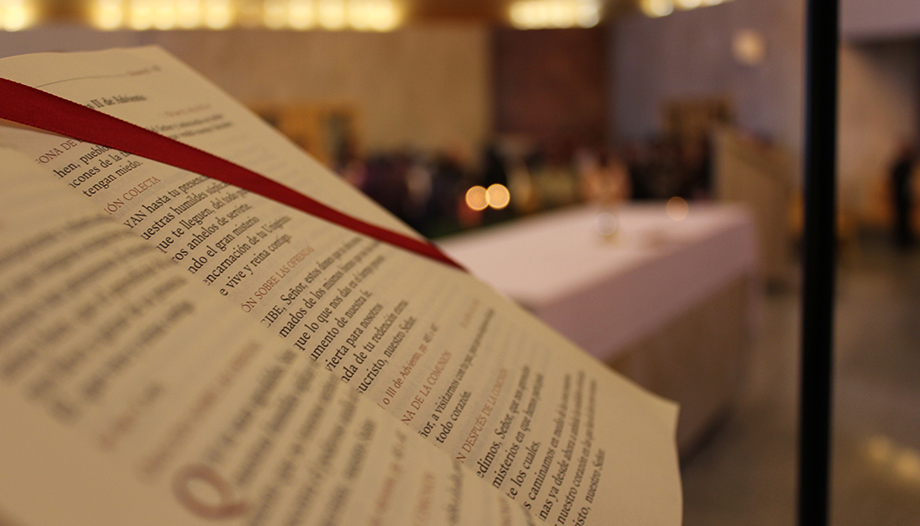
The first Sunday of Lent is marked by the victory of Jesus over temptation. The Church offers us, at the beginning of the Lenten journey, the story of Jesus tempted in the desert and how he overcomes these temptations. This episode sets the tone for the season of Lent, which calls us to penance and conversion.
Temptation is always an invitation to sin: an attempt to break the unity we share with God. Sin wounds our union with God; it separates us from Him and from others. Temptation can lead us to sin, and if we do not recognize the reality of sin, neither will we recognize temptation when it presents itself. The existence of the season of Lent, the journey to the Cross, is because evil exists, sin exists. On our way to conversion, it is important to recognize sin and the possibility of falling into it. Christ goes to the Cross by the power of the love that desires to free us from the slavery of sin.
Today's Mass readings present us with two contrasting episodes of temptation: that of Adam and Eve, and that of Jesus Christ. The first reading, taken from the book of Genesis, reveals the origin of sin: original sin. The wily serpent tempts the woman by entering into a dialogue with her and, as a consequence, she and her husband eat from the tree in the center of the garden. Scripture tells us: “And he said to the woman, ‘Has God said to you that you should not eat of any tree in the garden? And the woman answered the serpent, ’We may eat the fruit of the trees of the garden; but of the fruit of the tree which is in the midst of the garden God has said to us, ‘Do not eat of it or touch it, or else you will die.’”".
In contrast, we find Jesus in a moment of great vulnerability, able to immediately reject temptation thanks to the firmness of his purpose. Hungry after fasting for forty days, he is tempted to turn stones into bread. Behind this temptation lies an attack on his identity as the Son of God and his filial relationship with the Father. Unlike Eve, Jesus does not engage in dialogue with the devil. The devil is cunning, and dialoguing with him places us in danger. Instead, Jesus responds decisively with the Word of God: “...the devil is the devil....".“If you are the Son of God, command that these stones become loaves of bread. But he answered him, “It is written, ‘Man does not live by bread alone, but by every word that proceeds from the mouth of God’".’”. This understanding of the nature of temptation, which today's readings offer us, is also vividly presented in the literary work of C. S. Lewis, Letters from the devil to his nephew, The correspondence between the veteran tempter Scrutpus and his nephew Orugarius. There we see how the devil adapts his strategies, using subtle and modern techniques to turn people away from God.
Overcoming temptation requires a mature use of freedom and reason. Jesus“ temptations are our temptations, he teaches us to overcome the temptation to believe ourselves self-sufficient, for having gone through the same thing, he gives us his grace, he helps us as our elder brother. As St. Paul reminds us: "just as for a single crime resulted in condemnation for all, so also for an act of justice resulted in justification and life for all.".
The first Sunday of this liturgical season encourages us on the way to Easter, where we contemplate Christ's victory over sin and death. Victory over sin begins with our ability to reject temptation. It does not begin after our death, but in the temptations we encounter in daily life. Recognizing and rejecting temptation is, therefore, an essential dimension of the Christian life.






 Español
  English
  Italiano
  Français
  Deutsch
  Polski
  简体中文
简体中文