



 "In Indonesia we are few Catholics, but with ardent faith."Pope bids farewell to Indonesia, inviting Catholics to "never tire of sowing".Pope joins in Haiti's grief and prays for earthquake victims
When Cyclone Senyar hit the Indonesian island of Sumatra at the end of November 2025, devastation was sudden and overwhelming. Floods and landslides submerged entire villages. Hillsides collapsed. Thousands were injured and displaced across Aceh, North Sumatra, and West Sumatra. Yet for local communities and Church leaders, the catastrophe was neither sudden nor unforeseeable.
“These were not merely natural disasters”., said Fr. Martinus Dam Febrianto, SJ, Director of Jesuit Refugee Service Indonesia. “They were ecological disasters.”.
For decades, Sumatra’s dense tropical rainforests have been steadily stripped away. Illegal logging, industrial forestry, palm oil plantations and mining operations have eroded the land’s natural defenses. When unusually intense rains arrived, linked to rising ocean temperatures, the forests were no longer there to absorb water or stabilize soil.
“What occurred was not just flooding by water,”, Febrianto explained, “but floods of mud and logs that devastated residential areas, destroyed people’s property and damaged public infrastructure.”Hillsides left bare by deforestation, gave way. Entire communities were buried under debris flowing downhill.
The aftermath of Cyclone Senyar
By late December, the scale of the disaster was clear. Official figures as of December 21, show that more than 3.3 million people across Sumatra were affected, with nearly one million forced from their homes. At least 1,090 people were reported dead, 186 remained missing and around 7,000 were injured. More than 147,000 houses were damaged or destroyed, with economic losses estimated at nearly $19.8 billion.
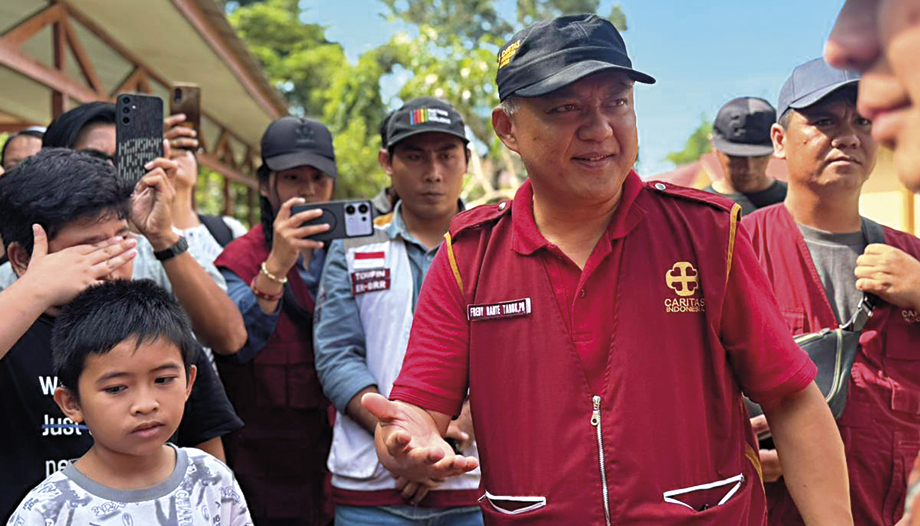
As suffering spread across Sumatra, the Catholic Church mobilized its humanitarian response. Caritas Indonesia emerged as a central humanitarian force, working through diocesan networks to deliver urgent assistance.
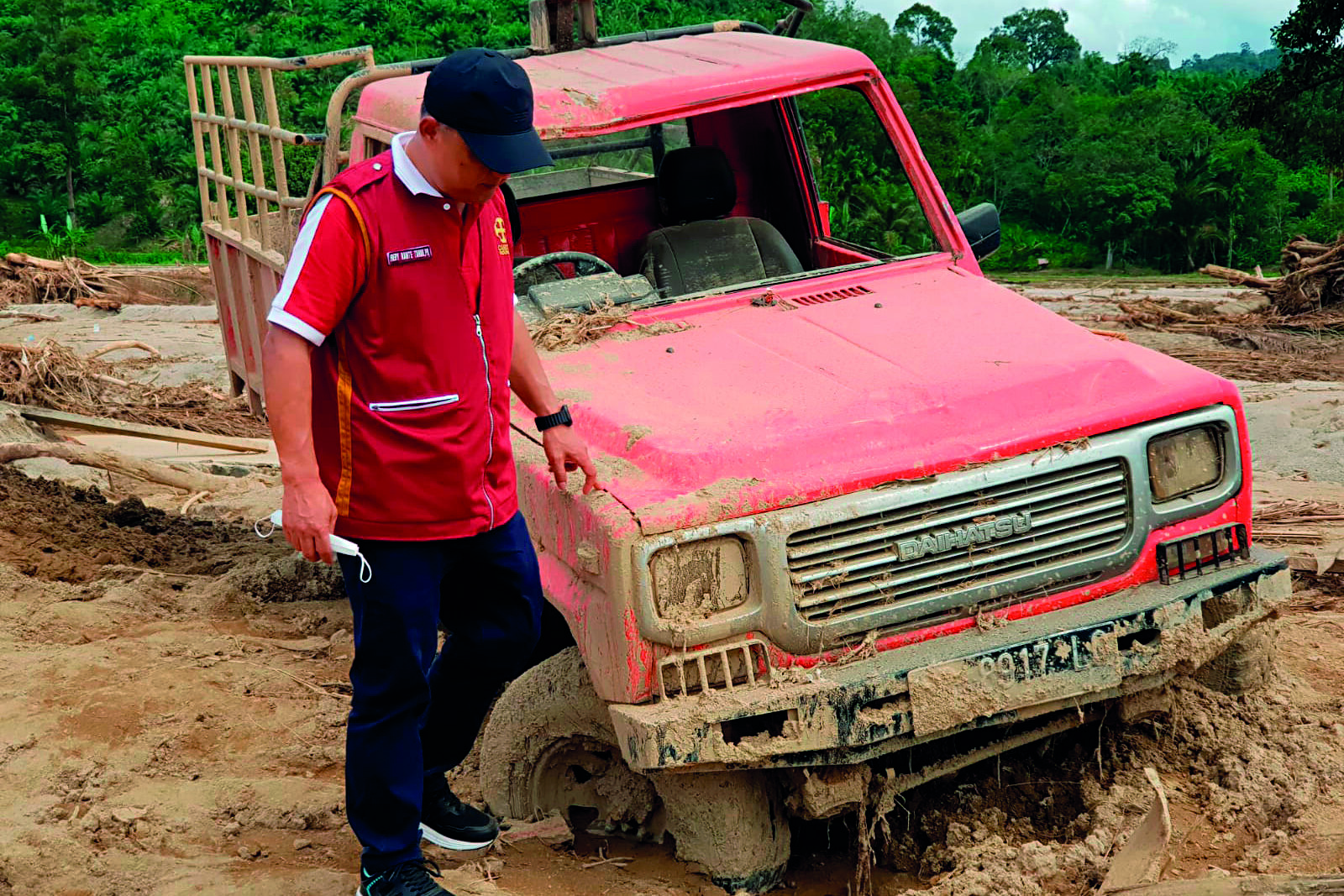
“Our focus is ensuring access to food, temporary shelter, clean water, sanitation and hygiene services and essential health care,”, Fredy Rante Taruk, executive director of Caritas Indonesia, in a statement to Omnes. Displaced families and vulnerable groups, he said, remain the priority.
So far, Caritas and its partners have assisted more than 22,000 people with food, distributed hygiene kits to over 5,700, provided health care to 3,700, and offered psychosocial support to nearly 1,600. In total, 60 tons of aid have been delivered.
Fr. Taruk stressed that international solidarity from Catholics abroad remains essential to sustain relief and recovery.
Development without safeguards
Indonesia’s disaster reveals the human cost of a development model driven by short-term economic gain and weak environmental protection. Nowhere is this clearer than in North Sumatra, where Catholic clergy have taken the unusual step of publicly protesting industrial forestry practices.
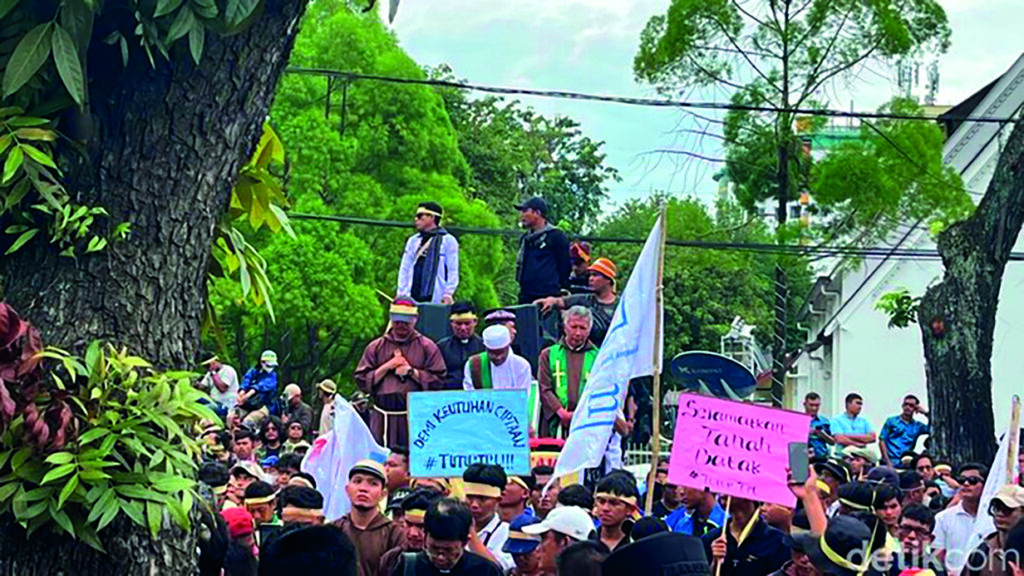
Fr. Supriyadi Pardosi, OFMCap, has helped organize demonstrations since November 2025 against PT Toba Pulp Lestari (TPL), a major pulp and paper company operating in the region. Protests have been directed at Indonesia’s parliament, government ministries, the National Commission on Human Rights, and provincial authorities.
“Our demand remains consistent: the closure of the pulp firm PT Toba Pulp Lestari,”, Pardosi told Omnes.
For him, the issue is not abstract environmentalism but the survival of local communities. Large areas of natural rainforest have been replaced by eucalyptus monoculture plantations, which do little to prevent erosion or flooding. Even before the 2025 cyclone, flash floods repeatedly struck areas near TPL’s operations, including Harian–Samosir in November 2023, Simallopuk in December 2023 and Parapat in March 2025.
“Closing this firm is the only way for local communities to return to their normal livelihoods,”he said. “It is also the only way forward toward a sustainable future.”.
A social as well as an ecological crisis
The damage extends beyond the physical landscape. According to Fr. Pardosi, deforestation has deeply fractured the social fabric. Competition over land and jobs has fueled resentment and violence within villages.
“Clashes regularly occur between those who support and those who oppose TPL’s operations,”, he said. These tensions have “turned neighbor against neighbor”,, fracturing indigenous communities, churches and households.
In this sense, environmental degradation becomes a catalyst for social breakdown. When land is degraded, livelihoods collapse. When livelihoods collapse, communities fracture. What appears as an environmental issue quickly becomes a crisis of human dignity.
“Human livability cannot be separated from a livable environment,”Fr. Pardosi said. Drawing on the teaching of Pope Francis and the spirituality of St. Francis of Assisi, he discussed humanity’s dependence on creation. “We cannot live without our environment, but the environment can exist without us. The degradation of nature is, in essence, the degradation of human life itself.”.
Indonesia is often described as one of the world’s ecological “lungs.” Yet forests continue to be cleared for corporate projects. Fr. Pardosi criticized authorities for siding with companies that replace rainforests with mines or monoculture plantations, practices he said contradict the life-supporting purpose of forests.
“An attitude that degrades and exploits nature,”he warned, represents “a low point in our humanity,”with consequences that will be borne not only by today’s victims but by future generations.
Discernment and responsibility
Fr. Febrianto approached the crisis from an Ignatian perspective. Citing St. Ignatius’ Contemplation to Attain Love, he recalled that God is present and active in all creation and thus recognizing that presence should lead to reverence and care.
Instead, he said, many political and economic decisions treat nature as a resource to be dominated. “There is no spiritual discernment here”, he said.“God is not taken into account”.
Even rational discernment is often absent. Despite scientific evidence linking deforestation and climate change to flooding, officials have denied such connections. Some have even claimed that oil palm plantations are equivalent to forests. Behind these arguments, Fr. Febrianto warned, is “a massive appetite to extract forest wealth instantly, without considering long-term consequences”.
Discernment, he said, requires conversion “from indifference and self-centeredness toward opening one’s heart to God”.That conversion involves listening to scientific findings, to prayerful silence, to the cries of the poor and to the warning signs written into the land itself.
More fundamentally, the Church must help address the root causes of ecological collapse. Fr. Febrianto pointed to Laudato Si' and Pope Francis’ call for “integral ecology,” which recognizes that environmental, social, economic, and spiritual crises are inseparable. Human development cannot be measured by economic growth alone. It must promote“the development of every person and the whole person,”especially the poor, indigenous communities, and those most exposed to environmental risk.
A global warning
What is unfolding in Indonesia is not unique. Similar patterns of deforestation, displacement, and climate vulnerability are visible across the developing world from the Amazon Basin to Central Africa and Southeast Asia.
The lesson is important. When forests fall, floods follow. When land is treated as expendable, people become expendable too.
For Fr. Pardosi, the moral stakes are unmistakable. Environmental exploitation, he said, harms not only those alive today but"thousands of people in future generations who have never chosen to participate in these destructive acts", Indonesia’s tragedy is therefore not only a national crisis but a global warning. Development without discernment leaves devastation in its wake. The question facing governments, corporations, and societies worldwide is whether progress will continue to be driven by appetite or guided by responsibility, restraint, and care for the common home entrusted to humanity.
Journalist and essayist born in the United Arab Emirates and based in Lithuania. He is a contributor to Omnes, EWTN News and CNA Deutsch.






 Español
  English
  Italiano
  Français
  Deutsch
  Polski