


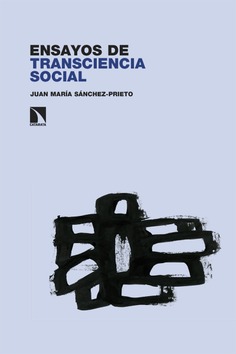
Juan María Sánchez Prieto (Madrid, 1958), professor of sociology at the Public University of Navarra, has published in Catarata editions, an interesting compilation of illuminating articles on a new field of research that has emerged in the social sciences and that has been silently forging over the last few years.
Starting from the French School of the “Annales” of the 1980s, Professor Sánchez Prieto masterfully delineates the passage from history to sociology and from sociology to history, to the point where a system of thought has developed that goes far beyond the mere interrelation between two sciences to become a new science and a new methodology: the “social transcience” that has transcended the “historical social science” (23).
Sociology and objectivity: limits of ideologized study.
Certainly, for many years now, both quantitative and social sociology have been making headway and are beginning to be key to interpreting contemporary and recent history, because having documents is useless if we do not have an adequate key to interpret them or, at least, to approach them as objectively as possible.
The clearest example (and this belongs to our personal harvest) is the sociological studies published in recent years by the famous Spanish sociologist José Félix Tezanos, which, undoubtedly, are very complete and very well elaborated, but are so ideologized that they deviate from reality and fail miserably as valid elements for decision making.
The key is that sociology must unite with history, law, politics, philosophy and economics, on the basis of a common anthropology that would help us to understand social reality and individuality: this is the “transcience” that Professor Sánchez Prieto masterfully delineates in this book.
In the face of quick and unsubstantiated analyses that sociology would have failed, a new hermeneutic has emerged with “transcience. A few years ago it seemed that sociology was the key studies of the future but, after a time of uncertainty, it seems that with ”transcience“ sociology will continue to be a bet on the future to help us know man and understand the shortcomings of our democratic society.
The interrelation of sciences is very interesting because with them and the transcience, fences and frontiers are broken. For example, when speaking of freedom, Sánchez Prieto reminds us that: “man's strength does not come from being devoid of an inexorable destiny, but from knowing it. His destiny is to be responsible for himself” (47).
Temporal plurality and social concepts
Pages later, he will analyze the concept of ideology that permeated historical sociology until a few years ago, to show that there has been a “dissolution of the concept of ideology within political culture, even if it no longer conforms to its original conception anchored in the political science tradition of Almond and Verba, which has, in any case, proved to be insufficient” (100).
I found it very interesting to bring, in this review, these conclusions of the historian Braudel in his famous work on the Mediterranean when he underlined the plurality of social time: “multiple and contradictory times of human life are not only the substance of the past, but also the fabric of present social life. A clear awareness of this plurality is essential for a common methodology in the sciences of man” (122).
Democracy and contemporary values
It is very interesting that, following Lévi-Strauss and rethinking myth, Sánchez Prieto ends up affirming: “The tension, in any case, between revolution and tradition is something consubstantial to the dynamics of modernity: it is perhaps what properly defines the fate of the human being” (125).
Moreover, with respect to the myth, he recalls that “Democracy demands faith in reason -and in the person and in freedom- but also a certain confidence in the myth (however long its shadow may seem to us): no one has said that democracy is the government of the wise, on the contrary (precisely for this reason democracy is above all control: the ability of the rulers to control and change the rulers). It is not enough to be right, there must be a perception that one is working in the best common interest and not in one's own” (127-128).
Sánchez Prieto's relaunching of democratic values and of democracy itself is very interesting, in our view. In the first place, he points out the solid base from which we start: “democracy is a system that never ceases to question itself. Permanent criticism is also a source of creativity, although the creative responses that may have been or may be given do not necessarily have to be satisfactory. Truly creative subjects are unaware that they are creative” (219).
Immediately, after pointing out the undoubted problems and difficulties of our time, he will point out the strengths of democracy: “Direct democracy then would not be so much an engineering to achieve the expression of a social will as the awakening of attitudes and behaviors that generate that social will: living a democratic life of ideas and experiences, co-creating and sharing a power that benefits all” (232).
Professor Sánchez Prieto, you will recall the importance of the Universal Declaration of Human Rights and points out the “moral aspect” of these rights which, in practice, are acting (we affirm this) as if it were the universal ethics of which Habermas or Hans Küng or Ratzinger spoke (236).
Resilience and gaze transformation
We cannot finish without pointing out the value attributed by our author to “resilience” when he affirmed: “in the portrait of resilience, the importance lies in the gaze. The direction of the subject's gaze is the fundamental line (...). Resilience as a transforming power requires a transformation of the gaze” (249).
Essays on social transcience






 Español
  English
  Italiano
  Français
  Deutsch
  Polski