



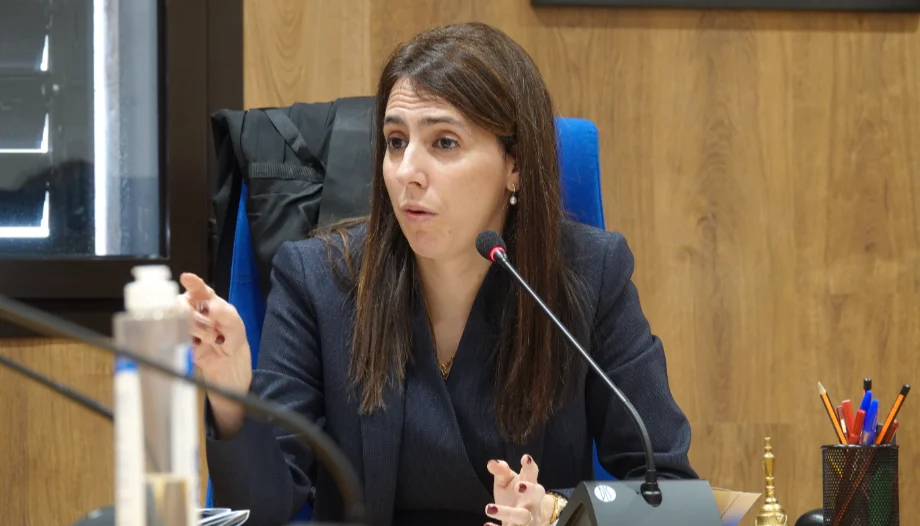
Before donning the toga and deciding on the freedom of men, Miriam Garcia already knew what it was like to impose authority in hostile terrain. Between the ages of 12 and 16, while other teenagers were looking for their place in the world, she was already holding the whistle: she refereed the boys' soccer games in the courtyard of the Jesuits in Durango. In that Basque camp, among shouts and untimely tackles, she forged the character of the person who today is a respected voice of the judiciary in La Mancha.
That determination led her to pass the competitive examination when she was only 24 years old, but it was in the «mud» of the instruction where she earned her stripes, which do not appear in the codes. In September 2023 she received the official promotion to Magistrate, a seal to her professional competence, but her true consecration came much earlier, in the streets of Puertollano.
There, between the ages of 28 and 32, she spent her time leading high-profile operations where she earned the honor of receiving in 2021 the Medal of Merit with White Distinction, awarded by the state security forces. However, four years ago, the Magistrate reduced her working day to dedicate more time to her family, so she is currently in charge of the Almadén court.
In addition to her technical and professional competence, the magistrate strives to administer justice in the most humane way possible. This is shown, first and foremost, in the court she directs, a calm and efficient workspace, staffed by officials who project an impeccable and humane image of the Administration of Justice.
Also, it is evidenced by the reduced number of convictions for gender violence that it issues, avoiding the unjust situations that frequently occur against men.
However, for those who spend a morning of trials in his courtroom, his concern that, as far as possible, families should be rebuilt or resolve their conflicts outside of the justice system, that peace and common sense should return to the tensions of a nursing home in town, or that he should go online to encourage a prisoner he sent to jail to get his high school diploma, is striking.
Sitting in front of her computer, with the naturalness of someone who contemplates the dark side of human nature every day, Judge Miriam García reminisces. She does not speak with the arid jargon of the Official State Gazette, but as someone who knows that, after each number of procedure, there is an interrupted dinner, a son who does not understand anything or a pardon that no one expected. We talk to her about some of the stories that have marked her.
A perfectly normal life
The search of an official's house in Castilla-La Mancha showed that human nature can hide great horrors behind the appearance of a normal life. Miriam remembers that morning as one of the hardest of her career, to the point of causing her a gastrointestinal ailment after somatizing the impact of having to watch a small part of the videos that the Guardia Civil found in the home of the accused.
The case was part of the trail of a European child pornography ring based in Barcelona. Judge Garcia was only dealing with the arrest of one of the clients who bought the child pornography videos, but what gave her a big chill was to check the complete list of “clients” in the region. They occupied a very fat dossier, in which 80% of the municipalities of Castilla-La Mancha had at least one implicated.
During the statement, the worker acknowledged that he was «sick», but with a disturbing nuance: he equated his actions to the «dark side» that everyone has, like someone who justifies a moment of bad mood or an act of selfishness. In his speech one could feel that «banality of evil» of which Hannah Arendt spoke: the inability to dimension the atrocity of one's own act, integrating it into a bureaucratic and daily routine.
After the case appeared in the local press, testimonies began to come in from men, now adults, who had been abused as minors. The case did not even make the national press, overshadowed by the news of the arrest of the leaders of the child pornography distribution network. “It is something that usually happens, the sexual abuse of minors in the family or school environment has hardly any repercussion in the press”, comments the magistrate.
Superstition in Fuenlabrada
Drug trafficking also has its aristocratic and absurd side. Miriam remembers a Mexican citizen arrested in Fuenlabrada whose life seemed scripted for a soap opera. In fact, he was married to a well-known soap opera actress. His house was a display of luxury: areas chill out, The curious thing is that, despite his sophistication in moving containers from Mexico, his downfall came at the hand of superstition. The curious thing is that, despite its sophistication in moving containers from Mexico, its downfall came at the hand of superstition.
The narco would not take a step without consulting a «pythoness. The investigation discovered that the witch's predictions were so accurate because she had a contact in the police who leaked information to her. By tapping the psychic's phone, investigators got to the heart of the plot. After being arrested, the man showed a devastating philosophy of life: »I have lived at full throttle since I was 16 years old, I have already enjoyed what I had to enjoy«. However, the post-arrest reality was absolute emptiness: his wife left him and his empire vanished, making it clear that criminal »success« is a contract with extreme loneliness clauses.
Called by name
The prison system is far from ensuring that convicts truly repent of their crimes, but what is even more difficult is that a prisoner can incorporate into a life within the law, considering that prison is a “university of crime” in which one learns and weaves a network of relationships that may be the only way out if once out of prison there is no family support or work to be found. The good news is that there are also exceptions to the general rule, as Rafa's case shows.
Rafa is not a criminal who makes headlines. He is, in the words of the magistrate, “the typical drug addict who was consumed until he was left in his bones”. When he entered the Almadén courthouse, Rafa was almost one meter ninety and barely weighed 50 kilos. His record was not that of a criminal mind, but that of a man who was unable to say no to bad company and ended up adding merits in the criminal ladder: small-scale trafficking, bag snatching, thefts for “necessity”.
«What moved me the most the first time I had him in custody,» recalls Magistrate Garcia, «is that I called him by name and he started to cry.» In his town he was not known as Rafa, but only by the typical nickname. For his fellow citizens, he was a reproach that everyone tried to avoid, but the simple fact of hearing a «sit down, Rafa» from the mouth of a judicial authority gave him back a dignity that he thought was extinct.
This story, which for many would be an irrelevant anecdote, reveals one of the notes of the judicial system: the law judges acts, but justice deals with people. Rafa ended up in prison after a robbery with a knife, a leap into the «first division» of crime driven by withdrawal symptoms.
Thanks to correspondence with the judge and contact with the chaplain - whom he asked to see after discovering to his astonishment that there was no «punishing God» waiting for him - Rafa began a physical and spiritual transformation. Today he weighs 90 kilos and writes letters that show his personal reconstruction. His life is still behind bars, but it doesn't end there. He has managed to break his vicious circle and pull himself together. He is proof that it is possible to meet God and redeem one's sins.
These stories, which Miriam García unpacks with legal rigor and empathy, form a mosaic of what lies behind the big statistics. To be a judge in a small party is not only to apply the code; it is to understand that behind every crime there is a broken biography that, sometimes, just needs someone to call it by its name.







 Español
  English
  Italiano
  Français
  Deutsch
  Polski