


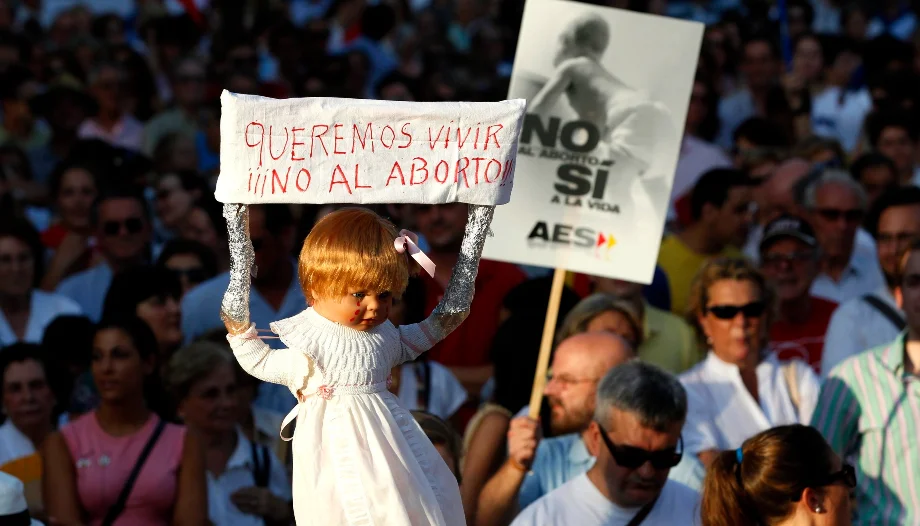
The Plenary of the Council of State studied this Thursday the opinion on the constitutional reform promoted by the government of Pedro Sánchez to “shield” the right to abortion. The report, which is mandatory but not binding, was approved by 16 votes in favor and 4 against, giving the green light to the processing of the initiative, although it includes warnings of both legal and political significance.
The proposal of the Executive consists of reforming Article 43 of the Constitution - concerning the right to health protection - to expressly include the voluntary interruption of pregnancy. This is a path that only requires a three-fifths majority in Parliament, without the need to dissolve the Cortes or call a referendum. However, this majority is not guaranteed due to the rejection announced by PP and Vox.
The reproach for the constitutional “shortcut”.
The main objection of the advisory body focuses on the choice of Article 43 instead of Article 15, which enshrines the fundamental right to life. According to the opinion, if the objective were to fully protect abortion as a fundamental right, the reform would have to affect Article 15, which would imply the aggravated procedure foreseen in the Constitution: parliamentary approval, dissolution of the Cortes, general elections, referendum and subsequent ratification.
The Council of State questions the arguments put forward by the government to opt for article 43, which in the preliminary draft were justified by “greater simplicity and speed” and by facilitating the “political viability” of the agreement. In the opinion of the advisory body, these are “considerations of political opportunity that, from a constitutional point of view, should not be taken into account when choosing the precept that is the object of the reform”. The procedure, it stresses, must be a consequence of the decision on the merits and not its cause.
Despite this criticism, the opinion concludes that there is no legal obstacle to reforming Article 43, and therefore allows the Executive to continue the process.
The report has been prepared under the presidency of Carmen Calvo's Council of State and with the former Minister of Health María Luisa Carcedo as rapporteur.
Political and judicial context
The announcement of the reform took place in a context of strong political tension. On the one hand, President Sanchez praised this measure at a Socialist campaign rally for the regional elections in Castilla-Leon. The government presents the initiative as a step to match France, which recently enshrined abortion in its Constitution, and as a response to right-wing movements.
Among the triggers was the controversy last October in the Madrid City Council, when a Vox proposal on the supposed postabortion syndrome was discussed. In addition, the Executive reacted to the refusal of the President of Madrid, Isabel Díaz Ayuso, to draw up a registry of doctors who object to the voluntary interruption of pregnancy in the Community of Madrid.
For Rafael Domingo, professor of law, “the alleged constitutional right to abortion is an «abortion of law» that contaminates our entire legal system, like a poisoned bonbon. If the law is intended to protect human beings, human life must be protected in all its phases”.
The jurisprudence of the Constitutional Court
Another of the arguments that the opinion dismantles is the idea that abortion needs to be “shielded” against a possible change of criteria by the Constitutional Court. The Council of State recalls that the high court has already ruled on two occasions endorsing both the law of assumptions and the law of deadlines. Recently, the Constitutional Court also endorsed the current legislation, consolidating the consideration of the termination of pregnancy as a woman's right in the current legal framework.
In this sense, the advisory body points out that the inclusion of abortion in the Constitution would not be strictly necessary from the legal point of view, since the constitutional doctrine has already established criteria.
Although the opinion allows the reform to go ahead, its non-binding nature and the lack of sufficient parliamentary support significantly reduce its chances of success. Without the votes of the PP, the three-fifths majority required to modify Article 43 is unattainable.
Abortion situation in Spain
In Spain, both the number of abortions and the birth rate paint a worrying picture from a demographic point of view. In 2024, more than 106,000 abortions were recorded, a worrying figure that is not decreasing despite the sex education programs that have been implemented for decades.
At the same time, the birth rate remains at very low levels. In 2024, 318,005 children were born, continuing a decline of more than two decades, and although preliminary data for 2025 point to a slight rebound to 321,164 births, the underlying trend is a sustained decline that accumulates a reduction of about 23 % between 2015 and 2025. Fertility rates are also very low, at around 1.1 children per woman, well below the generational replacement threshold.






 Español
  English
  Italiano
  Français
  Deutsch
  Polski