


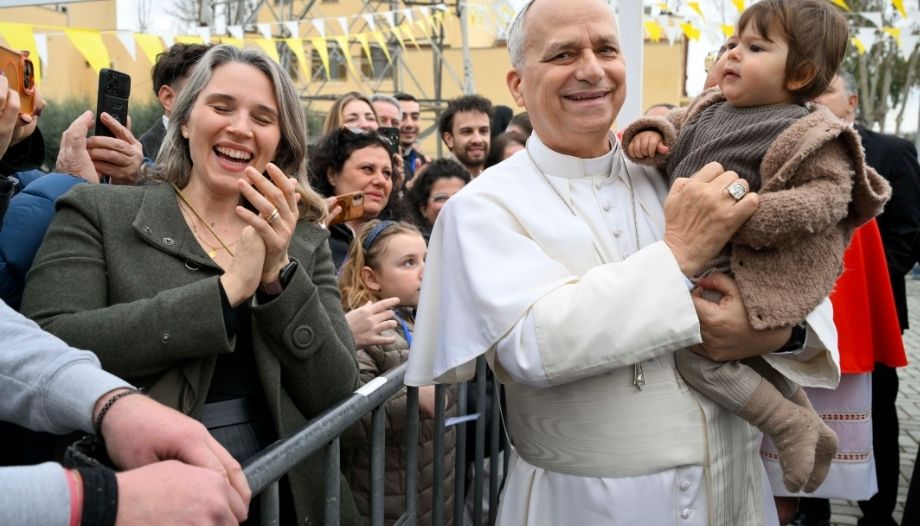
During this Wednesday's Audience, Pope Leo XIV continued his catechesis on the documents of the Second Vatican Council, in this case on the dogmatic constitution Lumen Gentium (Light of the Gentiles). The theme was ‘The Church, visible and spiritual reality”, with a reading from the Letter of St. Paul to the Ephesians (4:15-16), and he stressed that the Church is both human and divine.
What does it mean that the Church is “a complex reality”? Someone could answer, the Pontiff explained in the Audience This morning in Rome, that the Church is complex in that it is “complicated” and therefore difficult to explain”; or “that its complexity derives from the fact that it is an institution with two thousand years of history and with characteristics different from those of any other social or religious grouping”.
Humana: “a community of men and women, with virtues and defects, who proclaim the Gospel”.”
The constitution ‘Lumen gentium’ of the Second Vatican Council affirms that the Church “is a well-balanced organism in which the human and divine dimensions coexist “without separation and without confusion”.
“The first dimension is immediately perceived, since the Church is a community of men and women, with their virtues and their defects, who share the joy and the effort of being Christians who proclaim the Gospel and become a sign of the presence of Christ who accompanies us on the journey of life,” Leo XIV pointed out.
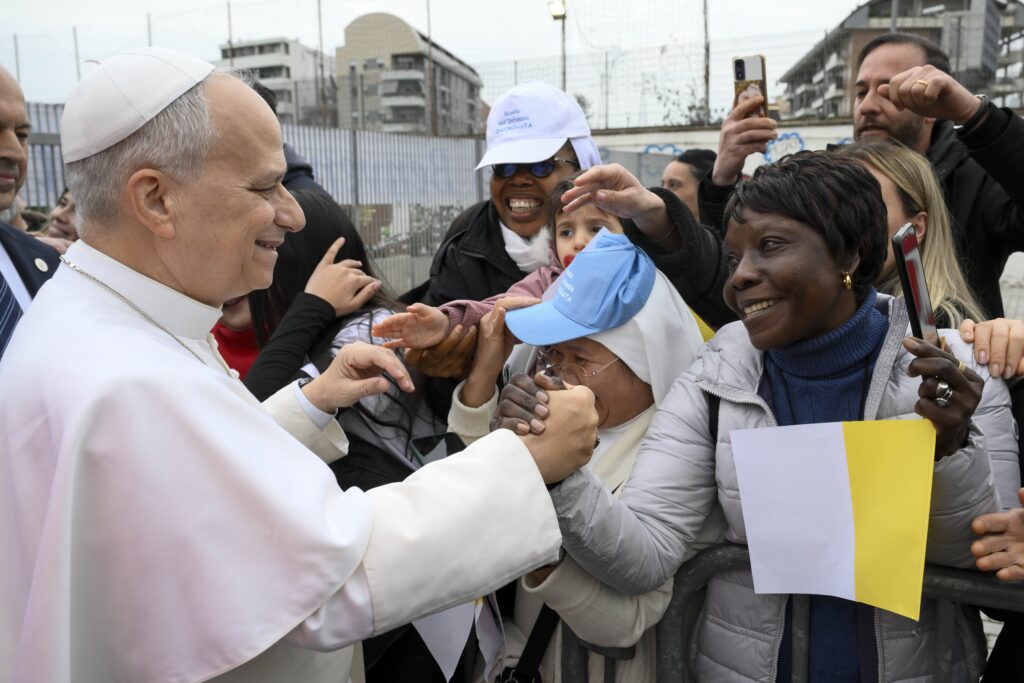
Divine: “the Church is the fruit of God's plan of love for humanity, realized in Christ”.”
But this aspect - which is also manifested in the institutional organization - is not enough to describe the true nature of the Church, because the Church also possesses a divine dimension, added the Successor of the Apostle Peter.
“The latter does not consist in an ideal perfection or in a spiritual superiority of its members, but in the fact that the Church is the fruit of God's plan of love for humanity, realized in Christ. Therefore, the Church is at the same time an earthly community and the mystical body of Christ, a visible assembly and a spiritual mystery, a reality present in history and a people on pilgrimage towards heaven (LG, 8; CCC, 771)”.
At the same time, has underlined, Thus, the Church lives in this paradox: she is a reality at once human and divine, which welcomes sinful man and leads him to God“.
The life of Christ illuminates it: his humanity and the encounter with God.
“In order to illuminate this ecclesial condition, the Lumen Gentium refers to the life of Christ. Indeed, those who met Jesus on the roads of Palestine experienced his humanity, perceived his eyes, his hands, the sound of his voice. Those who decided to follow him were moved precisely by the experience of his welcoming gaze, by the touch of his blessing hands, by his words of liberation and healing.
But at the same time, by following that Man, the disciples opened themselves to an encounter with God. In fact, the flesh of Christ, his face, his gestures and his words visibly manifest the invisible God”.
Benedict XVI (“there is no ideal and pure Church”). Francis: charity
In his concluding remarks, the Pope quoted Pope Benedict XVI, when he stressed that “there is no ideal and pure Church, separated from the earth, but only the one Church of Christ, incarnated in history”. And Pope Francis, who exhorted charity.
“This enables us to continue to build up the Church even today: not only by organizing its visible forms, but also by constructing that spiritual edifice which is the body of Christ, through communion and charity among us,” added Leo XIV.
In conclusion, Pope Leo said that “charity, in fact, constantly generates the presence of the Risen One. May heaven grant,‘ said St. Augustine, ’that all may think only of charity: it alone conquers all, and without it all else is worthless; wherever it is found, it draws everything to itself' (Serm. 354,6,6)”.
Lent: “a time of grace and spiritual renewal"
As for other topics, his words to the English-speaking pilgrims can summarize his allusions to the Lenten season in which the Church is living: “I greet all the English-speaking pilgrims and visitors participating in today's audience, in particular the groups from England, India, the Philippines, Singapore, Vietnam and the United States of America.
With my best wishes and prayers that this Lent may be a time of grace and spiritual renewal for you and your families, I invoke upon all of you joy and peace in our Lord Jesus Christ”.






 Español
  English
  Italiano
  Français
  Deutsch
  Polski
  简体中文
简体中文