




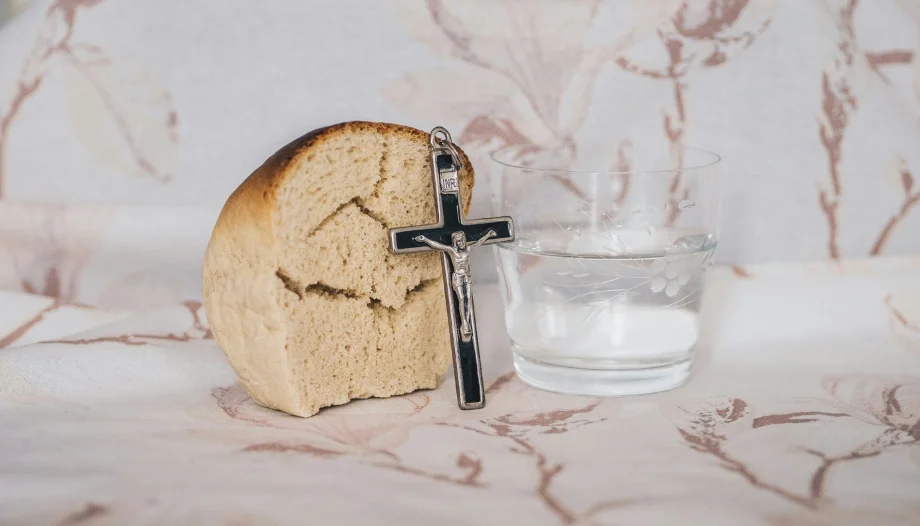
A charming grandmother offered a breakfast to her friends, some of whom had come from far away after several years of not seeing each other. Her daughters were also invited and the reunion promised to be a great time. The table was well laid out and a feminine hand, with attention to detail, could be seen in everything.
Hugs and phrases of joy were shared to the fullest, until, at the time of sitting down, one of the daughters demanded: “but it is fasting because we are in Lent! Immediately the opinions were divided: ”it is true, let's keep everything, we must offer something to Jesus and not continue with our bourgeois life as if we were not in the time of penance". Others said that the hostess had taken so much care that they could not do her a disservice. Still others suggested changing the fast to a work of mercy...finally a divided atmosphere reigned. Some ate, others did not. The former criticized the latter and vice versa. The hostess apologized for forgetting that Friday would be Lent. She felt a lump in her throat as the altercation escalated and some disqualifications were heard.
Learning self-controlto love
John Henry Newman insisted that external spiritual practices have value only when they transform the heart. He said that bodily sacrifice makes sense when it helps to purify the soul and orient the will toward God. Fasting is a pedagogical act: the body teaches the soul to love better.
The church invites us to practice fasting during Lent with a transcendent meaning: to learn self-control in order to love.
We live in a culture where almost everything is readily available - food, entertainment, information - fasting may seem a strange, masochistic, even useless habit. Why voluntarily deprive oneself of something as basic and lawful as food?
However, fasting is one of the oldest and most universal human practices. Long before Christianity, different civilizations discovered that renouncing food for a while could help human beings to order their inner life.
In Judaism, for example, fasting occupies a central place on Yom Kippur, the Day of Atonement, when people acknowledge their faults and seek reconciliation with God. In Islam, millions of believers practice fasting each year during Ramadan as an exercise of purification and obedience. Also in Eastern spiritual traditions, inspired by Siddhartha Gautama, Buddha, moderation in eating has been seen as a form of inner discipline.
This cross-cultural agreement reveals something important: fasting responds to a deep intuition of the human heart.
What is fasting?
Fasting is not simply to stop eating. Its deeper meaning is to remind us that not every desire must be satisfied immediately. In a world that constantly pushes us to consume, fasting becomes a small school of freedom. It teaches us that we are capable of mastering our impulses and choosing what really matters.
In addition, fasting has a very concrete human value. By voluntarily experiencing deprivation, even for a short time, it awakens in us a greater sensitivity to those who experience scarcity on a daily basis. What for some is a spiritual practice, for millions of people is a daily reality. Fasting, lived with awareness, can thus become a bridge to solidarity.
The Church says...
Christianity took this ancient practice and gave it a new meaning. Before beginning his public life, Jesus Christ fasted for forty days in the desert. That is why the Church proposes fasting especially during Lent, in preparation for Easter.
The Catechism of the Catholic Church reminds us that fasting, together with prayer and almsgiving, is part of the Christian's journey of conversion. It is not a matter of punishing the body or complying with an external rule, but of making room in the heart for God and for others.
This is why the Church insists that fasting only makes sense when it is accompanied by a true interior transformation. Pope Francis has explained it in very clear words: authentic fasting does not consist only in cutting down on food, but in renouncing that which harms others: indifference, hardness of heart or words that hurt. Otherwise, fasting simply becomes a diet.
Christian wisdom has always understood it this way. As St. Augustine of Hippo wrote: “Fast from hurtful words, and feed on kind words”.
This is an invitation renewed today by our Pope Leo XIV in his recent Message for Lent: “If Lent is a time of listening, the 40 days fast constitutes a concrete practice that disposes us to accept the Word of God. Abstinence from food, in fact, is a very ancient and irreplaceable ascetical exercise on the path of conversion. Precisely because it involves the body, it makes more evident what we “hunger for” and what we consider essential for our sustenance. It serves, therefore, to discern and order the “appetites”, to keep the hunger and thirst for justice awake, to remove it from resignation, to educate it so that it becomes prayer and responsibility towards our neighbor”.
Perhaps therein lies the true meaning of this ancient practice: fasting helps us to remember that human beings do not live only by what they consume, but by what they love.
And that the conversion that God expects does not begin in the stomach, but in the heart.
For this reason, the Lenten liturgy reminds us of the words of the prophet: “Is this not the fast I desire, to break unjust chains, to share your bread with the hungry, not to neglect your brother” (Is. 58:6-7).
Clinging to the law, stripping it of its meaning, divides and poisons us. To carry out the Lenten practices as well as possible YES... but cultivating first of all their authentic meaning: to master ourselves in order to truly love.






 Español
  English
  Italiano