



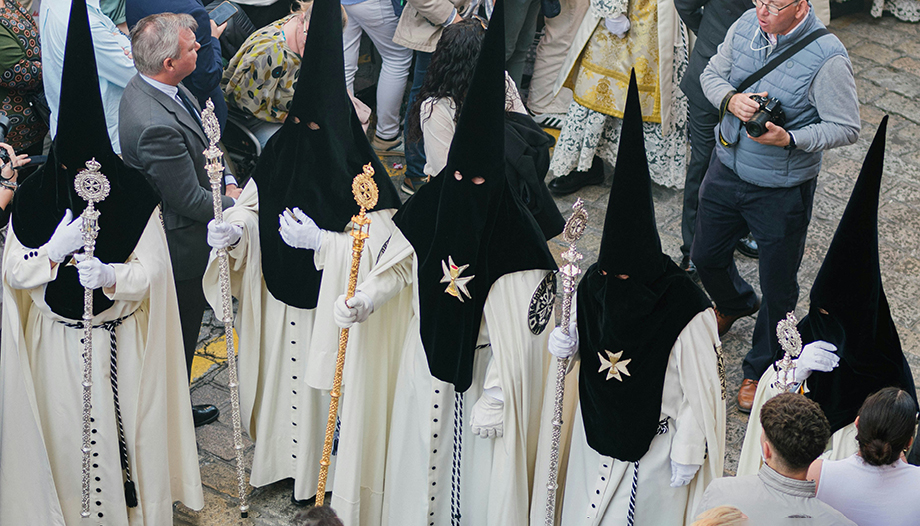
 "The brotherhoods bring hope to thousands of people and lead them to faith."The Brotherhoods and Confraternities, relics of the past?Formation: key to freedom and innovation in the Sisterhoods
Popular piety is not a folkloric appendage of Christian life. It is the threshold through which many people are introduced to the Mystery of God: a mother who teaches the sign of the cross, a candle lit before an image, a rosary prayed as a family, a penitential station that awakens questions. However, for this threshold to truly lead to Christ, it must remain united to the liturgical life of the Church. The Vatican Council II clearly expresses it: “The Liturgy is the summit towards which the activity of the Church tends and at the same time the source from which all her strength flows” (Sacrosanctum Concilium, 10).
For this reason, the Council itself, in recommending pious practices, establishes a golden criterion: “It is necessary that these same exercises be organized with the liturgical seasons in mind, so that they may be in accord with the sacred Liturgy, in a certain sense derive from it and lead the people to it” (Sacrosanctum Concilium, 13). This pastoral rule avoids two temptations: liturgicism that disdains the devotion of the people, and devotionalism that forgets that the Eucharist is the heart of the life of the Christian and of the Church.
St. Paul VI, with a fatherly gaze, recognized lights and shadows of “popular religiosity”; but he affirmed that, “when it is well oriented... it contains many values” (Evangelii Nuntiandi, 48). And Pope Francis has strongly emphasized that in popular piety “underlies an actively evangelizing force that we cannot underestimate”.” (Evangelii gaudium, 126). It is not a question of marginal pious practices: it is a pastoral fact. Where faith seems weakened, there often remains a glowing ember in these expressions that are as simple as they are profound.
Brotherhoods and confraternities: a privileged ecclesial subject
In our land, the brotherhoods and confraternities are a privileged subject of this popular piety. The Directory on popular piety and liturgy recalls that, in addition to the exercise of charity and social commitment, its purposes include the following “the promotion of Christian worship” (Directory... n. 69). It also describes their concrete life: they have their own calendar of worship services, processions and pilgrimages, and they mark days of worship, processions and pilgrimages. “in which certain works of mercy are to be done”.” (Ibid.). The Church recognizes them, approves their statutes and values their acts of worship; but, at the same time, it asks them to, “avoiding all forms of opposition and isolation.”, are “integrated in an appropriate way into parish and diocesan life”.” (Ibid.).
From here we can understand its evangelizing mission. A fraternity evangelizes when it takes care of communion: with the pastor, with the diocese, with the ordinary liturgical life, with the poor and with the youth. It evangelizes when worship is not reduced to aesthetics, but leads to confession, to a profound experience of the Eucharist, to listening to the Word, to coherence of life and to its charitable and social work. And it evangelizes when its public presence is not self-affirmation, but witness: a people that walks humbly, praying, offering penance, placing Christ at the center.
Three unpostponable tasks
First: formation. Without doctrinal and liturgical formation, piety is impoverished and exposed to confusion. The Directory reminds us that the exercises of piety should be “conformable to sound doctrine”, "in harmony with the sacred Liturgy”.” and promote “a conscious and active participation in the common prayer of the Church.” (Directory..., n. 71). Therefore, a persevering catechesis is urgently needed: on the mystery of Christ, on the Virgin Mary, on the saints, on the meaning of penance and mercy, on the Social Doctrine of the Church.
Second: celebrate with truth. Well-prepared services - centered on Christ, illuminated by the Word, with sobriety and an ecclesial sense - evangelize without fanfare. Also pilgrimages and processions, when they are prayer and not spectacle, can be a “first proclamation” for many. Francis reminds us that “walking together to the shrines... is in itself an evangelizing gesture”, and adds: “Let us not curtail or seek to control that missionary force!” (Evangelii Gaudium, 124).
Third: to serve. Devotion that does not become charity becomes sterile. The brotherhood that accompanies the sick, supports the needy, welcomes the migrant, visits the elderly, promotes works of mercy and defends the dignity of the poor, preaches the Gospel with works and credibility. Popular piety then becomes integral evangelization: worship and life, beauty and truth, tradition and mission.
Popular piety, purified and encouraged, is a place where the Spirit continues to work. Let us care for it with pastoral love so that our brotherhoods may be, more and more, communities of missionary disciples who lead to the liturgy and, from the liturgy, go out to meet the people.
Archbishop of Seville






 Español
  English
  Italiano
  Français
  Deutsch
  Polski