


 Contemplare Foundation. Showing the richness of the contemplative lifeThe communities of contemplative life launch an SOS
There is a fact that crosses our time and that cannot be overlooked: on the one hand, increasingly frenetic rhythms, polarizations that harden the public debate - also the ecclesial - and a digital environment that reduces the spaces for interiority; on the other hand, a search for meaning that reappears with force, sometimes outside the usual channels of the Church, but no less profound for that reason. In this context, the monastic proposal does not sound like nostalgia for the past, but rather a fully current provocation. Ancient“ words such as silence, communion, sobriety, fraternity and shared life place the essential at the center of Christian life.
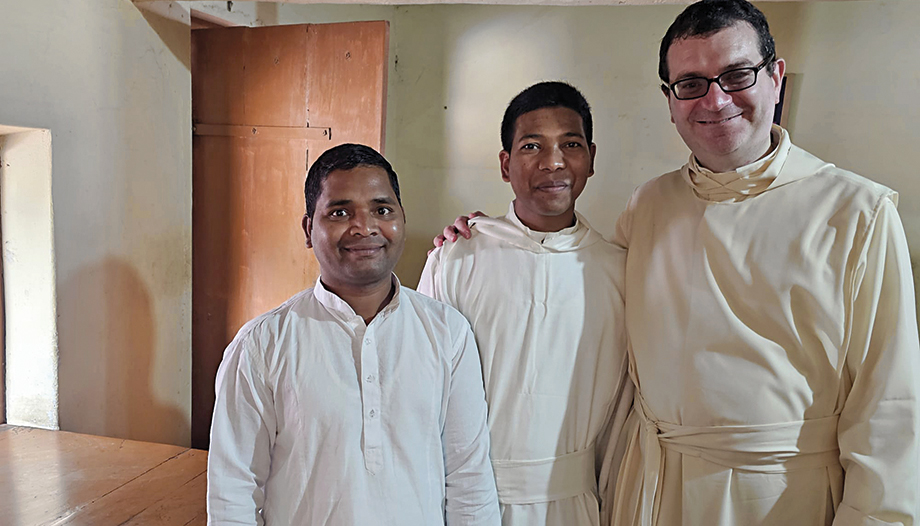
Dom Matteo Ferrari, Prior General of the Camaldolese Congregation, was born in 1974 in Parma and has been a monk in Camaldoli since 2001 and a priest since 2010. An esteemed biblical scholar and liturgist, author of numerous publications, he was responsible for the liturgies during the two sessions (2023 and 2024) of the XVI General Assembly of the Synod of Bishops on synodality.
In this interview for Omnes reflects on the relevance of monastic life, the value of silence in a society saturated with stimuli, the challenge of polarization, the credibility of the Gospel and the spiritual quest that many men and women face today.
Matteo Ferrari, you are Prior General of the Camaldolese Congregation. What spiritual community is it and from what experience is it historically born in the Church?
-The Camaldolese Congregation is a branch of the Benedictine family and was born from the intuition of a monk from Ravenna, St. Romuald, who, in search of a simpler and more sober spiritual experience, found in the eremitical life the path for his inner search. Romuald, whose life is narrated by St. Peter Damian, died in 1027; therefore, next year we will celebrate the millennium of the death of our founder, but also of the dedication of the first church of the Sacred Hermitage of Camaldoli.
If one wanted to summarize Camaldolese spirituality in two words, one would propose: solitude and communion. Two fundamental poles of the monastic life, which in Camaldoli take visible form in the experience of the Hermitage, and the solitary life, and in the Monastery/Cenobium, the common life. However, in the wake of the Benedictine tradition, also the life of the Hermitage at Camaldoli is not a choice of isolation or of a totally solitary life, but a certain communitarian dimension is always experienced, especially in the sharing of liturgical prayer.
In line with the style of the Camaldolese monk, what does it mean, in concrete terms, to keep silence and fraternity together?
-Keeping silence/solitude and fraternity together is an extremely fruitful dialogue, as well as a great challenge. Hermitage and Monastery do not live “parallel lives”, but it is as if they educate each other. The Hermitage tells the Monastery that there is no true communion if one does not live the fruitful solitude of the encounter with God and with oneself, that one cannot live with others who does not know how to be alone before oneself and before God; the Monastery tells the Hermitage that solitude is not isolation and is not an end in itself, but is for a deeper communion with God and with others. A Christian can never live his experience of faith outside the community, even if he lives the most radical form of solitude as seclusion.
In your opinion, does monastic life still have something to say to the Church and the world today?
-I believe that monastic life is a fundamental vocation for the Church today. At least for the Church in the West. The world, in fact, knows very diverse and fruitful experiences of faith. Romuald's intuition was not the search for solitude as an end in itself, but, deep down, the search for greater sobriety. I believe that today this is a fundamental word for living the Gospel. The monastic life is the vocation that in the Church constantly reminds everyone to go to the essentials of the Word of God, of prayer, of fraternity.
“If I wanted to summarize in two words the Camaldolese spirituality I would propose: solitude and communion. Two fundamental poles of monastic life”.
Matteo FerrariPrior General of the Camaldolese Congregation
One lives in the city, with frenetic rhythms... What can Camaldolese spirituality offer to those who are not monks but wish to seek God in everyday life?
-Many lay people and priests frequent our communities especially in search of a different “rhythm. All of them, when they begin to pray with us, are initially struck by a purely external but significant fact: slowness. A rhythm that allows us to interiorize, to pause for reflection, to discern before the Word, to live the gratuitousness of time. I think this is another gift of monastic life: gratuitousness. The monk, in a way, ”wastes time“. I think that today this is a fundamental message, because gratuitousness is a paschal sign. The life of Jesus was also a time given freely. Monastic life, with its rhythms, its time ”wasted“ in prayer and liturgy, is a paschal sign that reminds everyone that in life the things that really count are not those that are born in the time of ”production“, but in the space of gratuitousness.
What wounds and what questions do those who come to the monasteries in search of listening and peace most often bring?
-The questions and searches of those who come to our communities are very different. The monastery is a space open to all, without asking questions, without conditions. People seek silence, listening, different rhythms of life. Often people seek “consolation” in particular moments of their life; they seek spiritual nourishment in the encounter with the Word of God in the lectio divina and in the liturgy. There is a great need for spirituality, at times not specified, but present in the hearts of the men and women who come to our hermitages and monasteries. I think that offering this hospitality is fundamental in the Church today. Basically, monasticism, in the practice of hospitality, so important in the Rule of St. Benedict, is a privileged place where we find a hospitable face of the Church, which is a continuity of the same ministry of the Lord Jesus.
In various countries, a new spiritual need seems to be emerging, a search that does not always pass through the Church. How to interpret this dynamism and how to accompany it adequately?
-This search crosses the life of our communities and the forms of our welcome. I believe that this fact should challenge all our Christian communities. In the episode of the wedding feast at Cana, Mary realizes that there is no more wine and that we need the courage to listen to the Son's words so that the water can become God's good wine, so that the feast can continue. Perhaps all Christian communities should ask themselves about the “lack of wine” and listen to the words of the Mother: “do whatever he tells you”. Then, if we have the courage to pour out the poor water we have, we will be able to realize that we can offer that wine which is capable of satisfying the spiritual search of the men and women of our time.
Another feature of contemporary societies is the strong polarization in many contexts, including the ecclesial context. How can we prevent differences from turning into confrontation?
-I believe that the presence of two poles in our communities can be a small example of how polarities can be lived as a richness for all and not as an element of division. True fraternity is that which is born from the valorization of differences: only many different precious stones can make a beautiful jewel. But this entails a care for the interior life and spirituality. Without spiritual life, without prayer and without listening to the Word of God, we will never learn to integrate differences into a fruitful dialogue. And all this is not easy and the challenge of common life tells us this clearly.
“Solitude is not isolation and is not an end in itself, but is for a deeper communion with God and with others.”.
Matteo FerrariPrior General of the Camaldolese Congregation
Along with religious indifference, there is also a growing rejection or suspicion of the Christian faith in some contexts. What is this situation saying to Christians?
-I think it is a call to “live well,” to seek that coherence of life that is fundamental and at the same time very difficult. But deep down this has always been the test of the presence of Jesus' disciples in the world. The New Testament bears witness to this. Let us think of the First Letter of Peter: “Adore the Lord Christ in your hearts, always being ready to give an answer to anyone who asks you to give an account of the hope that is in you. But do this with gentleness and respect, with a right conscience, so that when you are slandered, those who slander your good conduct in Christ may be put to shame.” (1 Peter 3:16).
What attitudes make the Gospel more credible to those who observe the Church from the outside?
-I think that today fraternal life is fundamental: how do we live in community? The people who come to our monasteries, especially the younger ones, are very attentive to the relational dynamics, to the fraternal climate they perceive. Sometimes even we are surprised by what people notice. We often feel lacking, we see above all our defects and our wounds, but the people who frequent us often perceive a positivity that even we do not see. Fraternal life, communion, is a fundamental factor in witnessing to the Gospel today. Then I also believe that prayer, the time dedicated to God, to listening to his Word, is an aspect of the Christian life that others see and from which the authenticity of what we live can be understood.
In your relationship with young people seeking spiritual accompaniment, what questions come up most frequently and what risks hindering their faith journey?
-Young people are first and foremost looking for listening. In our Christian communities, where so many things are done, there is often a lack of time for welcoming and listening. Young people are also looking for someone who can help them to descend into their inner world, to know themselves. This is where the search for spirituality and an encounter with God and his Word begins. We are often too afraid to offer young people serious paths of spiritual accompaniment, of prayer, of relationship with the Word of God.
“True fraternity is that which is born from the appreciation of differences: only many different precious stones can make a beautiful jewel”.
Matteo FerrariPrior General of the Camaldolese Congregation
You have written a letter to the Camaldolese Community to initiate a reflection on the use of social networks, smartphone What is the essential point, for you, in the relationship between spiritual life and technology?
-I believe, even though I am not an expert in this field, that it is a knot that we cannot avoid. There is a great forgotten protagonist of life, which is called “silence”. Today we are no longer able to make silence and social networks, smartphone and the digital world have to do with this. Especially for a monk, but I would say for everyone, if silence is missing, a fundamental component of life that allows the encounter with others, with oneself and with God disappears. Reflect on the use of social networks, smartphone and digital media leads us to reflect on our capacity for silence, which is also the presupposition of freedom.
Finally, a word of advice: what concrete steps can be taken to recover silence, listening and space for God in daily life?
–It is a “struggle” and like any struggle it requires commitment, training and time. Above all, I suggest to let oneself be helped: having someone to confront is essential and is an “ecclesial” act. The spiritual path is not individualistic, but always communitarian. The spiritual life is not learned in books or from other instruments, but is transmitted from living to living... it is a fact of living tradition. And then to start from the essential: from the relationship with the Word of God, which is “powerful” and has the power to renew and make our life flourish.






 Español
  English
  Italiano
  Français
  Deutsch
  Polski