


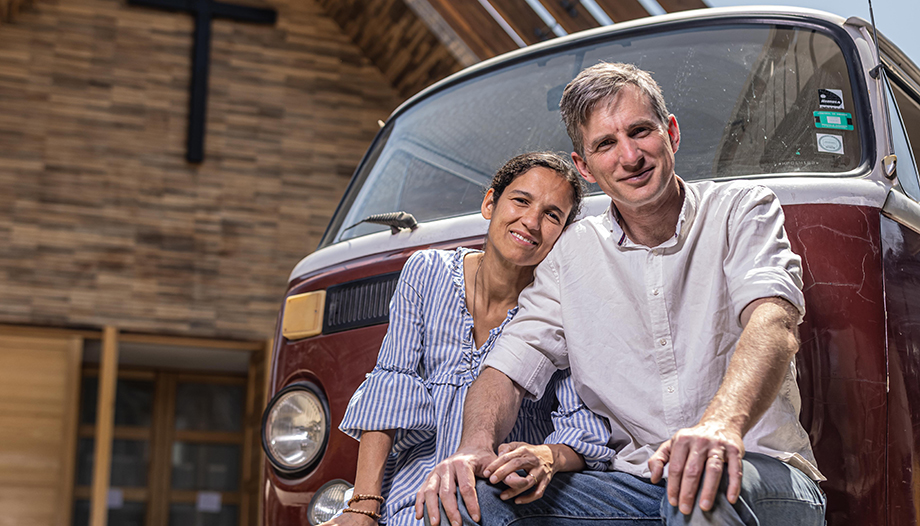
The French missionary architect Romain de Chateauvieux is in the news, because the poor are in the focus of attention of the Church. They always have been, but the impression is that now, more so.
His wife, the Brazilian Reina, was born and grew up in a favela, in a very poor family in San Salvador de Bahia. She converted after being visited by missionaries from her parish, which was run by a French priest, a very missionary, explains Romain de Chateauvieux.
St. John Paul II visited that same parish on an apostolic trip, because he had the desire to go to the poorest places in the country. And one of them was the favela of Reina. In this conversation, Romain tells Omnes the story of his vocational discernment, his wife's vocation and his own. A family with six children fully involved in Mercy, a mission founded a month before the election of Pope Francis in 2013, who received them in Rome.
We are talking about the core of the foundational charism of Mercy, The projects in the peripheries of large capitals: “They are Christocentric. Christ is at the center of everything that is done. The close link between adoration and the presence of Jesus in the poor is common to the various Mercy projects.”.
How do you explain Mercy, What defines your charisma?
–Mercy is defined as a work of the Church at the service of evangelization and the service of the poor in the peripheries of the great cities of the world. Our mission and vocation is to be the heart of Jesus that beats day and night for the poorest. To this task of compassion in the service of the poor and evangelization, proclamation of the Gospel, are joining mostly lay people -young singles, couples, families-, who come for six months, a year, two or more, as missionaries and live this radical life at the service of the Church and the poor.
There is also a way to get involved as a volunteer. These are people who have their lives in the world, and who come once a week to participate and support a Misericordia project. There is also the possibility of working for Misericordia on a contract basis. In total, today there are about 30 people of six different nationalities working in the different countries where Misericordia is present.
Where did you meet Reina, your wife? Tell us about her conversion, and yours?
-Reina experienced her conversion as a teenager by reading the Word of God in a Bible she found in her home after a visit from the parish missionaries. As she read the Passion she discovered that she was very much loved by the Lord, and she had a call to reciprocate that love. So she approached the parish. She received the sacrament of Baptism, First Communion, Confirmation, and asked to be welcomed in this small missionary community that a French priest had set up to serve the parish and the favela. She lived there for six years.
When I visited this French priest friend, I also experienced this conversion in contact with the poorest of the poor. It was a Good Friday, after having acted as Jesus on the Way of the Cross. Visiting a very humble person, I was able to have that contact with the living Lord in the poor and I heard a little phrase that said: “Romain, the happiness you seek in the service of the poorest, you will find it.”. And there I received the call to dedicate my life to serve the Lord in the poor, for love of Him and for love of the Church.
You had to discern if you had a vocation to marriage. How did you found Mercy?
–Reina and I met in this small missionary community, we lived several months together, a very beautiful friendship, a fraternity of the soul. Then I returned to France. And being there in the discernment of my vocation, it was very clear the call to the matrimonial vocation, and a very clear call with Reina. So after graduating as an architect, I returned to Brazil, we were able to open our hearts, to discern together, and we got married in this same parish where the Pope had come to visit the poor.
We were sent on mission by the French Episcopal Conference for two years to the United States, and we had asked the Lord for those three marriage gifts: prayer, simplicity of life and missionary life. With these three gifts we went on mission to the United States in a ghetto populated by clandestines and migrants from all over the continent.
And there, for two years, we set up a very nice missionary work that took shape in a missionary center that later became a parish. Then, with the contact of so many people from all over the continent, we felt a call to an itinerant mission, to the call of our neighbors who asked us to go to their neighborhoods, to their cities.
We were sent by the Episcopal Council of Latin America to the sixteen countries of the continent for three years, to carry out this mission of compassion, serving the poor and evangelization. We went to the most remote and excluded places, where the Church did not reach in such a powerful way.
Later, at the end of that missionary journey, we felt a call to open this experience to more people, outside our family circle, Romain, Reina and the children. There were people who were asking to experience the mission in this way, and so we founded Mercy a month before the election of Pope Francis, with that intuition of the works of mercy both corporal and spiritual, which were found in the service to the poor, evangelization in the Heart of Jesus, in mercy, and there was founded Mercy.
¿What underlies each social project of Mercy in the heart of neighborhoods in large cities, such as Santiago de Chile, Paris, Nantes, Buenos Aires or New York?
–What the different projects have in common is the DNA of Mercyare Christocentric projects. Christ is really at the center of everything we do, everything we live, especially through a very Eucharistic prayer life, through the celebration of the Holy Mass, through Eucharistic Adoration. For us, Adoration is really contemplating Jesus present in the Eucharist, to continue to contemplate Him, as Mother Teresa said, in the weary bodies of our poor.
This close link between Adoration and the presence of Jesus among the poor is very central and very common in the various projects of Mercy in the world. And also the fact that they are Christocentric projects, that is, they work around the chapel of Adoration, the presence of the Lord in the Eucharist.
These are social projects of innovation and excellence that work in the neighborhoods like a magnet, attracting the neighbors because they are projects that respond very closely to their needs. The neighbors come to our projects and within the projects, in a transversal way, there is the evangelization content, which allows the neighbors to discover the great love of the Lord, to integrate the life of the Church, especially through the sacraments, and then to become missionaries themselves. This is very transversal in the different projects of Mercy in the world.
In reality, it is a proclamation of the Gospel... You speak of five steps.
–As I was saying, it is compassion and evangelization. And evangelization is the proclamation of the Gospel, which is done through friendship. We say it is like five steps.
1) To live with the people; to come to live, a little bit the same dynamic as the Incarnation. Jesus came to dwell with us. Emmanuel, God with us.
2) The second; listen, listen to the pains, to what is in the hearts of our neighbors.
3) The third; after having lived with and listened to, is to understand. When the life of our neighbors enters into our reason, we understand better the reason for their wounds, the difficulties, the sin that may be in drugs, delinquency, prostitution. This is understood after having lived, after having listened.
4) The fourth is that once understood with the head, it goes down to the heart and that is to let oneself be wounded, the love of compassion, to let oneself be wounded by it, by the pain, by the cross of the other.
5) The fifth step is, from that wound, to be able to love and proclaim. It is that love that springs from the wounded heart of Christ pierced by the lance. Then our love also wants to spring from a wounded heart, pierced by the pain and suffering of our neighbors.
So, evangelization is impregnated by this process of compassion, evangelization from friendship in the long term, with great joy, with great prudence and respect, as friends, as brothers, we share the greatest treasure we have, which is the treasure of faith. What I hold most precious, most valuable, I want to share, because I love you and trust you, so it is not proselytism, it is sharing a treasure that the other is free or not to receive and welcome.
Can you comment on how Pope Francis' teachings have influenced you?
–Pope Francis has been for us, well, for the whole Church, a great inspiration. He has confirmed for us that what was in our hearts through Misericordia, those intuitions of announcing the Gospel, serving the poor, were being confirmed with Pope Francis, with his exhortations, his encyclicals. It was as if the Holy Spirit was blowing in the same direction. We enjoyed very much his teachings, especially for the mission, for the young people, who are very present in our lives. Mercy, The service of the poor, the presence of Jesus there.
And perhaps also the desire for a poor Church for the poor, a Church going out, are many things that we live in Mercy, The words of the Pope, of the Vicar of Christ on earth, have confirmed this. It was very nice.
We also had the privilege of being with him in Rome, we were with our children. It was a very nice meeting. The Pope said: “I am very happy to know that the peripheries of the Church, through Mercy, are very well cared for”.”. There has been a very great communion of soul with the Holy Father. And his last encyclical on the Heart of Jesus has been a great light for us, and also a confirmation because Mercy is centered on the Heart of Jesus, from where mercy flows, and our vocation of wanting to be the heart of Jesus for the poor. It was a gift from the Holy Spirit through the mouth and teachings of Pope Francis.
Pope Leo XIV published Dilexi te.
-Indeed, the great surprise has come, which is perhaps the continuity of Pope Francis, united to the vision of Pope Leo XIV. For us it has been a great joy, which we are tasting in prayer, that centrality of love for the poor in the Church, in the living out of our faith, a place of new fruitfulness in the history of the Church. From there, from that poor Church for the poor, great saints emerge in the history of the Church. For us it is a very great exhortation to holiness, being close to the poor.
Something that has marked us very much is the protagonism of the poor in the construction of the Church of today and tomorrow. The poor, says Pope Leo XIV, have a specific and indispensable intelligence in the construction of the Kingdom of God from the peripheries. For us it is also very important to give the poor their full place in the Church, not only as subjects but also as protagonists.
The Pope speaks of a very strong discrimination suffered by the poor, which is a discrimination of spiritual attention, and for us this is key. At Mercy, The works of charity are the means to reach our goal, which is the proclamation of the Gospel, the gift of faith, the sharing of the treasure of knowing that we have always been loved by the Lord from all eternity. Mercy is a very powerful exhortation to continue to be that fullness of the Church in the peripheries, to be able to give to the poor the beauty, the fullness of the liturgy, of evangelization, of formation, of the magisterium for the poor.





 Español
  English
  Italiano
  Français
  Deutsch
  Polski
  简体中文
简体中文