


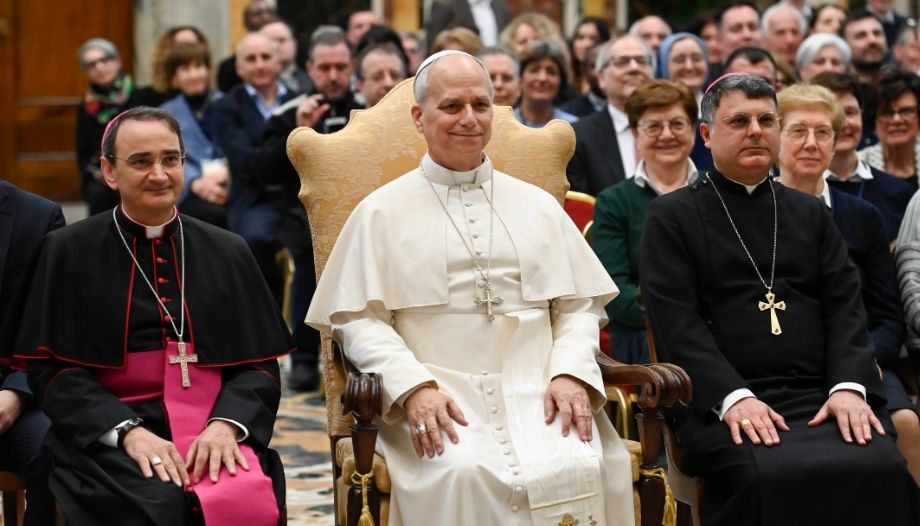
Faith and reason, to keep “our eyes open” in the face of violence and suffering, and the call for a cessation of hostilities in the Middle East and the resumption of dialogue, especially in Lebanon, were central themes in the Angelus of Pope Leo XIV on the IV Sunday of Lent.
In fact, the Gospel The Pope said that the theme of this Fourth Sunday of Lent recounts the healing of a man blind from birth (cf. Jn 9:1-41), and “it is striking that for centuries there has been a widespread belief, still present today, that faith is a kind of “leap in the dark,” a renunciation of thought, so that to have faith would mean to believe “blindly”.
“An open-eyed Christianity.”
However, “the Gospel, on the other hand, tells us that in contact with Christ eyes are opened, to the point that the religious authorities insistently ask the healed blind man: ‘How were your eyes opened?’ (Jn 9:10); and also: ‘How did he open your eyes?’ (v. 26).
The Pontiff encouraged that “we, healed by the love of Christ, are called to live a Christianity “with eyes open”, especially to the sufferings of others and the wounds of the world. Faced with the many questions of the human heart and the dramatic situations of injustice, violence and suffering that mark our time, we need an awakened, attentive and prophetic faith that opens our eyes to the darkness of the world.
Leo XIV, Benedict XVI, Jürgen Habermas
Shortly before, the Successor of Peter had said: “Faith is not a blind act, a renunciation of reason, a disposition of a certain religious conviction that leads us to look away from the world. On the contrary, faith helps us to look from Jesus” point of view, with his eyes".
Some have recalled on this point the conversations between the German philosopher Jürgen Habermas, The dialogue was held with Joseph Ratzinger (Benedict XVI) in 2004, in which the latter acknowledged that religion somehow needed a critical control of reason. The context of the dialogue was faith, reason and democracy in Europe.
Habermas, for his part, recognized that religion continues to play a relevant cultural and moral role, and did not propose its exclusion from the public sphere, but rather to translate its ethical intuitions into a language accessible to all citizens. At the same time, the philosopher affirmed that the relationship between faith and reason is not one of subordination, but of reciprocal learning.
War in the Middle East
Regarding the war in the Middle East, Leo XIV noted that “thousands of innocent people have lost their lives and many others have been forced to flee their homes. I reiterate my closeness in prayer to all those who have lost loved ones in the attacks that have struck schools, hospitals and populated areas.”.
“Lebanon, a cause for great concern”.”
He then acknowledged, as he did last Sunday, that “the situation in Lebanon is a source of great concern. I hope that paths of dialogue will be opened that can help the authorities of the country to implement lasting solutions to the current serious crisis, for the common good of all Lebanese.
In the name of the Christians of the Middle East and of all women and men of good will, I address those responsible for this conflict: cease hostilities! Let the paths of dialogue be resumed! Violence can never lead to the justice, stability and peace that the peoples are waiting for.”.
The Pope is already residing in the apartment of the Apostolic Palace.
For the rest, Pope Leo has already transferred your residence to the apartment in the Apostolic Palace, together with his closest collaborators, as confirmed by Matteo Bruni, director of the Holy See Press Office. It consists of several spaces, including the private study, from where the Pope looks out for the Angelus in St. Peter's Square, the Library and a small chapel. Until now, the Pope had lived in the Palace of the Holy Office, where he resided when he was prefect of the Dicastery for Bishops.






 Español
  English
  Italiano
  Français
  Deutsch
  Polski
  简体中文
简体中文