



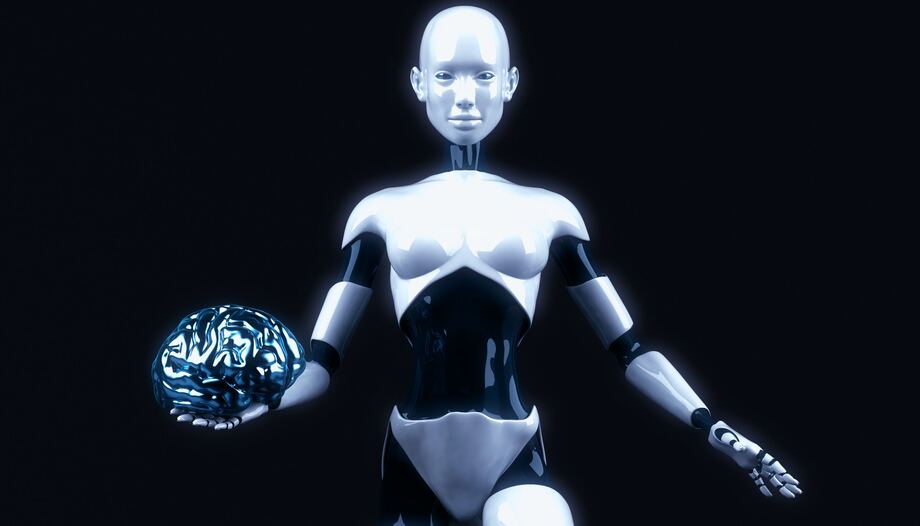
Questions that for centuries were entrusted only to the confessor, the wise old man or the silent darkness of prayer, such as "Does God exist," "Why do I live," or "Why do I suffer," are now asked every night, before closing our eyes, to an AI machine.
The phenomenon is real and profound. Not as a threat, but as a sign. Because if there is one thing that Artificial Intelligence has done with unexpected mastery, it is to reveal to us - with crystal clarity - exactly what we are.
The machine can respond. It can quote Thomas Aquinas, summarize the Book of Job, enumerate cosmological arguments. But - and here is the astonishing truth - the machine cannot ask the question. It does not need it. It does not feel it. It has no heart to hurt it.
The thirst that no screen can quench
We live in an age of an overabundance of answers and a growing hunger for meaning. We have access to more information than any previous generation, and yet spiritual loneliness is spreading like a desert. The contemporary human being, saturated with data, languishes for something that is neither downloaded nor stored in the cloud.
The technocratic culture - as the document of the International Theological Commission ‘Quo vadis, humanitas’ warns - is tempted to measure everything, to reduce man to function and performance. But man is not a function. He is someone who remembers with tenderness, who loves with vulnerability, who weeps before a sunset or at the foot of a tomb. Someone who, in the deepest silence of the night, feels that there is a voice calling his name.
– Supernatural Artificial Intelligence cannot know that voice. Not because it's small, but because it's just code. Brilliant, efficient, amazing code. However, the code doesn't bleed. It does not wait. It does not love.
The image of God in everyone
Herein lies the greatest astonishment: every time a machine does something we thought was exclusively human - writing, reasoning, composing - we discover, as if by luminous contrast, what no algorithm can replicate. The Catechism of the Catholic Church has always said it with beautiful simplicity: God's desire is inscribed in the human heart.
It is not a learned or programmed desire. It is born from the very experience of existing: from the amazement before a starry night, from the pain that cries out for justice, from that incomplete happiness that no earthly good can ever fulfill. St. Augustine knew it before anyone else: “You made us for yourself, Lord, and our heart is restless until it rests in you”.
The human being has been created in the image of God. Not as a pious metaphor, but as an ontological description of our deepest reality. We are capable of knowing the truth, of loving gratuitously, of opening ourselves to the eternal. No machine can be the image of God because no machine can search for God. And in that search -imperfect, painful, full of doubts and grace- lies all the greatness of the human.
Why this truth matters to us today
Deep down, the phenomenon of millions of people asking spiritual questions to a machine is not about the machines. It is about us. It speaks of a thirst that is never quenched, of a heart that finds no rest on any screen because it was made for a reality that no screen can contain.
– Supernatural Artificial Intelligence, Paradoxically, it gives us one of the oldest and most urgent questions: what am I that not even the most brilliant machine can be? The answer is not in the code. It has always been inscribed in the depths of your being: you are someone capable of loving, of suffering, of hoping, of searching. You are someone made for God.
An algorithm can answer the question “Does God exist?”. But only you can ask it with all the weight of your history, your wounds and your hope. And it is precisely in that search - fragile, courageous, unrepeatable - that religious experience begins. Life begins.
Doctor of Canon Law






 Español
  English
  Italiano
  Français
  Deutsch
  Polski
  简体中文
简体中文