


 Alejandro Villena: "Mobile phones are the main entry point for pornography".How to help quit pornographyPornography comes to ChatGPT
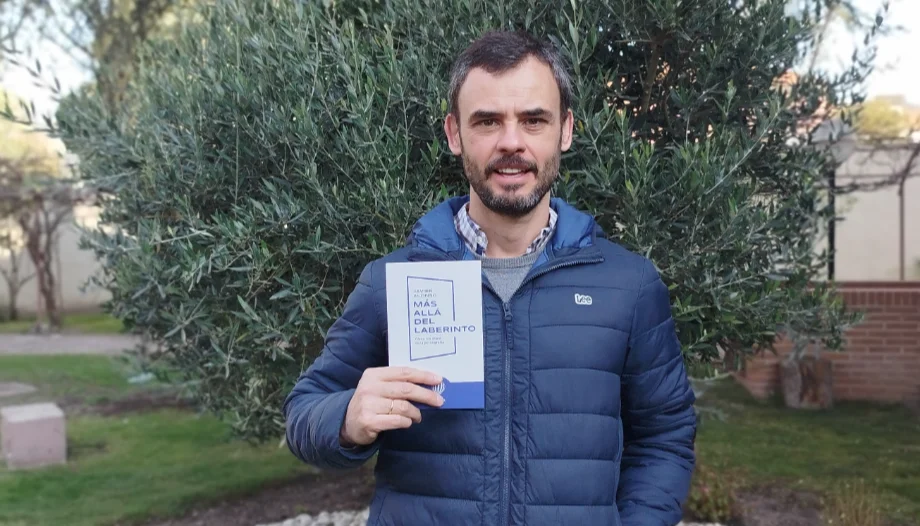
Javier Alonso does not fit the clichéd profile of the prefabricated testimony. His account combines rawness, practicality and a surprising capacity for analysis of inner experience. At Beyond the labyrinth narrates his process of overcoming pornography and proposes a broader reading on masculine fragility, the search for meaning and the way in which faith can transform -without idealism- concrete life.
Far from offering simplistic formulas, Alonso articulates an itinerary in which psychology (a career he studied), personal experience and a spiritual experience that he recognizes as decisive. He shares his experience in educational centers and Emmaus retreats, where he feels first-hand the effect of his testimony.
In the final part of the book you introduce a very suggestive idea: the “eight traps” of the Christian process. What exactly are they about?
-I discovered that being a Christian is not about fulfilling a list of things - going to mass, praying, behaving well - but about walking a path towards a goal. And as in any path, there are pitfalls. They are like cognitive biases in psychology: errors of the brain that one does not easily detect and that can lead you astray without realizing it.
Can you give an example?
-One of them is the “Pharisee's trap”: believing oneself better than others because one is a Christian, entering into a kind of moral competition for points. Another is the “isolationist trap”, which consists in focusing obsessively on one's own spiritual perfection, forgetting others.
There is also that of the “Aladdin”, which is to wait for God to grant you everything, as if he were a genie. I myself fell into that after living very strong experiences. But the reality is that many times God does not grant what you ask for, and that is also part of the path.
You also mention the “cab driver's trap”, which is striking.
-Yes, it has to do with how we look at others in everyday life. Sometimes we treat people as obstacles: the one who bothers in the subway, the one who delays the queue... But in reality they are people with deep stories. When you change your gaze, you even surprise yourself: this has led me to meet people who go unnoticed; I once spoke at length with a homeless man who had nothing and yet lived with a joy that unsettled me.
Although the book revolves around pornography, you insist that the problem is deeper.
-Of course. Pornography is the tip of the iceberg. Underneath there are insecurities, wounds, tiredness, loneliness... And behind that systematic production of fragile emotions, there is a specific personality that produces them. And that personality is forged from childhood. The problem is that it is very difficult for men to recognize this fragility.
Pornography is a widespread problem. In the young kids I talk to, I would say that practically 100% have had contact with pornography. And in adults it is still widespread, but hidden. It's a taboo subject: many couples don't even talk about it, and that complicates everything even more.
What advice would you give in this regard?
-Talk about it. Without drama, but with clarity. Avoiding the conversation only increases the problem. And besides, nowadays it is essential, because sooner or later you have to educate your children about it.
In your experience, is it possible to get out of an addiction only with psychological tools?
-Yes, it is possible. I myself managed it for a while with professional help, self-knowledge and discipline. But in my case it was not definitive. The definitive difference was a personal encounter with God. For me it was a real turning point. After that, as far as pornography was concerned, the attraction disappeared. It wasn't a gradual process, it was radical.
Does that mean there is no more fight?
-Not exactly. I'm still human and I have other temptations, of course. But in that particular area there was a very clear liberation.
You speak of a personal encounter with God. What would you say to someone who has not experienced something like this?
-That it not be satisfied. Many times we live our faith in a routine, almost utilitarian way. I would say to him: ask for more. You have to go all out in this sense. Ask God to experience his presence, even if you don't feel anything. And the best thing is that this advice is not only for people who believe in Him, but for everyone. And anywhere; you don't have to be in a church to be encouraged to do so. And anytime; for example, right now.
Isn't it dangerous to base faith on experiences?
-Yes, a faith based only on experiences is weak. But it is also true that, for me in particular, in moments of dryness, those experiences have helped me a lot. For me they have been like an oasis in the desert.
After that turning point, how has your growth process been?
-I have had a fairly intense period of formation. I spent two years in a program in the United States, with theory and practice, focused on living the faith in everyday life. I also participate in formation and leadership initiatives.
Is this balance between experience and training important?
-Fundamental... but I don't consider myself an example of balance. There are people who are super constant. I struggle to form myself and take my faith to the concrete. But then all sorts of things happen to me: I get distracted at Mass, I find it hard to concentrate when I pray, and many times I need to move because I can't stand still.
You come from a not particularly religious background. How did that influence your path?
-I had everything to keep me away from the faith. I had many prejudices regarding certain ecclesial environments. But with time I realized that it was not I who was looking for God, but He who was looking for me. After all that I have gone through in my life, I would say that what has changed is my “look”. Before, I was very focused on myself: my problems, my downfalls, my improvement. Now I try to look more outward, towards others and, of course, towards God.
Beyond the labyrinth







 Español
  English
  Italiano
  Français
  Deutsch
  Polski
  简体中文
简体中文