


For the contemporary reader, opening the Old Testament can sometimes be a bewildering experience. Between psalms of praise and surprising stories, stories emerge in which the divinity seems to act with a violence that clashes head-on with the “God is love” of the New Testament. How can we reconcile the God who orders the extermination at Jericho with the Christ who forgives his executioners from the cross?
The answer lies not in hiding these passages, but in learning to read them in the light of the great Tradition of the Church. As Benedict XVI pointed out in his exhortation Verbum Domini, These “dark pages” of the Bible contain a mystery of salvation that requires two fundamental keys of reading: progressivity in revelation and the interpretation of the Old Testament in the light of the New Testament, that is, of Jesus Christ.
1. Scenes without context
The most violent biblical scenes are regularly proclaimed in the liturgy, because the Church does not hide difficult texts or eliminate them. It should be noted, however, that isolated fragments are often read without the broad narrative context that allows us to understand the reasons for the most severe punishments.
In many ancient cultures, practices now considered aberrant were common: human sacrifice, infanticide or deeply degrading sexual behavior. This context helps to understand why, on certain occasions, God commands the Israelites to completely destroy their enemies (including women, elders, and children), as in the case of the Amalekites, the capture of Jericho and of some Canaanite city.
A complete reading of the texts allows us to appreciate that God acts with patience and mercy before resorting to punishment, which appears as a last resort when there are no other ways left. Nevertheless, the difficulty of justifying the death of the innocent persists, a question that will be addressed later.
2. God's pedagogy is progressive
God does not reveal himself fully and immediately, but through a pedagogy that adapts to each era. He adapts himself to the language, culture and mentality of men in order to progressively elevate them.
St. Augustine explained that the punishments of the Old Testament constituted a necessary medicine for a people whose hardness of heart would not have understood any other language. God enters history by assuming the categories of his time in order, once the relationship with the people has been established, to purify their understanding of justice.
Ancient societies lived with a heightened awareness of their vulnerability. In this context, it is understandable that they expected protection from the divinity against their enemies. This is how they understand episodes such as the plagues of Egypt or the destruction of Pharaoh's army in the sea..
3. Medicinal justice
Throughout Scripture there are moments in which divine justice is manifested in an extreme form, but with a background that the Christian tradition has interpreted in terms of mercy. St. Ambrose and other Fathers of the Church maintained that these acts do not respond to a logic of vengeance, but to a corrective purpose.
By putting an end to situations of structural evil, God prevents human beings from continuing to accumulate faults that would compromise their ultimate destiny. In this sense, the flood or the destruction of Sodom and Gomorrah are presented as interventions aimed at halting the advance of evil and preserving the possibility of conversion for future generations.
On other occasions, the manifestation of divine power seeks to reaffirm the authority of those who have been chosen as mediators. This is the case with Moses, in episodes such as the punishment after the worship of the golden calf, when he commands to drink the melted gold of the calf execute 3,000 Israelites.
«Put every man's sword on his thigh; go through the camp from gate to gate, killing every man his brother, his friend, and his kinsman.» Thus the Exodus contains words of particular harshness. However, the reading of the preceding chapters shows that the divine punishment comes after repeated warnings to the people to rectify. The alternative would have been to annul or limit human freedom in order to force faith, a possibility that will be discussed later.
In the face of the people's unbelief in God's deliverance through Moses, various punishments of a pedagogical nature follow one after the other, aimed at showing the origin of true salvation. This occurs in the rebellion of Korah, when the earth opens up and engulfs the rebels; or in episodes such as Taberah, where fire punishes the complaints of the people in the desert, and the plagues of poisonous snakes that cause many deaths..
4. Treat the sacred with respect
Some passages may seem disproportionate from a contemporary sensibility, but they underscore a central idea: the holiness of God demands reverent treatment. According to St. Augustine, these external signs served to instill in a still immature people an awareness of the divine majesty.
In this way, it is understandable that God orders the stoning of Achan and his family as punishment for stealing sacred objects. Similarly, Nadab and Abihu die for offering “strange fire” on the altar, thus violating the sacredness of the cult.
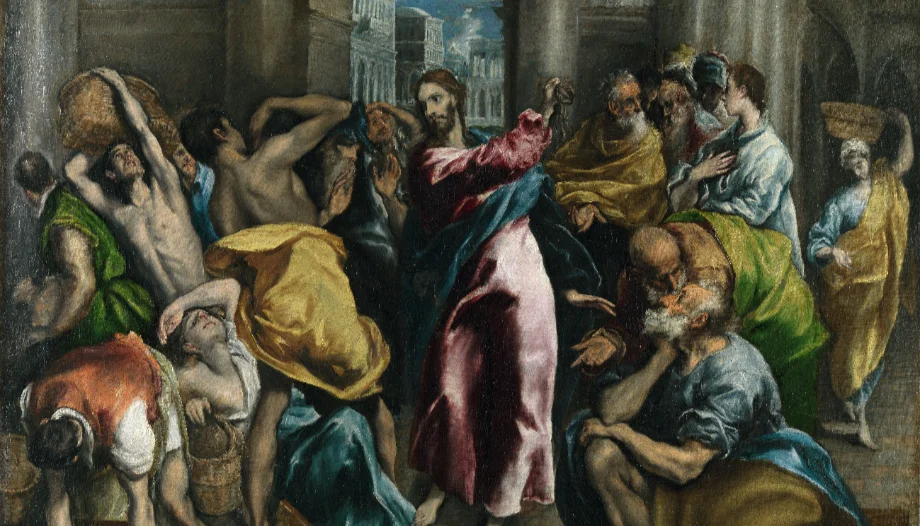
The demand for respect for the sacred is also underlined in the most “violent” scene of Jesus Christ in the Gospel: the expulsion of the merchants from the temple. Although the text does not indicate that Christ struck anyone directly, it does relate that he made a whip of ropes -probably to frighten or scare animals- and overturned the tables of the money changers.
This demand for glory due to the Creator alone is not exclusive to the archaic ages of the Old Testament; it manifests itself with equal force at the dawn of the Church. This is attested to by the New Testament in the book of Acts, when it narrates the end of Herod Agrippa (who ruled from 41 to 44 A.D.). By allowing himself to be cheered by the crowd as if his voice were that of a god and not of a man, the story shows us that was smitten by an angel and eaten by worms for allowing himself to be treated as a god.. This episode underlines a fundamental continuity: the majesty of God and the seriousness of the sacred do not change with the passing of the testaments, confirming that the God of Jesus Christ is the same Lord of history who claims for himself what is proper to him.
Possibly the even more striking episode of “divine violence” is the death of Uzzah, struck down when he touched the Ark of the Covenant to prevent it from falling to the ground. At first glance, it might seem an extreme rigor: to die for an act of apparent good intention. However, when the full context is considered, it becomes clear that his mistake began much earlier. According to the book of Numbers, the Ark was to be carried exclusively by Levites of the clan of Kohath, on their shoulders and with wooden poles, without anyone touching their bodies directly, under the warning that touching the holy could cause death.
In the case of Uzzah, David and his people transported the Ark in an ox cart, following a Philistine practice foreign to Israelite tradition. By treating the Ark as a commodity, they had lost the ritual respect demanded by divine law. The theological lesson of this passage underlines that good intentions are no substitute for obedience to the sacred: Uzzah considered the ground more impure than his own sin-scarred hand, but God teaches that the sacred cannot be manipulated outside his rules.
As a consequence, the biblical account indicates that David was filled with fear, realized that he could not move the Ark to Jerusalem as a political trophy and waited three months before moving it again, this time in strict compliance with divine provisions.
5. Christ, fullness of revelation
Christian tradition holds that Scripture must be read in a Christocentric key, for Christ constitutes its ultimate meaning. In the light of Calvary, the most difficult passages acquire a new perspective.
On the cross, God does not unload his justice on others, but takes it upon himself. The God who in the Old Testament appears to punish the sinner is finally revealed as the one who bears the sin of the world. From then on, the Christian response to evil is oriented towards forgiveness and self-giving.
In the second book of Kings, a particularly moving episode is narrated: God responds to the prophet Elisha's imprecation against a group of boys who were rebuking him, and allows two bears out of the forest to kill forty-two of them. (Important note: Elisha was insulted for being bald, so take note: beware of bald people).
This passage, at first sight disconcerting, has been the object of constant reflection in the theological tradition. From this perspective, the so-called “The ”wrath" of God, frequent in the Old Testament, should not be interpreted as a vengeful reaction, but as the expression of the radical rejection of God for sin that harms human beings.. This is emphasized by patristic theology, which understands these stories in a pedagogical and salvific key.
Along these lines, St. Augustine affirmed that “the God of the Old Testament is the same as that of the New Testament; what changes is man's capacity to understand his justice and mercy. This affirmation allows us to situate these texts in a horizon of continuity, where divine revelation unfolds progressively in history.
The most difficult pages of Scripture, therefore, are not a defect in revelation, but the witness of a God who is fully involved in human history. A God who, far from remaining aloof, assumes the contexts of violence and harshness proper to each epoch in order to lead them, from within, toward their transformation. Read in the light of the spiritual tradition, these scenes reveal that, even in their severity, God acts as a Father who tirelessly seeks man's conversion and return.
6. God gives us freedom, but truly
From this perspective, it is worth asking why God permits evil. He could have created a world without the possibility of error, but that would have meant eliminating human freedom.
An existence without freedom would turn life into a mechanism without merit or authentic love. By granting God free will to human beings, he accepted the risk that this power would be used to turn his back and generate evil. Therefore, it is not strange that one of the works of St. Augustine, at the beginning of the fifth century, was dedicated to reflecting on whether God was right to make us free, since man runs the risk of offending him and condemning himself eternally.
7. God, author of life
Finally, the theological tradition stresses that God is the author and sustainer of all life. Therefore, his decisions cannot simply be equated with human actions. From this perspective, the biblical passages in which God orders the death of certain persons would only be morally problematic if they implied a real injustice towards those who suffer it.
However, the ultimate good of the human being is not exhausted in the prolongation of earthly life, but consists in attaining eternal life. To this is added a decisive element: the impossibility of knowing fully the measure of the gifts received by each person and the degree of responsibility that will be demanded of him in the particular judgment.
In this sense, the divine rigor that appears in numerous biblical texts does not lend itself to simplistic judgment from exclusively human categories. It is indeed possible that those who are punished in this life may receive mercy in the next.
Episodes such as that of Lot's wife, turned into a pillar of salt after disobeying the divine command by looking back at the destruction of Sodom, can also be understood from this double dimension: as a pedagogical warning for believers, a call to obedience that leads to true good, and as an event that does not exclude, in the last analysis, God's saving action.






 Español
  English
  Italiano
  Français
  Deutsch
  Polski
  简体中文
简体中文