



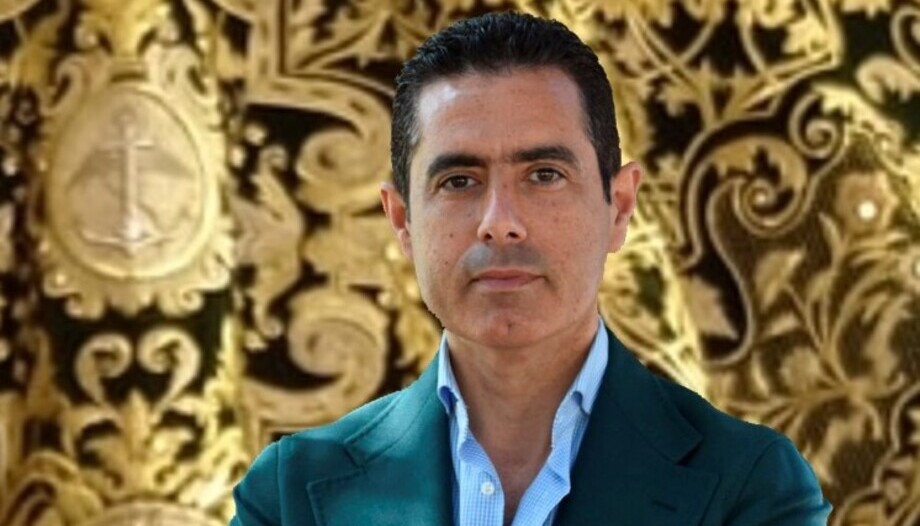
At the age of 54, César Augusto Díaz Narváez has the honor, and not a little difficult duty, of holding the title of Elder Brother of the Real Hermandad y Cofradía de Nazarenos de Nuestro Padre Jesús de la Sentencia y Humildad, Santísimo Cristo de la Yedra, Nuestra Señora del Rosario y Nuestra Señora de la Esperanza Coronada, more popularly known as the "Real Hermano Mayor de La Real Hermandad y Cofradía de Nazarenos de Nuestro Padre Jesús de la Sentencia y Humildad, Santísimo Cristo de la Yedra, Nuestra Señora del Rosario y Nuestra Señora de la Esperanza Coronada". Brotherhood of the Yedra of Jerez.
This law graduate, married and father of three daughters, has been linked to this Brotherhood since his birth. “I have been a child of La Esperanza since I was born,” he tells Omnes, not in vain, his grandfather was one of the initiators of this Brotherhood without which the Jerez Madrugá would not be understood today.
His affection has also led him to research the history of the Confraternity and to write a book with these researches entitled ‘Illusions of Hope, Men of Legend’.
The Brotherhood of La Yedra
The origin of this Brotherhood, which performs its penitential station in the early morning of Good Friday in Jerez, dates back to the late seventeenth century with the devotion to the Holy Christ of La Yedra, an image that originally received worship in a public niche in the Plazuela de Orellana.
This devotion was united with Marian piety and, on October 1, 1928, the corporation was officially founded under the title of Brotherhood of the Santísimo Cristo de la Yedra and Nuestra Señora de la Esperanza (Holy Christ of La Yedra and Our Lady of Hope).
In 1939, was the first procession of the Virgen de la Esperanza, although the key date to understand this brotherhood today is in 1952 when the brotherhood made its first Penitential Station in the early morning of Good Friday, a schedule that remains to this day and that gives it its distinctive character in the city.
A few hours before the penitential station of 2026, César A. Díaz Narváez has talked to Omnes about how he lives his faith within this Brotherhood, the importance of the popular piety in a secularized world and the task of the brotherhoods beyond the penitential station.
A characteristic of the Sisterhoods At what age did you start in the Brotherhood? What does the task of being a Big Brother in such a distinguished brotherhood mean in your life?
-Obviously, family tradition is an important part of the world of the brotherhoods. I, as they say in my family, I was born a child of the Esperanza.
My grandfather was one of the founders of the brotherhood. My father is part of it, my uncles, many relatives. Me too, as a third generation. Siblings, cousins of mine are closely linked to the Brotherhood. In fact, my three daughters and my wife are also sisters.
One of the most important challenges I have is to know how to transfer this affection for the institution and devotion to the images of the Lord of the Sentence and Humility and the Virgin of Hope to my daughters so that they can continue this family legacy.
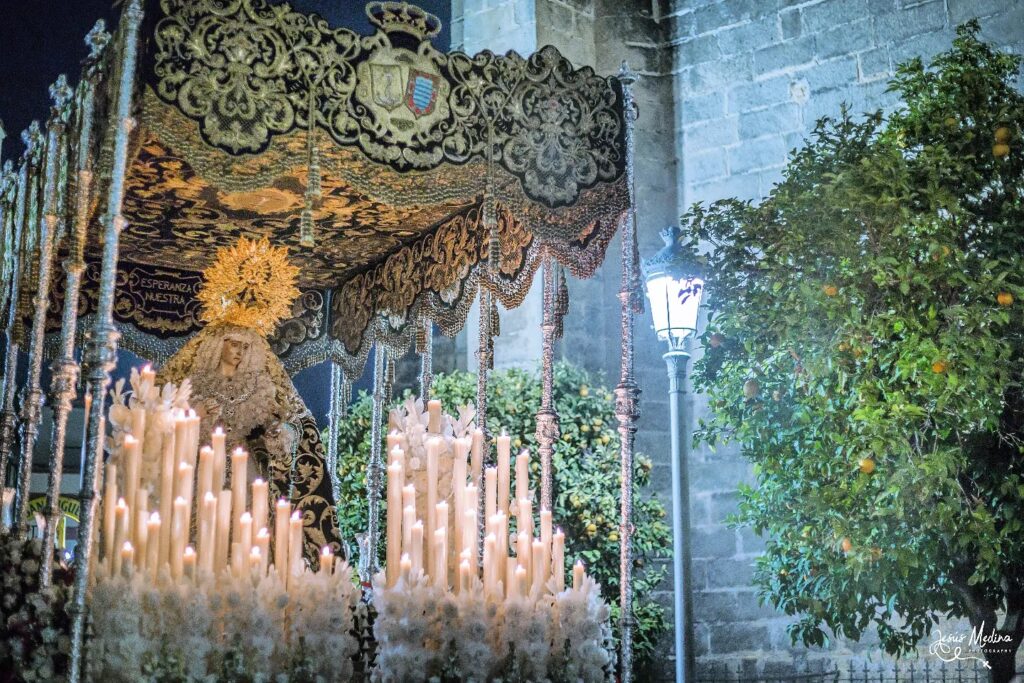
La Esperanza de la Yedra is one of the most beloved and most devoted images in Jerez. How do you explain the deep emotional connection that Jerez has with its Mother of Hope?
-Devotion to the image of the Esperanza de la Yedra is an accumulation of several facets. In the first place, it is an image of unquestionable artistic historical value. It is attributed to Diego Roldán, in the middle of the 18th century, around 1750-52. And that already makes it an image with a special unction, which attracts each of the devotees who pass through our chapel. But it also has an explanation, since it has always been a pilgrim image.
Due to the circumstances of our small chapel, we could not leave from that place and we had to leave from different points of the city of Jerez: the convent of Madre de Dios, the parish of San Miguel, the Colegio Oratorio Festivo and then we returned to the chapel of La Yedra.
In addition, the image of the Esperanza seems to be that it was part of an old brotherhood that was called de los Dolores and was in several temples as well. After the disentailment of Mendizábal, it was moved from the convent where it was located to the church of San Lucas and the asylum of San José. And that has made the image travels through the different corners of the city and has been able to go stealing hearts of many Jerezans which has caused it to be the image of sorrow of more devotion in the city.
One of the pillars of every Brotherhood is its social and charitable action. In an environment of socioeconomic contrasts, such as Jerez, how does this action translate throughout the year?
-Many times, the brotherhoods are negatively valued by those people who do not know the depth of the 365 days and the work that the Brotherhoods do throughout the year.
One of these aspects is social action.
The Hermandad de la Yedra has a special commitment in this sense. We, at the time, had a self-managed kitchen that was at the forefront of Caritas at a national level and developed a very important work for many years.
Today we have a direct collaboration with various institutions here in the city, among which we can highlight Caritas Parish, where we have a very close collaboration, and the Hogar San Juan, here in Jerez de la Frontera, where we are always taking all kinds of needs, clothing, food ..., any economic circumstance that needs, is there the Brotherhood of La Yedra to contribute.
We are also collaborating with the children of an association here for children with oncological problems, and with an autism association in Cadiz with which we are collaborating directly in many areas.
The work of the Brotherhood of the Yedra in terms of welfare works is very important. All this work is not well known by the rest of society and the brotherhoods are at the forefront of social assistance.
Some call the brotherhoods the “dikes of contention” in the face of the advance of secularization. Do you live this reality in Jerez society? What does the Yedra offer to the new generations?
-In recent years, the Brotherhood of La Yedra has undergone an important revolution with the access to the list of brothers of many people, among which young people stand out.
Kids today live in a world without roots, where they want to detach them from the family, from Christian values, from the idea of Spain. This makes people -like plants that have no roots- easy to dominate. However, in the bosom of a brotherhood, where what prevails is the word of Jesus Christ, the Church; where family values and tradition prevail, where there is a series of anchors to hold on to..., these are very important places for young people, where they can settle and develop as persons.
That is why the confraternities, with their capacity to engage the youth, have become a containment dike for secularization. With secularization, the aim is to isolate the individual from all this baggage of tradition and family and Christian teaching that we have. What the confraternities do is, precisely, to fight against this tendency.
Jerez attracts thousands of visitors for its Holy Week. How do you work so that the penitential procession does not become a mere tourist spectacle and maintains its sense of faith?
- The confraternity has the virtue of getting or even “returning” to the Church through different paths. The path can be tourism, music, photography... There are many, many aspects that are concentrated in the world of the confraternities, and each one can reach them through different paths.
The important thing is the formation that takes place in the confraternities. We have conferences through which we try to form, for example, liturgically in the knowledge of the Word of Jesus Christ. Everything is done so that those who arrive in a more superficial way, in the end, find in this formation the sense of faith.
We have, every year, many people, even adults, who were not baptized, children of parents who left the Church because of anticlericalism or any other circumstance. Well, these young people who are being baptized now, at a certain age, in their twenties, in their twenties, are bringing back these families that separated from the Church.
I believe that this is a value that is not yet being recognized in the confraternities and, in this impulse among young people to return to religion and faith, I believe that the spearhead are the confraternities.
As a Christian living your apostolic mission within a Brotherhood, how do you express the testimony of Christian life in your daily life and, especially in your penitential station?
-I live the penitential station in a special way. In a world where everything is frenetic, where there are no moments to reflect, where everything is focused on a mobile, tablet or television terminal, where what they do is to tell us what others want..., the penitential station is an ideal moment to be with oneself. I live it behind the mask, in anonymity. This allows me, for about ten hours, to pray, to reflect a lot and, in the end, to strengthen my Christian values.






 Español
  English
  Italiano
  Français
  Deutsch
  Polski
  简体中文
简体中文