



Zaragoza is a land of wind and water, an ancestral city, filled with a spirit of devotion, under the protection of its profuse history. Under the protection of its two cathedrals, La Seo and the basilica-cathedral of El Pilar, and a multitude of churches, many of them erected more than five hundred years ago, a plurality of brotherhoods and confraternities have been formed from 1935 to the present, demonstrating that the Holy Week in Zaragoza not only offers a religious, spiritual and cultural spectacle of incalculable value (in fact, it has been a National Tourist Festival since 2014), but also a living presence of a religious, spiritual and cultural spectacle of incalculable value, is a Festival of National Tourist Interest since 2014), but also a living presence of devotion and good spirit of participation among the new generations of young people, who come to the call of the tercerol, of the capirotes, of the trumpets, rattles, drums and bass drums that accompany steps of remarkable sculptural delicacy and antiquity, as is the Ecce Homo, from around the fifteenth century, which can be venerated throughout the year in the Church of San Felipe and Santiago el Menor, or the Nazarene, which dates from the sixteenth century and is in the Church of San Miguel de los Navarros, to name two of the most prominent and beloved of the holy days of the capital of the Ebro.
The best kept secret
However, there is a brotherhood that stands out for its ancient origins and its lofty values and traditions. The Very Illustrious and Very Ancient Brotherhood of the Holy Sepulchre has its roots in the 13th century, parallel to the constitution of the Monastery of the Canons of the same name.
Both institutions, different from each other, are related only by a subtle bond of brotherhood: both, directly linked to the extinct order of chivalry of the Sepulchre, share space in the Monastery, which today is located, like a beautiful haven of quiet and serenity, in the heart of the fifth city of Spain.
The confraternity has its headquarters in the Church of the Holy Sepulchre, which is accessed on the right hand side of the Plaza de San Nicolás. There, on one side of the Monastery, a small miracle that has been vibrating in the heart of the city for seven hundred years takes place: the local devotees, and some who come to the city on purpose not to miss the event, come to the Sepulcher parading in a silence that seems mystical in an age where noise reigns. The silence that dwells in the cozy monastic church intuitively invites contemplation.
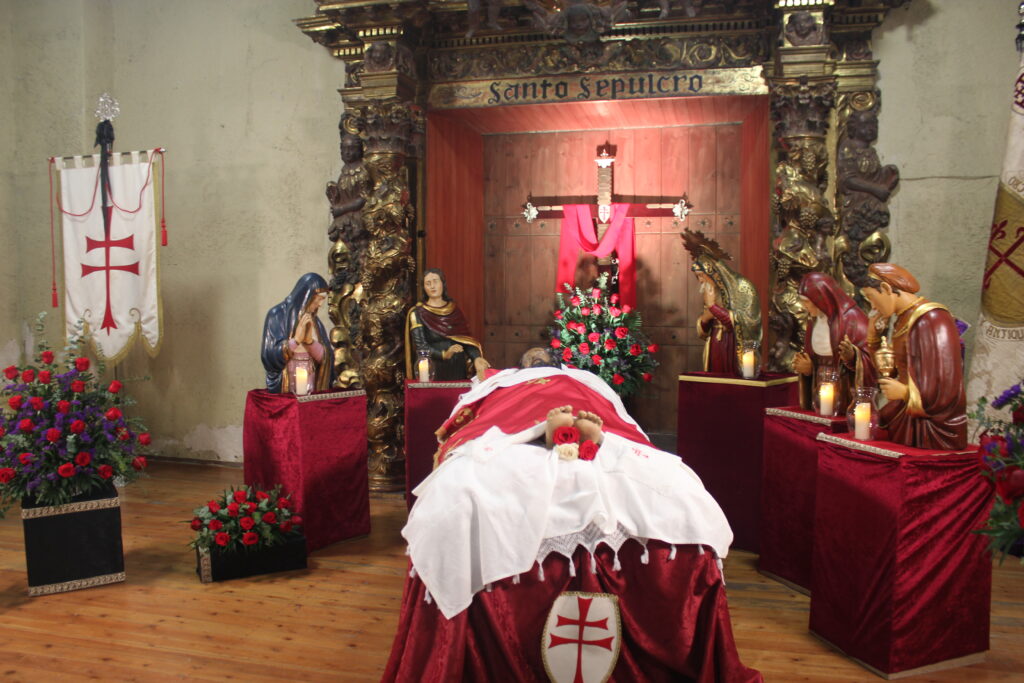
It is precisely the invitation to silence, stillness and inner introspection, away from the din of the drums and symbolic profusion, the principles that make the Brotherhood of the Holy Sepulchre the best kept secret of Holy Week in Zaragoza. I speak of the brotherhood that explains it and gives it meaning, of genuine roots and tradition. A tradition that has for value the recollection in front of the exhibition. And it is not for less, since its invocation is that of the Recumbent Christ, venerated by thousands of faithful from Holy Thursday to Easter Monday.
The current carving, dating from the 17th century and restored by the Government of Aragon in 2000, stands out for its peaceful gesture and facial beauty. Originally, probably an articulated Christ (at present, it is no longer so), it invites the possible tradition of the Descent from the Cross, in habitual disuse in the country since the 19th century. However, the brotherhood has replaced this act by another, which takes place every Holy Thursday at the Sepulcher, the Holy Transfer of the Recumbent Christ. Taken in the arms of the brothers of the brotherhood, with candle and guard on both sides inside the church, the carving is carried with solemnity to his bed, where the body of Jesus Christ is guarded by the Virgin Mary, in suffering character; Mary Magdalene, St. John the Evangelist and Mary of Cleophas. When the prioress confers the three blows of honor with the crosier, the Transfer takes place, of great attention by curious and devotees. Next to the Christ, the brotherhood houses a very perfect replica of the Holy Shroud, the Shroud of Turin, which is available to the offerers for their admiration and curiosity, along with a sample of the books of minutes and precious trousseau of the brotherhood.
However, the central act of the brotherhood is its traditional Solemn Procession of the Recumbent Christ. Unlike other equivalent acts, the brothers and sisters of the brotherhood advance, solemn, through the streets of the Old Town of the city. There is no noise, but music, from the band, and devotion. Until the year two thousand and fifteen, the brotherhood processed during the afternoon of Holy Saturday, the year in which the permission to procession was revoked.
A decade later, in a long process to adjust the schedule to one more suitable for the invocation of the imagery, the Solemn Procession of the Recumbent Christ has returned to the streets of the city with its archiepiscopal permission restored in justice. Until the temporary ban of 2015, the Procession was only suspended at times of political and social crisis of the country or the city, as in the case of epidemics or the two Sieges that the city endured during the War of Independence, in the nineteenth century.
Joy, nervousness and restored honor
For the brothers of the Confraternity, the recovery of probably the oldest and most iconic manifestation of faith in Zaragoza has been a reason for joy and restored honor. To give the reader an idea, the Confraternity counts in its membership minutes nobles linked to the Aragonese monarchy, heroes of the War of Independence -such as the famous Jorge Ibor, the Uncle Jorge-members of the high national and international intelligentsia, as well as members of a multitude of social strata.
The brotherhood was born at the dawn of the powerful Order of Knighthood of the Holy Sepulchre of Jerusalem in medieval times, restored in recent times, so that the sense of honor and respect in the veneration, custody and vigil of the Recumbent Christ are very present in the minds of many brothers and sisters. In this sense, the Confraternity was almost from its origins an example of equality, If presenteeism is allowed: both women and men have the same rights and duties within the company.
And, in fact, the presence of women in the highest hierarchical positions is a consolidated reality. «I used to go to the Holy Sepulcher, but I was not a sister, and I saw them with their cloaks, but they were very few, and older, so I said to myself: “if I come every year to pray to my Holy Christ, why shouldn't I collaborate with them?», says Candida Micaela Redondo, the current prioress, who, in our conversation, continues to recount her decades of voluntary dedication to the needs of the Canonesses, specifically since she was twenty-five years old. She is now in her eighties.
It is the Christ who chooses his brothers, and not the brothers who choose the Christ, excuse the pun and the reference. It is not a joke, but a common perception shared, in shy confidence, by the majority of members. The Confraternity of the Holy Sepulchre keeps its doors and its membership open to any good-hearted person who wishes to share, even if only for a few minutes of prayer during the Holy Days, the value of silence, introspection and reflection. A break from the noise and an invitation to the suspension of judgment that evokes the wisdoms of the East from which, in some way, the Order of the Holy Sepulchre was nourished in its medieval origin, at least, syncretizing with Christian Hesychasm.
This treasure, immaterial and intimate, is the gem that offers and distinguishes the peculiar Brotherhood of the Holy Sepulchre of Saragossa. María Ángeles Isiegas, vice-prioress and coordinator of the brotherhood, explains the process by which most of the brothers and sisters decide to become members of the brotherhood: «I came by chance; In fact, a friend of mine brought me in, almost “on the push”,» she confesses, amused. «I always say: this Christ brings you, grabs you and doesn't let go, or he passes you by and you can come as many times as you want, you don't get attached to him». A servant converges with the experience of María Ángeles and Cándida, or Tati, as they prefer to call it affectionately. Although I have been visiting and venerating the Christ since my childhood, it was about two years ago that I felt the call or inner impetus to become a member of the confraternity.
The recovery of the procession this two thousand twenty-sixth year has meant a totum revolutum in the heart of the group. It has been necessary to organize the usual events (the meeting of Holy Saturday at noon with the Congregation of the Handmaids of Mary Most Holy of Sorrows, an all-female sisterhood, in the Holy Transfer of Holy Thursday, the Chaplets and prayers that are prayed during Holy Week, in addition to the tasks of preparing every ornamental, floral and clothing detail and the placement of the Christ and the Holy Shroud) and to channel the Solemn Procession, which counts with the Solemn Procession of the Holy Shroud, in addition to the tasks of preparing every ornamental, floral and clothing detail and placement of the Christ and the Holy Shroud) and channeling the Solemn Procession, which has guests of honor, as is the case of emissaries of the Hospitaller Order of St. John, musical bands, brotherhoods and authorities who wish to join such an emotional act. It is not for less: the Holy Week zaragozana has recovered, thus, one of its main acts, more ancient and honorable.
Among those responsible for making possible the reunion with the faithful in the streets of the city there has been nervousness and tension, but also a passion and a desire to devote themselves to and for the glittering Christ. María Ángeles explains that the Christ knows his times well and that «he also chooses when he wants to be carried in procession». At the head of the main preparations for the procession and at the head of the peaneros and capataces, she asks me again. «I don't know how it will turn out! And he confesses: »a lot of work has been done to go out again, and this Christ deserves to be in the street with all the honors and, as such, we are going to carry it out with the maximum dignity. Peaneros, members of the Board [of Government of the Brotherhood]... we have prepared everything with the maximum illusion«, he specifies.
Tati takes the opportunity to recall that, in her journey to the priory, she has passed through all the positions of government: luminera (who is responsible for preparing and dressing the Recumbent Christ), treasurer, script (who carries the banner in the solemn acts), except secretary. They are decades of humble service to the veneration of Christ and to the sincere support of the brotherhood.
In addition to Tati and Maria Angeles« excitement, Yolanda, who is currently the treasurer, is also very excited. She explains to me how she has faced the preparation of the Holy Days with a deep introspective and spiritual spirit. »Preparing everything is being a big job and a huge responsibility, a very, very big one, but, at the same time, it is being rewarding: you see that things are coming out and the result of the work is visible. We are doing it with immense love and the hope that the faithful will like it and that it will turn out well, that the people will be happy [to meet again with the Recumbent Christ].".
When we talk about the atmosphere that is breathed in the brotherhood, his face sketches a smile that invites the innocence of childhood, the splendor of the emotion that intoxicates, sincere, to those who speak: «I am living it with great enthusiasm, with great faith, yes, with a lot of nerves too». And she ends by saying a detail that is aligned with that invitation shared and that Christ seems to give in the spirit of each member: «Generally, I live Holy Week from my inner world. I am a very introverted person who does not externalize much my thoughts, my prayers and, above all, my silence. The truth is that I love silence».
Expectation, joy, respect, emotion to the surface. And respect, «above all, respect», as Yolanda reaffirms, who adds that, for her, the Brotherhood is «a big family full of love and faith where everything is given without giving anything in return. In the Confraternity I have met new people who have made me see that human beings can be much better than what we are».
A must-see during the Holy Week in Zaragoza
Until a few years ago, a popular adage ran through the word of mouth of the people of Zaragoza: the Recumbent Christ is the Christ of the Three WishesIf during Good Friday the devotee prays with true dedication to Christ and formulates three luminous desires, He, if they evoke justice, will grant them. The tradition, far from threatening to be lost, continues to throb among many offerers, especially the older ones.
The beauty and the spirit of an inner encounter with God -or, at least, of recollection and inner pause- represent an inimitable gift that the foreign visitor or the offerer of the Holy Week of the Aragonese capital cannot overlook both for its sublime cultural value and for its powerful spiritual character. An invitation to Christian surrender, to contemplation, in its deepest sense, that invites to look at the goodness of others above the frailties that make the human condition pale. This inspiration is, in itself, a miracle, one that deserves to be experienced either accompanying the Recumbent Christ during his Solemn Procession on Holy Saturday or in his seat, where silence rules over the distraction and noise of vain words and broken thoughts.
Brother of the Confraternity of the Holy Sepulcher of Zaragoza






 Español
  English
  Italiano
  Français
  Deutsch
  Polski
  简体中文
简体中文