



An extended version of this article can be found here.
Biography
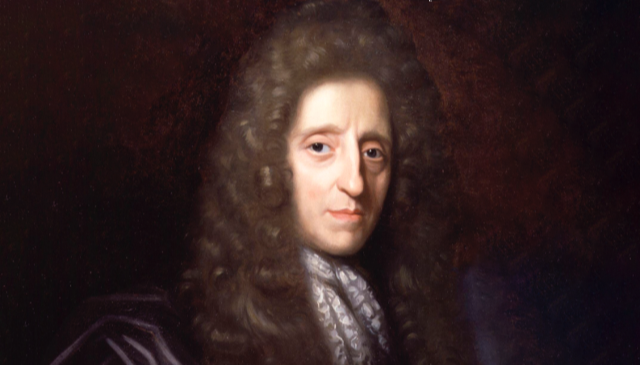
The “famous Locke”, as Immanuel Kant calls him, was the analogue of our Jovellanos in England, one of the fathers and most lucid minds of the Enlightenment. Educated at Oxford, he had a wide culture as a physician, philosopher and politician. His Essay on human understanding founded English empiricism in philosophy and his political theory of the State established the rule of law over absolute monarchy. His prestige was enough to bring peace to the Glorious Revolution of 1688, and he was the inspiration in 1776 for the Founding Fathers of the United States of America.
«John Locke's »Essay Concerning Human Understanding".
EXHIBITION
Simple ideas
Contrary to a Cartesian rationalism which, starting from thought, admitted the innatism of ideas, Locke begins by energetically rejecting such innatism, since for him all knowledge starts from what is arrived at by the senses, which he calls “ideas”, in the literal Greek sense of “what is seen” or “what is known”. Simple ideas are what is primarily or elementally “seen” or perceived by the senses, and they can arrive by a single sense - the case of a color or a sound - or by several, as in the case of corporeality, which we perceive by sight and touch; and they can be external senses, as in the examples mentioned, or internal, as in the case of our perception of the self.
These simple perceptions or simple ideas, The “I”, external or internal, can present itself under different "modes", as for example the different postures or the movement in a corporeal being, or the different perceptions of the "I" as "I" that feels, "I" that thinks, "I" that doubts. Thus, these simple ways come to be classically called accidents. And simple modes are also the various spatial forms and duration. Finally, a simple idea can be considered concretely, as a white color that I see, or abstractly, as whiteness itself.
Complex ideas: mixed modes, substances and relations.
Locke calls complex ideas combinations of simple ideas, which can be mixed modes or substances or relations. For mixed modes -or complex ideas, strictly speaking- means complexes formed at will by putting together several simple modes, as we do when defining a concept, whether of a real or fictitious being.
The substances would be a set of simple ideas that are given in one and the same being that sub-states all of them, and of which they are qualities. Primary quality is extension extension, with its modes of form and movement. The others are secondary, since all sound - and probably all color, smell, taste... are reduced to the movement of particles (today we know that color is vibrations of the electromagnetic field). Gold, for example, would be a substance, and its metallic luster and its fixation would be qualities:
“Thus, when speaking of gold we say that it is fixed, the knowledge of such a truth is only that fixity, that is, the power of remaining in fire without being consumed, is an idea which always accompanies and is always annexed to that particular species of yellowness, of heaviness, of fusibility, of malleability and of solubility in aqua regia, which compose the complex idea signified by the word gold”.
Finally, he also calls complex ideas, in a broad sense, those that are relations between ideas, since they can be understood as “ideas” or as “something seen” in the broad sense of the term “seeing”: we see relationship between two ideas when we are able to juxtapose them - Locke says in an effort to explain himself - as encompassed in a single glance. Because of the relationship between ideas, the knowledge or memory of one leads us to another related to it (the good law student grasps the relationship between the articles of a law when he understands it in depth, very different from the disjointed and impossible to memorize mosaic that a law is for the student who has not understood it).
Of the simple ideas he will say that we can know them clearly and distinctly - well distinguishable from each other - and therefore we also know clearly and distinctly the complex ideas in the strict sense, since we know all the simple ideas that form them (although they may not be real, since they may be the definition of a being that does not exist).
On the other hand, those complex ideas in the broad sense which are the substances, we cannot know them in a clear and distinct way, but they are obscure and confused, because we do not see the being that sub-states in the impressions that come to us together, but only see the impressions themselves. Therefore we have no true knowledge of substances, but only of some of the simple ideas of which they are composed. We can with these simple ideas enunciate a mixed mode - a complex idea in the strict sense - as a nominal definition of substance, but it will always be an approximation, the substance itself remaining unknown.
Since, therefore, we have no clear and distinct idea of substances, but rather an obscure and confused one, Locke considers them useless in philosophy, although he himself cannot dispense with them by using them in the classical sense of supporting their qualities, both those we perceive and those that remain hidden from our perception. And the fact is that Locke preserves the English common sense, and cannot admit that they are qualities of nothing, they must be qualities of something, and that is for him the substance, although our knowledge of them is obscure and confused.
Quid est veritas?
In the last chapter Locke examines what truth we are capable of, that is, the adequacy of our ideas with known reality, i.e. truth, since this is classically the “adequatio inter intellectus et re”. He distinguishes between propositions about ideas that we state with the intention of telling the truth, because we are certain about them, and those that we state as mere judgments when we only see them as probable.
Simple ideas are true, or adequate to the perceived reality, since we perceive them in a clear and distinct way (Locke has common sense and does not think that some little genie has put them in our mind), and so are also the mixed modes or combinations we make of them. Therefore, the statements we make about them can be true: about their identity or diversity; or about whether a certain complex idea is given in reality or is fictitious, as in defining an imaginary being.
But with regard to propositions about substances, about beings! John Locke says that we can never have a claim to truth in what we say about them, but that they will be mere judgments, with greater or lesser probability, but always without certainty, since we do not know what a substance is (this is said early, and seems to be unimportant, but it is a death sentence for our knowledge of being, if the reader reads well).
And as for the relation between ideas, Locke says that true knowledge is possible. In particular, we can have knowledge of the relation of causality or necessary coexistence that can be given between ideas, that is, we can come to know that whenever certain simple ideas coexist, whenever a certain nominal essence is given, other ideas must also be given, because they necessarily derive from such nominal essence.
“But only in a few cases can the coexistence of their ideas be known... For example, the fixity of gold has no necessary connection, that we can discover, with color, weight, or with any other simple idea of those which form our complex idea of gold.”.
In fact, this is the kind of knowledge that occurs in science, since science only deals with relations between ideas, so Locke's lament is because science was at its dawn (little could he imagine that from just one of the unseen qualities of gold, its atomic number, all its qualities, including fixity, could be demonstrated today as necessary).
But this is not possible in the case of “substances, where it is supposed that a real essence, distinct from the nominal, constitutes, determines and limits the species... since we cannot know what is, and what is not, of that species... there are few universal propositions about substances whose truth can be known” (Locke speaks of substance sometimes with the classical notion and sometimes as a complex idea according to his philosophy, but always as something unknowable and useless in philosophy).
And this is how Locke finally and abruptly arrives at morality, which was the reason for such a long study. For Locke, morality deals with relations: the general moral norm can be derived from the relations that creatures must keep with their Creator, and this even if there are no creatures and there is no creator; and furthermore, special morality deals with the relations existing between concrete acts and the general moral norm. Thus concludes this man, who knew how to do his duties, that a true and objective knowledge of morality is possible. This would have more or less value, but what he had left on the way was a totally revolutionary theory of knowledge, where substances, that is, being itself, began to be superfluous.
CRITICS
It is an accurate description of our knowledge if it were only about scientific knowledge, but it is a very unwise philosophy if it pretends to be the description of all human knowledge.
Excellent philosophy of science
Science begins by constructing nominal essences -what Locke here calls mixed modes or complex ideas- by means of definitions that put simple ideas together. Since the correspondent of these simple ideas is clear, it is also clear which beings correspond to such complex ideas.
And then science studies the relations between the complex ideas it has constructed - relations between the objects defined in scientific theories - and sometimes finds necessary relations, so that the observed coexistence of such ideas in the same being, in reality, comes to be understood as a necessary coexistence.
Locke says that knowledge of these relations is possible for science, although, as we have already commented, writing in 1690 , only three years after the start of physics in Newton's work Philosophiae Naturalis Principia Mathematica, He believes that science rarely achieves this, giving as a negative example those properties of gold that he believes it is very difficult for science to ever find them in a necessary relationship.
Now the reader can understand that the first scientific concepts, in the medieval prehistory of physics, were born precisely in a nominalist environment (Oxford, first half of the 14th century). And the fact is that Locke's complex ideas, those that we know clearly - as well as their relations - because we construct them, are exactly the universals of which Ockham speaks in his Summa Logicae, those constructed by us when we define them (Ockham admits universals, but as a mere human construction; he is therefore not a “nominalist”, but a “conceptualist”).
As we have said, this is what really happens in science. It was the Calculators of Trinity College, Oxford, who created by definition the first physical notions: uniform motion, uniformly accelerated motion, average velocity, which would later be followed by others such as quantity of motion, living force (kinetic energy) etc., notions that made possible the birth of physics in Newton's work, after centuries of necessary gestation.
Returning to Locke's example, the future development of this science would make it possible to define the element gold by a single quality - its atomic number - from which all those qualities of luster, ductility, malleability, etc. observed in gold could be deduced, i.e., demonstrated in necessary relation.
Death sentence for metaphysics
For he is saying, of all human knowledge, what is valid only for scientific knowledge. His description of knowledge is, yes, a perfect description of scientific theory, for, in effect, the latter constructs by means of definitions ideas whose relations it studies. But the problem is the title of the book: it pretends to be a description of all human knowledge. Implicit in this philosophical gesture is the positivism that will appear a century and a half later, for which only scientific knowledge, and not philosophy, is valid knowledge. And philosophy is not because it deals with notions of which we do not have a clear and distinct idea, the main one of which - in the philosophy of being, metaphysics - is the idea of substance, precisely that of which Locke said that we do not have a clear and distinct idea.
The prestigious Descartes had prescribed a century before, not to philosophize with notions of which we do not have a clear and distinct idea. For the Locke of Essay on Human Understanding, we would be better off in philosophy if we were to dispense with the notion of substance: “We would be better off in philosophy if we dispensed with the notion of substance".“The notions of substance and accident are of little use to philosophy.... If the Latin words inhaerentia and substantia were translated plainly ... it would show what use that doctrine has in the decision of philosophical questions.”.
We have said that Locke cannot do without substances in his philosophy-something contradictory since he considers them useless-because without them the simple ideas with which his philosophy begins would be mere impressions without anything to cause them: a metallic shine or a sound when struck, but nothing that shines or sounds. But a David Hume will come next who will dare what Locke has not dared: he will banish from philosophy the notion of substance, to remain with impressions alone. The loss of being in philosophy will thus have been consummated. The error of applying to philosophy the demands of the scientific method will have been the “chronicle of a death foretold” for metaphysics. In the end we will be left with science but without wisdom. Bravo, famous Locke.
Complutense University of Madrid. SCS-Spain.






 Español
  English
  Italiano
  Français
  Deutsch
  Polski