


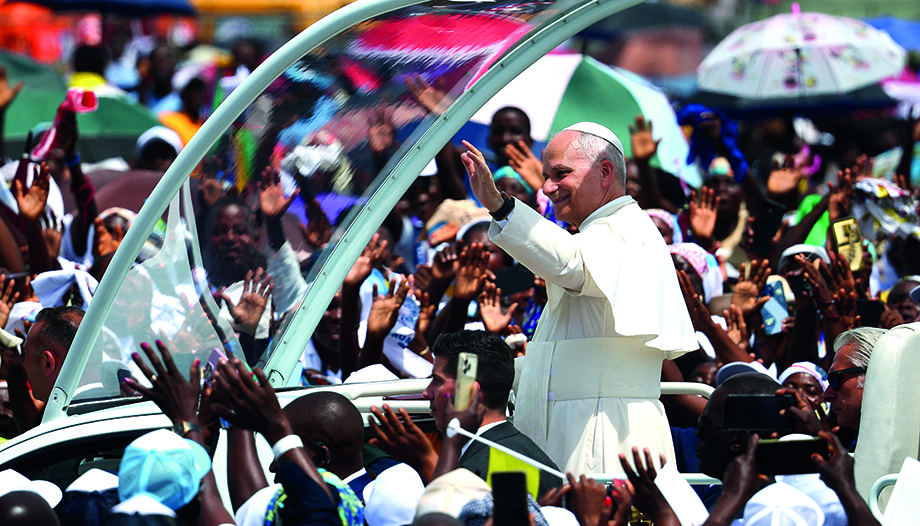
Leo XIV continues to draw the main lines of his road map. In the midst of his intense activity, he reminded us that being a Christian is a call, that is, a vocation that is concretized in various ways. He emphasized this on the occasion of the World Day of Prayer for Vocations. And the vocation is for a mission: the evangelizing mission, in which we all have to participate. For this reason, he proposes to relaunch the evangelizing commitment promoted by Pope Francis, as he has said in his Letter to the Cardinals.
A path of beauty
On April 26th, the LXIII Day of prayer for vocations. A month earlier (16-III-2026), the Pope had published his message, focusing on the Christian vocation as a path of beauty that opens us to the knowledge of God and to an existence fully lived in trust, and matured in his company.
Every Christian is called to holiness (cfr. Lumen gentium 11 and all of chapter V) and in this sense we speak of Christian vocation. The successor of Peter pronounces on this background. He does not refer only to priestly vocations or vocations of special consecration, but also to the Christian vocation of the majority of the faithful, the laity. His message is a confidence especially with young people, so that each one may find his or her concrete vocation within the Christian journey.
The Christian vocation, the Pope explains, can be understood from its inner dimension, that is,“as a discovery of God's free gift that blossoms in the depths of the heart of each of us”. Jesus is the good and beautiful shepherd (cf. Jn. 10: the Greek word for "shepherd"). kalós encompasses both aspects). That is, the perfect, authentic and exemplary shepherd, even to the point of giving his life for his flock, which manifests the very love of God.
"He is the Shepherd who captivates; whoever looks at him discovers that life is truly beautiful if he follows him. To know this beauty, the eyes of the body or aesthetic criteria are not enough; contemplation and interiority are needed. Only those who stop, listen, pray and accept his gaze can say with confidence: ‘I trust him, with him life can be truly beautiful, I want to walk the path of this beauty’. And the most extraordinary thing is that, by becoming his disciples, we in turn become ‘beautiful’; his beauty transfigures us.".
As the theologian Pavel Florensky writes, the saints are characterized not only by goodness, but also by “the dazzling spiritual beauty that radiates from those who live in Christ.”. And in this Leo XIV sees the deepest revelation of vocation: to participate in the life of Christ, to share his mission and to shine with his beauty.
The Pope also evokes the interior journey - a journey of life, of faith and of meaning - of St. Augustine, as he says in The Confessions. "Beyond self-consciousness, he discovers the beauty of the divine light that guides him in the darkness.". This, Leo XIV points out, shows the importance of the “.“care of interiority”which focuses on prayer.
This is one of the proposals - along with education for digital culture and for peace - with which Leo XIV enriched the “Global Education Pact” project launched by Pope Francis.
For all these reasons, he invites everyone to create favorable contexts so that the gift of vocation can be welcomed, nurtured, guarded and accompanied and thus bear abundant fruit.
Listening to God
God knows us and loves us, and calls us to know him. And for this we need to create “spaces of inner silence”We are not talking about abstract or academic knowledge, but about “knowledge that allows us to listen to the voice of Jesus Christ. For it is not a question of abstract or academic knowledge, but of "a personal encounter that transforms life”. This is the advice of St. Augustine: to enter into ourselves, because “.“in the inner man lies the truth".
Leo XIV echoes this advice, asking young people: “Listen to that voice! Listen to the voice of the Lord who invites you to live a full and fulfilled life, making your talents bear fruit. (cf. Mt 25:14-30). and nailing to the glorious cross of Christ one's own limits and weaknesses".
In this way, and following in the footsteps of the Popes who preceded him after the Second Vatican Council, by presenting the Christian vocation as an offer of a full life, the Pope places himself within the framework of Christian anthropology.
And he concretizes the ways of this “listening to God”: “Dedicate time to Eucharistic adoration, meditate assiduously on the Word of God in order to live it every day, participate actively and fully in the sacramental and ecclesial life.”. In this way they will be able to discover the gift of their concrete vocation within the plurality of paths that exist in the Church.
Trust and personal treatment
What makes it possible both to accept a vocation and to persevere in it is trust in the Lord, “even if their plans change ours.”. The bishop of Rome gives the example of St. Joseph, as “.“icon of total trust in God's design”. For, even when darkness and negativity seemed to dominate around him, and things seemed to be going in the opposite direction from what he had planned, “he trusted and trusted, confident of the Lord's goodness and faithfulness”. As Pope Francis writes, “in every circumstance of his life, Joseph knew how to pronounce his ‘fiat’, like Mary at the Annunciation and Jesus in Gethsemane” (Letter ap. Patris corde, 3).
This confidence is based on the virtue of Hope, that God will grant us, to overcome fears and uncertainties, “...".“with the certainty that the Risen Lord is Lord of the history of the world and of our personal history.".
Leo XIV does not hide the difficulties that the path of every vocation passes through. But he assures us of fidelity and its fruit, if we remain united with Jesus: “...".“He does not abandon us in the darkest hours, but comes to dispel all our darkness with his light. And precisely thanks to the light and strength of his Spirit, even in the midst of trials and crises, we can see our vocation mature, reflecting more and more the beauty of the One who called us, a beauty made of fidelity and trust, despite our wounds and falls....".
Like everything that is life, vocation - the Pope explains - is “a dynamic maturation process”The path of the “gift of the Holy Spirit", favored by intimacy with the Lord under the action of the Holy Spirit. A path where we learn to reread all events in the light of the gift received. And this means "growing in vocation”answering the call throughout life.
For this, and not only at the beginning of this journey, we count on the authentic and fraternal bonds that we are weaving.. Y "It is especially valuable to have a good spiritual guide to accompany the discovery and development of our vocation. How important are discernment and following in the light of the Holy Spirit, so that a vocation can be fulfilled in all its beauty.".
Thus, we can “to understand that nothing is the fruit of meaningless chaos, but that everything can be integrated into a path of response to the Lord, who has a precious plan for us.” (Francis, exhort. ap. Christus vivit, 248).
And Pope Leo XIV concludes by appealing to young people: “I encourage you to cultivate your personal relationship with God through daily prayer and meditation on the Word. Stop, listen, trust; in this way, the gift of your vocation will mature, make you happy and bear abundant fruit for the Church and for the world.".
Rediscovering “the joy of evangelizing”.”
Sharing in the life of Christ, as we have seen, leads to sharing in his mission and shining with the same beauty. This is shown in the fact that after the first consistory with the cardinals (held on January 7 and 8 last), where the course of the pontificate was set, Leo XIV has now written a letter to the cardinals (12-IV-2026). In it, he encourages them to relaunch the proposal of Pope Francis in the Evangelii gaudium: a Church that does not look at itself, but rather places itself in a renewed way “on the way out”.
"This Exhortation -he points out. The new content is still a decisive point of reference: it does not simply introduce new content, but refocuses everything on the ‘kerygma’ as the heart of Christian and ecclesiastical identity".
And he adds, making it his own, what was expressed especially in that consistory with respect to Pope Francis“ proposal: "It has been recognized as a true ‘new breath’, capable of initiating processes of pastoral and missionary conversion, rather than producing immediate structural reforms, thus orienting the Church's journey in depth.".
Personal commitment, discernment and accompaniment
Leo XIV specifies how “this perspective challenges the Church at all levels of the Church.”. First, on a personal level: “calls every baptized person to renew the encounter with Christ, moving from a faith simply received to a faith that is truly lived and experienced.”. And he notes that “the very quality of the spiritual life is also affected by this path, in the primacy of prayer, in the witness that precedes words, and in the coherence between faith and life.".
Secondly, at the community level, it drives to move “from a pastoral ministry of conservation to a missionary pastoral ministry, in which the communities are living subjects of the proclamation of the Gospel”. In other words, “welcoming communities, able to use understandable language, attentive to the quality of relationships and able to offer spaces for listening, accompaniment and healing.".
Concretely, at the diocesan level, underlining “the responsibility of pastors to firmly support missionary daring, taking care that it is not weighed down or stifled by organizational excesses, and encouraging discernment that helps to recognize what is essential".
In short, at the level of each individual: lived personal faith, the primacy of prayer, witnessing in coherence with life; and at the ecclesial level, welcoming, listening and accompaniment, and the impetus to mission through discernment.
Encounter and announcement, communication and mission
From all of this, says the Pope, emerges a profoundly unitarian understanding of mission: “a Christocentric mission and ‘kerygmatic’, It is a mission that is born of an encounter with Christ capable of transforming life and that spreads by attraction rather than by conquest. It is an integral mission that combines explicit proclamation, witness, commitment and dialogue.".
It is a matter of overcoming a perspective of merely increasing the number of followers, of mere conservation or institutional expansion.
Leo XIV expresses it incisively: “Even when it recognizes itself as a minority, the Church is called to live without complexes, as a small flock that brings hope to all, remembering that the purpose of the mission is not its own survival, but the communication of the love with which God loves the world.".
Among the specific indications that emerged in the consistory, he concludes by pointing out four, which deserve to be welcomed and further meditated on: 1) “the need to relaunchEvangelii gaudium to honestly verify what has been assimilated over the years and what, on the contrary, is still unknown and unimplemented.”; 2) in particular, “attention must be paid to the necessary reform of the Christian initiation itineraries"; 3) "the attention to value also the apostolic and pastoral visits as authentic occasions ‘kerygmatic’ and growth in the quality of relationships”; as well as 4) the need to reconsider the effectiveness of ecclesial communication, including at the level of the Holy See, in a more clearly missionary perspective".
As can be seen, the publication of this letter can be an occasion and an invitation, for each one and for every Christian community and ecclesial institution, to discern the path taken from participation in the life of Christ, to share his mission and to shine with the same beauty.





 Español
  English
  Italiano