



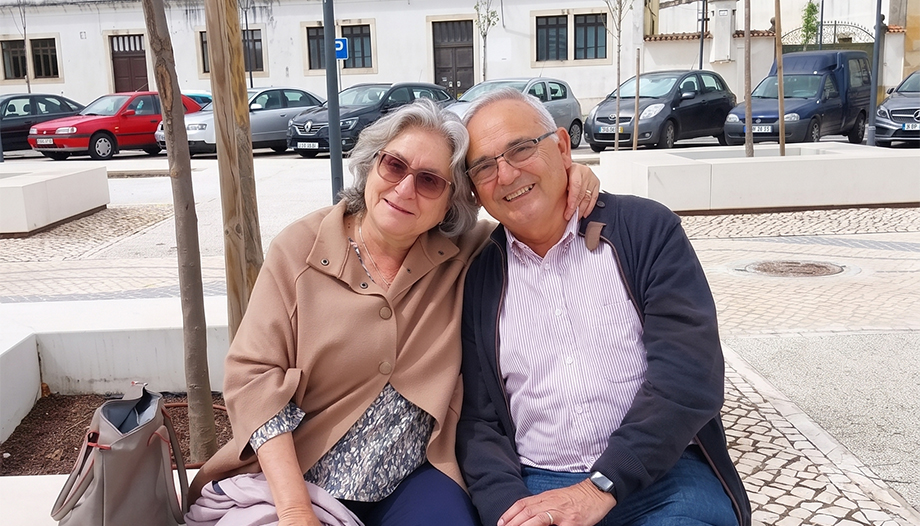
In some few Spanish parishes, the faithful have become accustomed to seeing next to the priest a figure who, without being a priest, participates actively in liturgical and pastoral life: the permanent deacon. Less visible, however, is the life behind this vocation when the deacon is a married man. For with him there is a wife, a family, a shared history.
Isabel knows it well. Her husband, Enrique Ten, has been a permanent deacon of the diocese of Valencia for fourteen years. Both have been walking in the Church for more than half a century, within the Neocatechumenal Way. He is 77 years old today. And although the word “diaconate” may sound solemn or institutional, in his house it is lived with a very human mixture of service, humor and a great conviction in the importance of his mission.
Isabel tells it without solemnity and with disarming frankness. “My husband has always been very involved in the Church, helping in whatever the priests sent him and always very busy in this.”, he recalls.
A vocation that came almost by surprise
The idea of the diaconate did not emerge as a project that took many years to develop. It was born unexpectedly, during a pilgrimage to Loreto in the 1980s. There Enrique felt that Our Lady was calling him to increase his spirit of service. However, since the ministry of the permanent diaconate was not yet instituted in the diocese of Valencia, he did not know how to put this intuition from Loreto into practice. In addition, the complexity of his family life was increasing, the number of his children was growing, and the youngest, Pepe, was born with a slight disability. At that time, “Enrique thought that Our Lady was calling him to devote himself to this needy son, his true diaconate, because when Pepe was born, we saw the needs of a boy with a disability and in need of special attention”, explains Isabel.
However, a few years later, “A Piarist friend of his attended the first ordination of permanent deacons in Valencia and immediately thought: ‘this would be very good for Enrique, it suits him’.”, says Isabel. Enrique had forgotten about the subject, but that suggestion sowed a restlessness that slowly matured. For a while, the vocation was put on hold. But life took its course, the children grew up and the idea reappeared. A long process of discernment and formation began.
A long road... and observed with a critical spirit
For Isabel, that process was long. Very long. “I was saying: with so much training for so many years for me that in the diocese they are entertaining them and that's it.”, she recalls with a chuckle. While Enrique attended preparation sessions and studied theology-which he did with a seriousness that surprised his own wife-she observed the process from the outside, with her usual critical sense.
“I was amused because when he was studying theology he would get nervous about exams, as if he were a kid in college.”, he says. This is particularly paradoxical, since both he and his wife had dedicated their whole lives to teaching high school.
Isabel explains that she has always been very outspoken and critical in expressing her opinions. In fact, her view of the clergy has never been particularly reverential and, as she herself says: “I am very unclerical and very critical.”. For this reason, “I am the first one to put Enrique in his place every time he gives a homily that seemed to me to be either a bore or too long.”, he says bluntly.
Wife's consent
When a married man is ordained a permanent deacon, the Church requires the explicit consent of his wife, since it is a decision that very directly affects the marriage and the whole family.
Elizabeth remembers that moment naturally. For her it was not a great conflict, partly because her husband had already been living an intense life of service in the Church for many years. “I lived through it well because he was actually already devoting a lot of time to helping in the parish and community.”he explains.
Ordination, however, did introduce a change: pastoral service became more visible and more organized. And here an unexpected sentiment appeared. “I felt jealous of the service and time Henry devoted to the Church.”, she confesses matter-of-factly. “There were Sundays when he had to go help out at Mass and I thought, well, when does he make time for me?”, he recalls.
Over time, however, his perspective changed. He understood that the diaconate was not just another activity, but a gift. “I had not understood anything about what the diaconate was, what the mission entailed. For me it is a charism.”, reflects today.
The silent service
This charisma is especially visible in one of the tasks that Enrique performs most faithfully: visiting the sick and elderly. Every Tuesday he has a fixed route. After attending Mass, he begins his round of visits.
Isabel has accompanied some of these visits when the sick person is known to the couple, so she has seen many times the gift that her husband has for treating the sick: “There are people with extraordinary cognitive impairment and Enrique can spend half an hour with someone who didn't know if he understood him or not.”he says.
This surprises her deeply. “Sometimes I've told him, how can you spend half an hour with this person who you don't know if he understands you?”. But for Enrique, he explains, it's not about conversation or efficiency. It's simply presence. “There you perceive that the Lord gives them a particular grace, because that humanly cannot be done.”, Isabel acknowledges.
Enrique's weekly schedule is far from the quiet retirement that many imagine at age 77. Every day he attends Mass at a nearby church. There, although he is not officially participating as a deacon, he helps out wherever he is needed: reading or distributing communion.
“He's always a second-rate soldier.”, says his wife. That discreet style is one of the characteristics she most appreciates about him. Enrique insists that the deacon should always be behind the priest, never seeking the limelight. “He always says his place is second row, even when he's at the altar.”.
In addition to visiting the sick, Enrique presides at celebrations of the Word in two young communities of the Neocatechumenal Way, prepares catechesis, participates in meetings of catechists and helps in his parish in Valencia, Saint Isidore, Bishop.
For his children, their father's diaconate is part of everyday life. “They wear it well.”, says Isabel. From time to time, however, he is asked to control the length of his homilies. “Grandpa, don't make it too long.”, The granddaughters tell her when she celebrates the christening of a family member.
The entire family is closely tied to the life of the Church, something Isabel considers a gift. “Having children in the Church is a grace, it is a gift.”he says.
An “unclerical” wife”
Elizabeth does not resemble the stereotype that some imagine for a deacon's wife. She herself recognizes this. “I am not a typical permanent deacon's wife.”. She does not always accompany her husband to parish functions nor does she feel obliged to assume a public religious role. “I have seen deacons' wives who went with them to everything, sang and participated in everything... I don't get caught for this.”, he says humorously.
The diaconate also brings everyday scenes full of humanity. In Elizabeth's house the liturgical albs are washed and ironed. “The whitest dawn I have ever seen on the altar was yours.”she sometimes says to her husband. After so many years, Isabel sums up her husband's life with simplicity: “Its center is the family, the community and the parish. It's just that there are no more.”. In this phrase there is room for an entire existence dedicated to service. A service that is not always seen, but that silently sustains the life of many Christian communities.
And together with this service, the presence of a wife who observes, laughs, accompanies and supports from a discreet but fundamental place. A shared vocation, although lived in very different ways. Because behind each permanent deacon, many times, there is also a story of marriage, patience and sense of humor.






 Español
  English
  Italiano
  Français
  Deutsch
  Polski
  简体中文
简体中文