



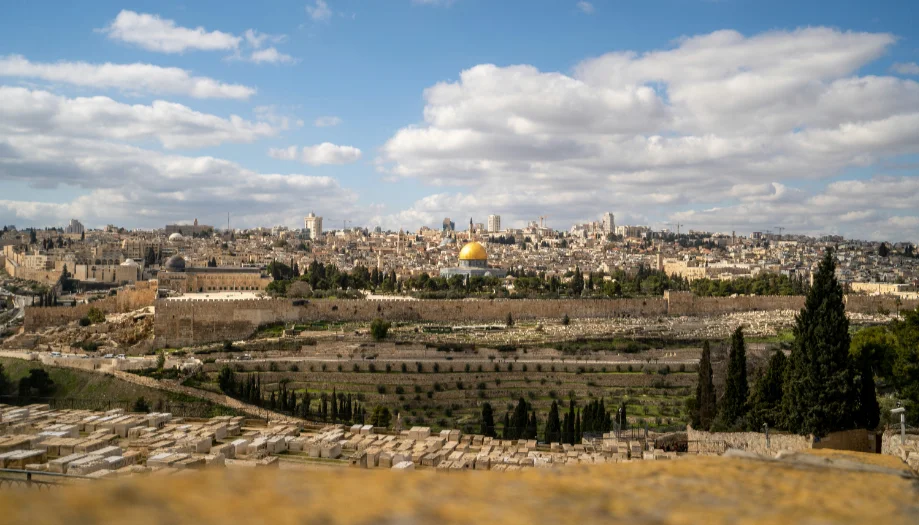
“Jerusalem is the heart of the world.” With this phrase, Cardinal Pierbattista Pizzaballa, Latin Patriarch of Jerusalem, sums up one of the central ideas of the letter he addressed to the faithful of the diocese last April.
At a time marked by conflict and uncertainty, his message invites us to view the Holy Land from a broader perspective: not merely as the scene of a war, but as a place whose spiritual, historical, and human significance transcends any temporary circumstance. “How can we, as Christians, remain in the midst of this conflict?” asks the Latin Patriarch of Jerusalem.
The letter, Issued in a particularly difficult context for the region, it emphasizes the need to keep hope alive and not to lose sight of the unique mission of Jerusalem and of the Catholics living in the Holy Land. For the Patriarch, the Holy City remains a point of reference for millions of people around the world and a place where religious traditions, cultures, and histories—all part of humanity’s shared heritage—converge.
Jerusalem, a City for Everyone
Few cities carry a symbolic significance comparable to that of Jerusalem. Sacred to Jews, Christians, and Muslims, it has been a place of prayer, pilgrimage, and encounter for centuries. Its significance stems not only from its past but also from its ability to continue welcoming people from a wide variety of backgrounds.
In his letter, Pizzaballa recalls precisely that universal vocation. Jerusalem cannot be understood from an exclusively local or political perspective: “We are the Church of Jerusalem, and the Holy City is the heart—not only geographical, but also spiritual—of our ecclesial community”…
This universal dimension makes the city a privileged space for dialogue. Despite the difficulties and tensions that the region periodically faces, the Holy Land remains one of the few places where the major monotheistic religious traditions coexist in a unique proximity. Interreligious dialogue here is not limited to institutional statements; rather, it is part of the daily lives of those who live and work in the region.
The Holy Places: A Living Heritage
The Patriarch also emphasizes the importance of safeguarding the Holy Places and preserving their significance for future generations. These places are not merely historical monuments or tourist destinations. They are places where millions of people find a tangible connection to their faith and to the roots of Christianity, for “the mission of earthly Jerusalem, in a certain sense, is to become an image and mirror of the heavenly Jerusalem,” he states in his letter.
The Basilica of the Holy Sepulcher, the Basilica of the Nativity, the Mount of Olives, and the Sea of Galilee are all part of a spiritual landscape that continues to attract believers from around the world. Their significance transcends the borders of the Holy Land itself and constitutes a heritage shared by the entire Church.
In this context, local Christian communities play an essential role. They are the ones who keep the Christian presence alive in the places linked to the life of Jesus and who continue to welcome pilgrims arriving from different countries. For this reason, the decline in visitors in recent years has not only had economic consequences but has also affected a human and ecclesial reality deeply rooted in the region’s history.
Understanding the Holy Land Beyond the Headlines
Amid a news cycle dominated by reports of the conflict, various initiatives continue to work to help people understand the historical, cultural, and religious richness of the Holy Land. One of them is Saxum Visitor Center, located in Abu Ghosh, a few kilometers from Jerusalem.
Through audiovisual resources, interactive technology, and educational content, the center offers visitors a comprehensive overview of the biblical context and the reality of the places where the events recounted in the Holy Scriptures took place.
“The Holy Land is not just a pilgrimage destination. It is a place where history, faith, and interfaith dialogue come together in a unique way,” explains Blanca Ramirez, director of the Saxum Visitor Center and representative of Saxum. “Those who visit Jerusalem discover that the Holy Places are living spaces that continue to bring people from all over the world together.” In fact, Cardinal Pizzaballa states in his letter that “its primary identity—the most important characteristic of the City and of the entire Holy Land—is that it is the place of God’s revelation, the place where religions are at home.”.
Blanca Ramírez adds that “understanding the Holy Land also helps us better understand the importance of coexistence and encounter. Even in difficult times, Jerusalem continues to remind us that it is possible to build bridges between people of different religious and cultural traditions.”.
These words resonate with the central message of Pizzaballa’s letter. Despite the current difficulties, the Patriarch urges us not to lose sight of what makes Jerusalem unique: its ability to bring together people from all over the world around a shared history.
Because, as the Patriarch himself points out, Jerusalem remains “the heart of the world,” and that is why “the international community has both the duty and the right to take an interest in Jerusalem, because it belongs to everyone.” A city whose significance depends not only on what happens within it, but also on what it represents for millions of people who continue to look to the Holy Land as a place of faith, memory, and hope.






 Español
  English
  Italiano
  Français
  Deutsch
  Polski
  简体中文
简体中文